
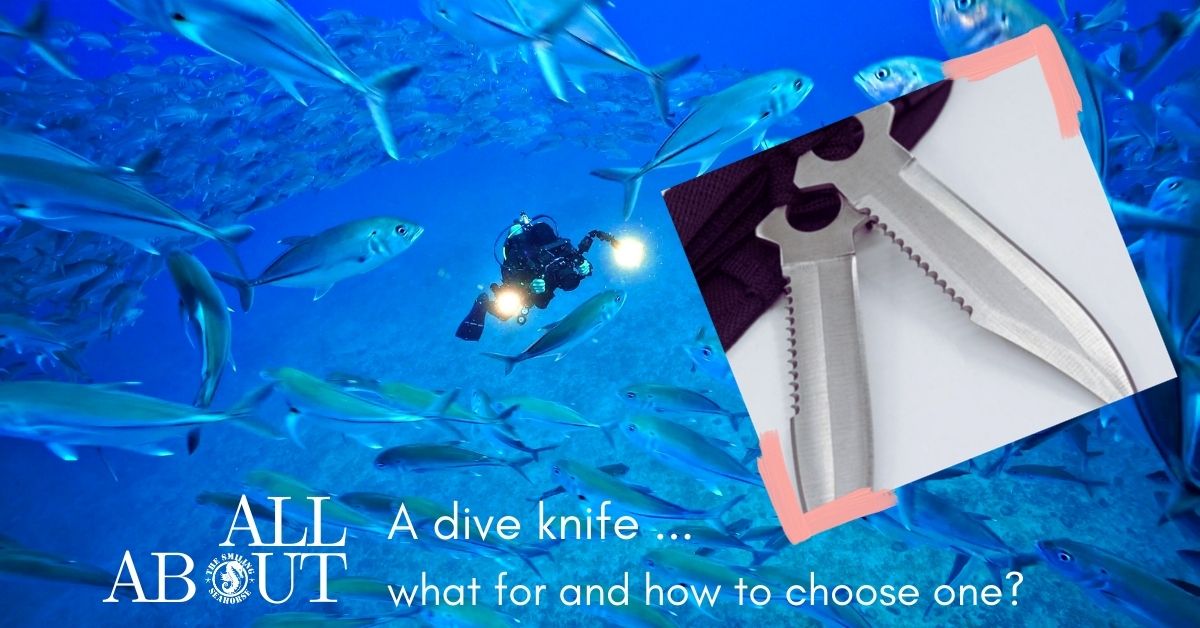
Dive Knives: How to Choose the Right Dive Knife

When talking about essential safety items, dive knives are not the first thing people think about when they start buying their own gear. So why exactly do you need a knife for diving? And with such a large variety of dive knives and line cutters available, which one is right for you?
A Dive Knife Is Not a Weapon, It Is a Tool
Even though you may be encouraged to get one as soon as you become an Advanced Open Water Diver, a dive knife might not be the first piece of equipment you think about.
The main point to understand is that a dive knife is not a weapon. It is a tool and should never be used to harm or touch aquatic creatures or to deface the underwater environment.


One of its most important uses is to free yourself or your buddy if you become entangled in a fishing net, line or vegetation.
But you can also become a hero by freeing a poor entangled marine animal or by helping to remove an abandoned fishing net from a dive site.
There Are So Many Dive Knives… How Do You Choose?
Here are some tips to help you find the dive knife that will work best for you, depending on your needs and the environment in which you are diving.
What should you pay attention to?

For most recreational divers, a blunt tip should be fine. And it is better not to puncture your air hoses or wetsuit!
Material: Stainless Steel or Titanium?
Stainless steel or titanium?
One advantage of titanium is that it requires very little maintenance. Titanium knives do not rust and are highly corrosion resistant. They are also lighter, more flexible and harder to break.
Titanium is the high-end choice, so it is significantly more expensive.
Stainless steel requires more maintenance to prevent rust. It should be cleaned with fresh water, dried and either oiled or rubbed with silicone after each dive.
When choosing stainless steel, you may come across 300 and 400 series blades. The different grades have different properties in terms of corrosion resistance, hardness and edge retention, so the exact steel specification is worth checking rather than relying only on the series number.
Shape: Blunt or Sharp?

Despite what people may say… size does matter! But not only…
A blunt tip is useful for prying, digging, hacking and chiselling.
A sharp tip is useful for puncturing and cutting.
You can also choose a dive knife with both straight and serrated edges for greater versatility.
Size: How Big Should a Dive Knife Be?
Remember that you are carrying a scuba knife in case you become entangled… not to make you feel like a superhero!
You should generally go for a medium-sized knife, around 4 inches.
Smaller knives can fit almost anywhere, but make sure you can grip the knife securely.
Bigger knives can be cumbersome and potentially dangerous.
Medium-sized knives are generally more practical and can be strapped to a variety of easy-to-reach locations.

Attachment: Where Should You Wear Your Dive Knife?
Your knife can be strapped almost anywhere.
Wear the knife somewhere that is easy to reach with one hand.
On the calf, “James Bond” style, on the leg, “Lara Croft” style… or more simply on your BCD pocket or inflator hose. In the latter case, make sure it is a medium-sized blunt knife.

Other Dive Knife Features to Consider
- Line-cutting notch
- Finger grips
- Security lock
- Fixed or foldable blade
And remember to use your dive knife safely and responsibly!
Want a knife for your next cruise with us? Check out the dive equipment catalogue.
Why a Dive Knife Is an Important Safety Tool
A dive knife is not something you carry to fight underwater or to interact with marine life. Its primary purpose is to give you another option if you or your buddy become entangled and need to free yourselves safely.
As with all scuba equipment, knowing where your knife is and being able to access it quickly are just as important as choosing the right model.




