
Arctic Sea Ice Reaches Record Low: What Does It Mean for Our Oceans?
There has never been so little ice in the Bering Strait for 5,500 years, according to a new US study…
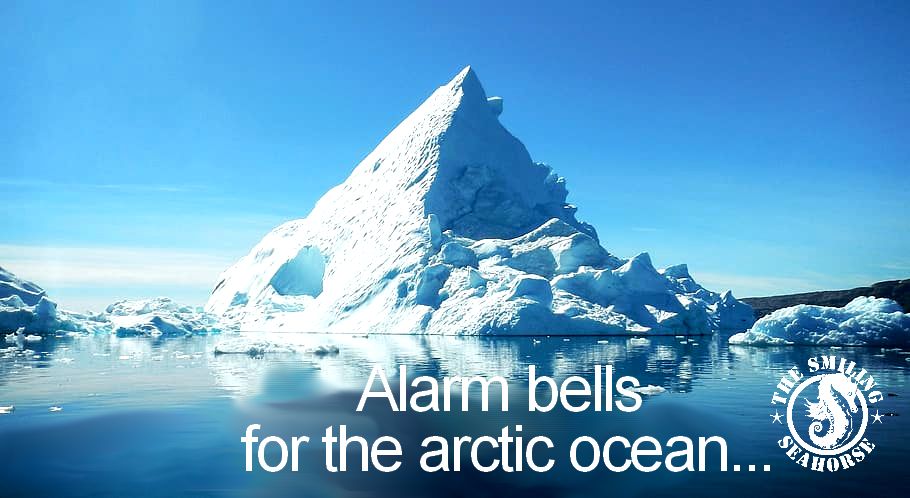
New alarm in the Arctic Sea! In October 2020, Arctic sea ice reached a record low, with the area covered by ice becoming exceptionally small for the time of year. The changes taking place in this fragile polar ecosystem are increasingly difficult to ignore.
First, Siberia experienced extreme temperatures. Then, further west, in Svalbard, halfway between Norway and the North Pole, temperatures reached up to 10°C above seasonal norms for several days. These phenomena, accompanied by extraordinary fires that year and an accelerated melting of glaciers and permafrost, worried those living in the middle of this fragile ecosystem. At the forefront of global warming, they were witnessing changes that should already concern us all.
Only two areas north of Greenland and along Canada’s northern islands were still covered with ice throughout the year in 2020, warned a study published on 15 October in the journal Geophysical Research Letters. Sadly, even these last areas of “eternal” ice were melting at twice the rate of the rest of the Arctic Ocean.
The Arctic is one of the planet’s most sensitive environments, and changes in its sea ice are closely watched by climate researchers. The extent of the ice changes naturally throughout the year, growing during the cold winter months before reaching its seasonal minimum towards the end of summer. However, the long-term trend observed over recent decades has been a significant decline.
Arctic Sea Ice Reaches a Record Low
“The area of the Arctic sea ice in October will be the lowest on record and the growth rate of the sea ice is slower than normal,” Rasmus Tonboe, an expert at DMI, told AFP. According to preliminary satellite data used by the institute, the area was only 6.5 million square kilometres on 27 October 2020.
Satellites have been observing the Arctic very precisely since 1979, providing researchers with decades of data to compare. The downward trend in sea-ice extent has become increasingly pronounced. For Mr Tonboe, October 2020 represented a “low record” unmatched during the previous 41 years.
In October 2020 alone, the ice cover had shrunk by 8.2% compared with the average for the previous ten Octobers.
“With less ice on the sea, the sun is also warming the seawater for longer every year, resulting in warmer seas and less ice settling down. Winters get shorter and shorter, and the ice doesn’t have time to thicken as it did before,” Mr Tonboe explained.
The size of the sea ice had already reached a very low level in September, with its second-smallest area ever recorded after 2012. On 8 September 2020, it measured only 4.2 million square kilometres, according to the researcher.
 There has been less and less sea ice in the Arctic over the last 40 years.
The Arctic’s Changing Ice Cover
There has been less and less sea ice in the Arctic over the last 40 years, and some maritime areas that used to remain iced over throughout the year, such as the Barents Sea in the north of Norway, are now covered by ice for only a small part of the year.
This reduction in sea ice is not simply a change in the appearance of the Arctic landscape. Sea ice is an important part of the polar environment, and changes to its extent and thickness affect an ecosystem that is already particularly vulnerable to environmental change.
The melting of Arctic ice is also opening new maritime passages. These routes are expected to play a growing role in international trade and are increasing interest in the region’s potential natural resources. The Arctic is estimated to contain around 13% of the world’s undiscovered oil reserves and 30% of its undiscovered natural gas reserves.
What About the Human Impact?
What about the human impact in all of this?
“Global warming is a multiplier of the effects of natural variability,” explained a researcher. The average rise in temperature means that natural heat episodes, influenced by the North Atlantic Oscillation, can become stronger and last longer.
This mechanism also helps explain why, if nothing is done, Europe could experience more frequent and stronger heat waves in the decades to come. The Arctic may seem remote from everyday life for many of us, but the changes taking place there are part of a much larger global climate system.
 Global warming is amplifying the effects of natural climate variability in the Arctic.
The MOSAiC Expedition to the North Pole
Mr Tonboe had just returned from the longest international scientific expedition to the North Pole. The Multidisciplinary drifting Observatory for the Study of Arctic Climate (MOSAiC) voyage lasted 389 days and was led by the Alfred Wegener Institute, Helmholtz Centre for Polar and Marine Research (AWI) in Germany.
The expedition provided scientists with an exceptional opportunity to study the Arctic climate and its changing environment over an extended period. The observations made during such expeditions help researchers understand how the Arctic is changing and how those changes are connected to the wider climate system.
AWI was also issuing an urgent appeal to try to save the “disappearing” summer sea ice. Researchers were describing what they were seeing as “melted, thin, crumbly ice” and “surfaces of liquid water as far as the eye can see, up to the horizon line”.
Why Should Divers Care About Climate Change?
As divers, we spend our time exploring another part of the planet that is particularly dependent on a healthy and stable marine environment. From tropical coral reefs to polar waters, the world’s oceans are interconnected ecosystems.
The Arctic may be thousands of kilometres away from the warm waters of the Andaman Sea, but changes in the ocean remind us how closely marine environments are connected to the wider climate system. Protecting the ocean means paying attention not only to the reefs we visit but also to the larger environmental changes affecting our planet.
What do you think can be done to reverse this trend? Leave us a comment below.
Discover More
- Discover the marine fauna of the Andaman Sea and the incredible biodiversity found beneath the surface.
- Explore diving in Thailand and discover the tropical waters of the Andaman Sea.
- View our liveaboard cruises and schedules and start planning your next diving adventure.
- Learn more about marine conservation and the importance of protecting our oceans.




