
“`html
Scorpionfish Identification: How to Tell Bearded Scorpionfish, Devil Scorpionfish and Stonefish Apart
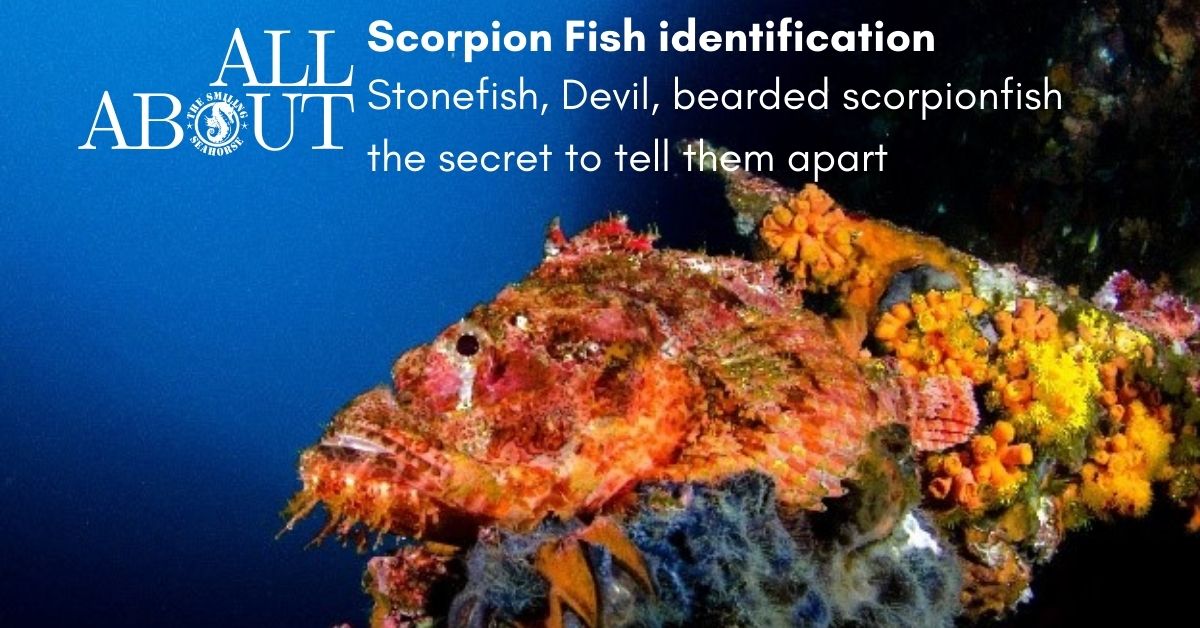
This article will teach you how to differentiate the three most common species of scorpionfish we encounter in the Andaman Sea: the Bearded Scorpionfish, Devil Scorpionfish and Stonefish.
These three species are often mistaken for one another because they are quite similar and belong to the same family. However, once you know what to look for, there are some simple ways to tell them apart during your next dive in Thailand or Myanmar.
Let’s start with their similarities:
- These members of the Scorpaenidae family live on the ocean floor, often hiding among coral reefs, and swim about as well as a chicken can fly!
- They have large heads with strong bony cheeks and surprisingly wide mouths capable of swallowing relatively large prey.
- They are not aggressive, but their dorsal spines are highly venomous. If threatened, they can raise their spines as a defence before quickly escaping to a nearby hiding place.
- They are all sedentary ambush predators, using the same passive hunting strategy as a gecko. You will rarely see them move anything other than their eyes, except when they suddenly swallow prey that has ventured a little too close.

How to Tell the Three Scorpionfish Apart
Bearded or Tassled Scorpionfish

The most common scorpionfish in the Andaman Sea is the Tassled Scorpionfish (Scorpaenopsis oxycephala), also commonly called the Bearded Scorpionfish.
The name comes from the fleshy outgrowths underneath its chin, which give it a distinctly bearded appearance. Its colouring usually matches its surroundings extremely well, and it is often found sitting motionless on rocks covered in brown, reddish-brown or other reef colours.
The body can reach around 36 cm in length and has a relatively recognisable fish-like shape compared with the much more stone-like appearance of its cousins.


Devil Scorpionfish

A little rarer and considerably more stone-like is the Devil Scorpionfish (Scorpaenopsis diabolus).
It is also known as the False Stonefish because of its remarkably convincing resemblance to a piece of rock. One useful feature for identification is the presence of a noticeable bump on the back of the head. Its skin also has a very rough, almost sandpaper-like appearance.
Another fascinating feature is found on the inner sides of the pectoral fins, where orange, black and white blotches can be flashed as a warning to inquisitive predators.


Stonefish

Lastly, let’s talk about the Stonefish.
While the other scorpionfish can be seen on many dives in Myanmar and Thailand, Stonefish are a little more of a treat. They are both rarer and considerably harder to spot than their cousins.


Stonefish belong to the Synanceia group and are usually quite large, measuring around 30 to 40 cm. Their rounded bodies can look exactly like a stone covered in sand, while their leathery skin may be brown, grey, yellow, white, pink or even purple.
Their skin is often covered with sponge, algae or other growth that matches the surrounding reef, making them extraordinarily difficult to see. This is one reason why Stonefish deserve particular respect from divers.
There are also several useful details to look for. Scorpionfish generally have eyes that protrude slightly from the head, whereas a Stonefish’s eyes are much more difficult to distinguish, being recessed into the head above its characteristic down-turned, grumpy-looking mouth.
Stonefish also have thicker spines and larger dorsal fins, although these are usually well hidden along the body. Their tail tends to curl more noticeably at the end, whereas the tail of a typical scorpionfish is comparatively straight.
Stonefish are among the most venomous fish in the world, which is another very good reason to be careful where you put your hands while diving. In fact, the safest rule is simple: never touch anything underwater.
Other Fascinating Members of the Scorpionfish Family

There are other beautiful members of the scorpionfish family, including Lionfish and Rhinopias, but these are generally much harder to confuse with the three species described above.

Scorpionfish Identification Infographic
Here is a simple infographic to help you visually differentiate the three species at a glance. Keep it in mind on your next dive and see how many you can find!

Spot Scorpionfish on Your Next Dive
That’s it for today! Hopefully you now know how to distinguish a Bearded Scorpionfish, Devil Scorpionfish and Stonefish. The next time you are exploring the reefs of Thailand or Myanmar, take a closer look at those apparently lifeless rocks. You may discover that one of them has eyes!
If you would like to discover the incredible marine life of the Andaman Sea for yourself, join us aboard The Smiling Seahorse for a day of diving or a liveaboard adventure. Check our cruises schedule and prices to see our current trips, dates and itineraries.
Discover More
“`




