
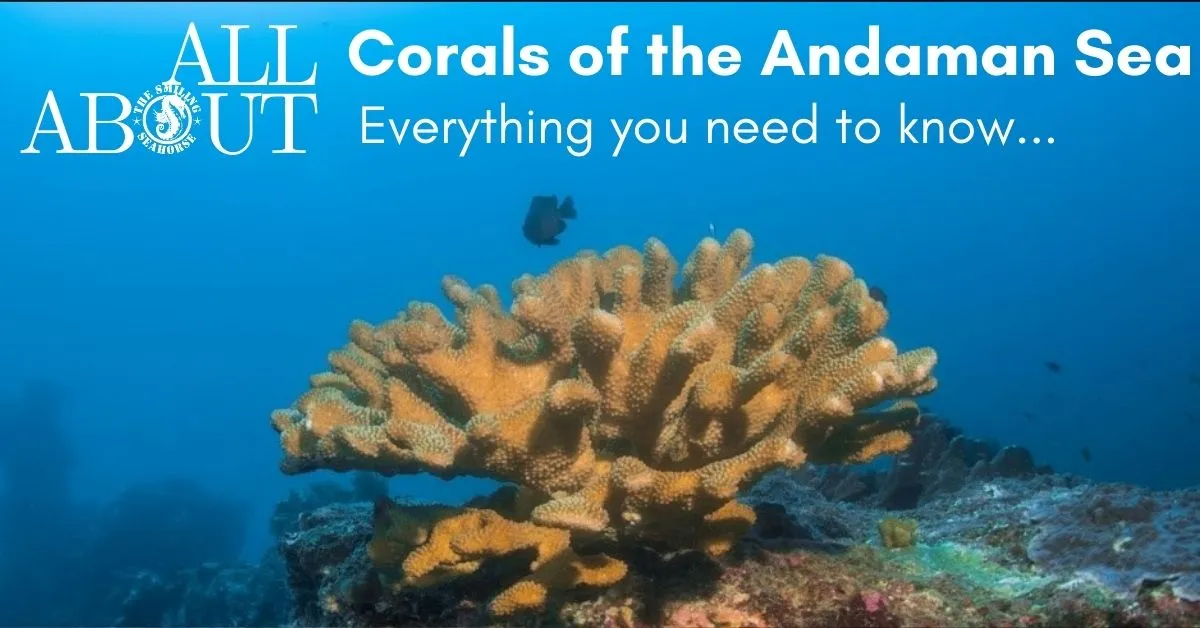
Corals of the Andaman Sea: A Guide to Hard and Soft Corals
Colourful fish have always been a favourite sight for tropical divers, but have you ever taken a closer look at the gorgeous coral species that inhabit the Andaman Sea?
Do you know what corals really are, how coral grows to form coral reefs, and why they are so important for our planet?
Contrary to common belief, corals are animals, not plants and certainly not rocks!
What you see above is actually a group of tiny animals living under the same roof. Coral polyps live together in colonies and, over time, build the incredible structures that we know as coral reefs.
How Do Coral Reefs Form?
Coral reefs develop over very long periods as millions of tiny coral polyps grow, reproduce and produce calcium carbonate skeletons.
As generations of coral grow on top of older skeletons, colonies can gradually create enormous reef structures. The result is a complex ecosystem that provides shelter, feeding grounds and nursery areas for a huge variety of marine life.

But Then, How Do You Differentiate Coral Species?

Coral identification can seem complicated at first. There are countless shapes, colours and growth forms, and it can be difficult to know where to start.
A useful first step is to look at the overall shape of the colony. Corals can grow as branches, plates, crusts, rounded boulders, tables, leafy structures and many other forms.
Here are some of the most recognisable hard and soft coral growth forms you can encounter while diving in Thailand, around the Mergui Archipelago and elsewhere in the Andaman Sea.
Hard Corals
Hard corals are sometimes called stony corals because they produce a rigid skeleton made primarily of calcium carbonate. This skeleton remains after a coral polyp dies and provides a foundation on which new coral polyps can grow.
Over many generations, these layers can build substantial reef structures. Hard corals therefore play a fundamental role in the formation of coral reefs.
Branching Corals

Branching corals are easy to recognise thanks to their numerous branches spreading upwards and outwards from the colony.
The intricate network of branches creates countless small spaces where juvenile fish and other reef creatures can shelter. For this reason, branching coral colonies can be particularly important nursery habitats on the reef.
When you look closely, these colonies are rarely as simple as they first appear. Tiny fish, crabs and other animals can often be found hiding between the branches.
Elkhorn and Staghorn Corals
Elkhorn and staghorn corals are spectacular examples of branching corals. Their branches can resemble the antlers of an elk or deer, which explains their common names.
Instead of forming a simple bush, the branches can develop prominent vertical projections with additional side branches. Large colonies create complex three-dimensional habitats for many reef animals.

Encrusting Corals

Encrusting corals grow closely against the reef surface, forming a thin layer or crust over the underlying substrate.
They can come in many different colours and may be easy to overlook when surrounded by more spectacular branching or massive corals.
Their surfaces can provide habitat for other organisms. Small creatures such as Christmas tree worms and other encrusting organisms can settle on or around these surfaces.
Once you start looking for them, encrusting corals become much easier to recognise during a dive.
Foliose Corals
Foliose corals grow in broad, leaf-like plates or folds. The colony remains attached around a central area while its outer sections grow outwards, creating a structure that can look surprisingly similar to a head of lettuce.
The folds and overlapping plates increase the available surface area and create additional spaces for small reef creatures.

Massive Corals

Massive corals form some of the most substantial structures on a reef. Their colonies are generally rounded or boulder-shaped and can become enormous over time.
Coral growth is slow and can vary considerably depending on the species and environmental conditions, with some massive corals growing only a few centimetres per year.
Over long periods, however, this slow growth can produce huge colonies. Some of the giant coral formations encountered around the Burma Banks are a wonderful reminder of just how long these reef structures can take to develop.

Brain corals are another impressive example of massive coral growth. Their distinctive grooves and ridges give the colony a maze-like appearance, making them particularly recognisable to divers and underwater photographers.
Like other reef-building hard corals, the living polyps occupy the surface while the calcium carbonate skeleton forms the structure beneath them.
Mushroom Corals
Mushroom corals are quite different from the large colonies that dominate many reefs. Many are solitary corals, with a single large polyp growing independently rather than being permanently attached to a larger colony.
They are often found on sandy or loose surfaces and can become surprisingly large, with some reaching around 25 cm across.
Their unusual shape makes them a fun coral to look for during a dive, particularly when exploring sandy areas between larger reef structures.

Table Corals

Table corals develop broad, horizontal structures that can extend well beyond their supporting base. These flat surfaces create shaded spaces and sheltered areas underneath the colony.
Table corals can provide important habitat for reef fish, creating hiding places and nursery areas among the complex structure.
Their broad horizontal shape also makes them particularly striking when viewed from below or from a distance.
Bubble Corals
At first glance, bubble corals can look as though someone has scattered a collection of translucent eggs across the reef.
During the day, the living polyps extend into rounded, bubble-like structures. At night, they retract and the colony takes on a very different appearance.
Despite their soft-looking appearance, bubble corals are hard corals and produce a calcium carbonate skeleton beneath their living tissue.

Sun Corals and Orange Cup Corals

Sun corals, often called orange cup corals, are among the most colourful hard corals you can encounter on the reef.
Their fleshy polyps give them an appearance that can be very different from the familiar branching and massive corals. They are non-reef-building or ahermatypic corals, meaning they do not contribute to the construction of tropical reef frameworks in the same way as major reef-building hard corals.
Their polyps commonly remain retracted during the day and extend at night, when the colony can transform into a spectacular display of brightly coloured flowers.
Small yellow snails may also be found feeding on these corals, providing another reason to look closely during a night dive.
Soft Corals
Soft corals do not produce the same rigid external skeleton as hard corals. Their flexible, fleshy colonies can therefore appear almost plant-like as they move with the current.
One useful characteristic is found in their polyps: soft corals typically have eight tentacles, giving them a distinctive eight-fold structure.
Carnation Corals
Carnation corals are among the most beautiful soft corals in the Andaman Sea. They often favour areas with good water movement and can develop spectacular colours ranging from pink and purple to orange, red and white.
Their delicate appearance and vibrant colours make them a favourite subject for underwater photographers.
Richelieu Rock is particularly famous for its impressive displays of soft corals, including colourful carnation corals.
When the current moves through a large colony, the entire coral can appear to dance in the water, creating one of the most memorable sights on an Andaman Sea dive.

Giant Sea Fans

Sea fans are another spectacular group of soft corals. Their colonies grow into tall, web-like structures that can spread across the reef like underwater trees.
They can be found in many different colours and shapes, with some giant sea fans reaching around two metres in diameter.
Large sea fans are particularly impressive when viewed against the blue water, and they are among the iconic subjects of underwater photography in the Andaman Sea.
The Wonderful Diversity of Andaman Sea Corals
From tiny encrusting colonies to enormous massive corals, and from delicate carnation corals to giant sea fans, coral reefs are incredibly diverse environments.
Each growth form creates a different type of habitat, and the reef becomes much more fascinating when you take the time to look beyond the obvious colours and shapes.
During your next dive, slow down and take a closer look. You may discover tiny animals hiding between branches, unusual coral textures, colourful polyps extending into the current, or a perfectly camouflaged creature sitting directly on the reef.

Why Are Corals So Important?
Coral reefs are much more than beautiful scenery for divers. They provide complex habitats for an enormous variety of marine life, from tiny invertebrates to larger reef fish and predators.
The different structures created by branching, massive, table and other corals provide shelter, feeding areas and nursery habitats. This makes healthy coral ecosystems an important foundation for marine food webs.
Coral reefs also have an important relationship with tropical coastlines. Their complex structures can absorb and dissipate wave energy, helping to reduce the force reaching shores and contributing to natural coastal protection.
For millions of people around tropical coastlines, coral reef ecosystems are also connected to food, tourism and livelihoods.
It is sometimes said that coral reefs are the “lungs of the planet”. While this is a popular expression, it is misleading to describe coral reefs as producing half of the world’s oxygen.
Most of Earth’s oxygen production comes from marine organisms such as phytoplankton, as well as terrestrial plants.
The real importance of coral reefs is just as impressive: they are highly productive ecosystems that support extraordinary biodiversity and provide essential habitat and coastal protection.
That is why the health of coral reefs matters, not only to divers and marine-life lovers, but to the wider ocean ecosystem and to people living along tropical coasts.
Coral Reefs Are in Danger
Unfortunately, coral reefs around the world are under increasing pressure.
Rising ocean temperatures can cause corals to expel the microscopic algae that live within their tissues, producing the phenomenon known as coral bleaching.
Bleaching does not automatically mean that a coral colony is dead. If stressful conditions are reduced, some corals can recover. However, prolonged or repeated bleaching can severely weaken colonies and may lead to widespread coral mortality.
Climate change is not the only threat. Pollution, destructive fishing practices, physical damage, poor coastal management and other human pressures can also affect reef ecosystems.
Our actions today will help determine what future generations will be able to discover beneath the surface.
As divers, we can all help by avoiding contact with corals, controlling our buoyancy, never standing on the reef and choosing responsible marine-tourism operators.

What Are We Doing to Protect Coral Reefs?
At The Smiling Seahorse, we believe that enjoying the ocean also means taking responsibility for protecting it.
We follow Green Fins principles and encourage environmentally responsible diving practices throughout our cruises. We also work to reduce our environmental impact onboard by reducing, reusing and recycling wherever possible, with particular attention to unnecessary plastic.
We provide refillable, organic and reef-conscious toiletries, including soap, shampoo and conditioner, helping to reduce single-use packaging while making our onboard amenities more environmentally responsible.
Our employees also contribute to marine conservation activities, while we support marine science research and clean-up projects whenever possible.
There is no single solution to protecting coral reefs, but thousands of small actions can make a difference. As divers, we can all choose to become part of the solution.
When planning your next holiday, consider choosing an operator that takes its environmental responsibilities seriously, and discover our 10 easy ways to protect the environment during your holidays.
Frequently Asked Questions
Are corals animals or plants?
Corals are animals. Each coral polyp is a small invertebrate related to other cnidarians such as sea anemones. Colonies of these polyps can form the structures we recognise as coral reefs.
What is the difference between hard and soft corals?
Hard corals produce a rigid calcium carbonate skeleton and are important reef builders. Soft corals do not form the same rigid external skeleton and generally have flexible, fleshy colonies. Their polyps typically have eight tentacles.
How do coral reefs form?
Coral reefs develop over long periods as coral polyps grow, reproduce and deposit calcium carbonate skeletons. New generations can grow over older skeletons, gradually creating larger reef structures.
Why are coral reefs important?
Coral reefs provide habitat, shelter and nursery areas for many marine species. They also contribute to coastal protection and support human activities and livelihoods associated with healthy tropical marine ecosystems.
What is coral bleaching?
Coral bleaching occurs when corals become stressed and expel or lose much of the microscopic algae living within their tissues. The coral then appears white. Bleached corals can sometimes recover if conditions improve, but prolonged or severe bleaching can cause coral death.
Can divers damage coral reefs?
Yes. Accidental contact from fins, hands, cameras or equipment can break fragile corals or damage living tissue. Good buoyancy control, maintaining a safe distance from the reef and never touching or standing on corals are important ways for divers to reduce their impact.
Where can I see colourful corals in the Andaman Sea?
Colourful coral communities can be encountered throughout the Andaman Sea, including dive destinations in Thailand and Myanmar. Sites around the Similan Islands, Richelieu Rock, Koh Lipe and the Mergui Archipelago can offer particularly diverse coral habitats.
Discover More About Marine Life in the Andaman Sea
Corals are only one part of the extraordinary marine life found beneath the surface of the Andaman Sea. Discover more fascinating creatures and diving destinations:





One Response
Very good introduction to corals, excellently illustrated and kept interesting and not overly academic.
Recommended reading for all tropical divers.
Well Done!