

Longfin Bannerfish vs Schooling Bannerfish vs Moorish Idol: How to Tell Them Apart
Three elegant reef fish, one common question: which species are you actually looking at?
If you have ever been diving or snorkeling on a tropical reef, chances are you have spotted a striking black, white, and yellow fish with a long, flowing dorsal streamer. Was it a Moorish Idol, a Longfin Bannerfish (commonly called the Common Bannerfish or Pennant Coralfish), or a Schooling Bannerfish?
At first glance, these three species look remarkably similar, and even experienced divers often mix them up. However, once you know what subtle anatomical cues and behaviours to watch for, identifying them underwater becomes surprisingly easy.
In this guide, we break down the key differences between these iconic Indo-Pacific species—including their anatomy, schooling habits, habitats, and the 7 easiest visual indicators to distinguish them on your next dive.
At a Glance: Key Differences
| Species | Scientific Name | Family | Usually Seen |
|---|---|---|---|
| Moorish Idol | Zanclus cornutus | Zanclidae | Solitary or in pairs |
| Longfin Bannerfish | Heniochus acuminatus | Chaetodontidae | Solitary or small groups |
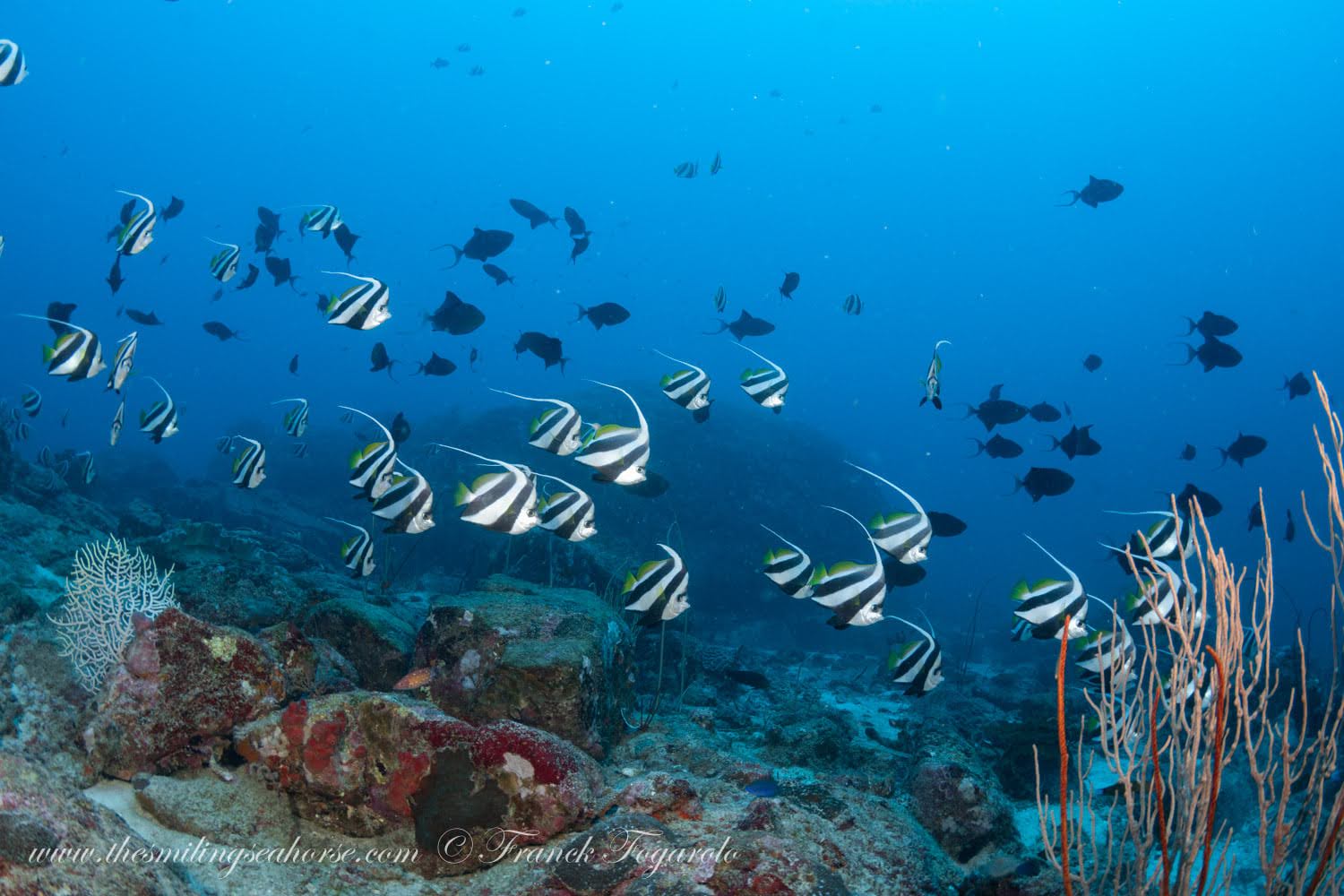
| Schooling Bannerfish | Heniochus diphreutes | Chaetodontidae | Large schools (dozens to hundreds) |
Although both bannerfish belong to the butterflyfish family (Chaetodontidae), the Moorish Idol is the sole living member of its own distinct family, Zanclidae.
The Moorish Idol (Zanclus cornutus)
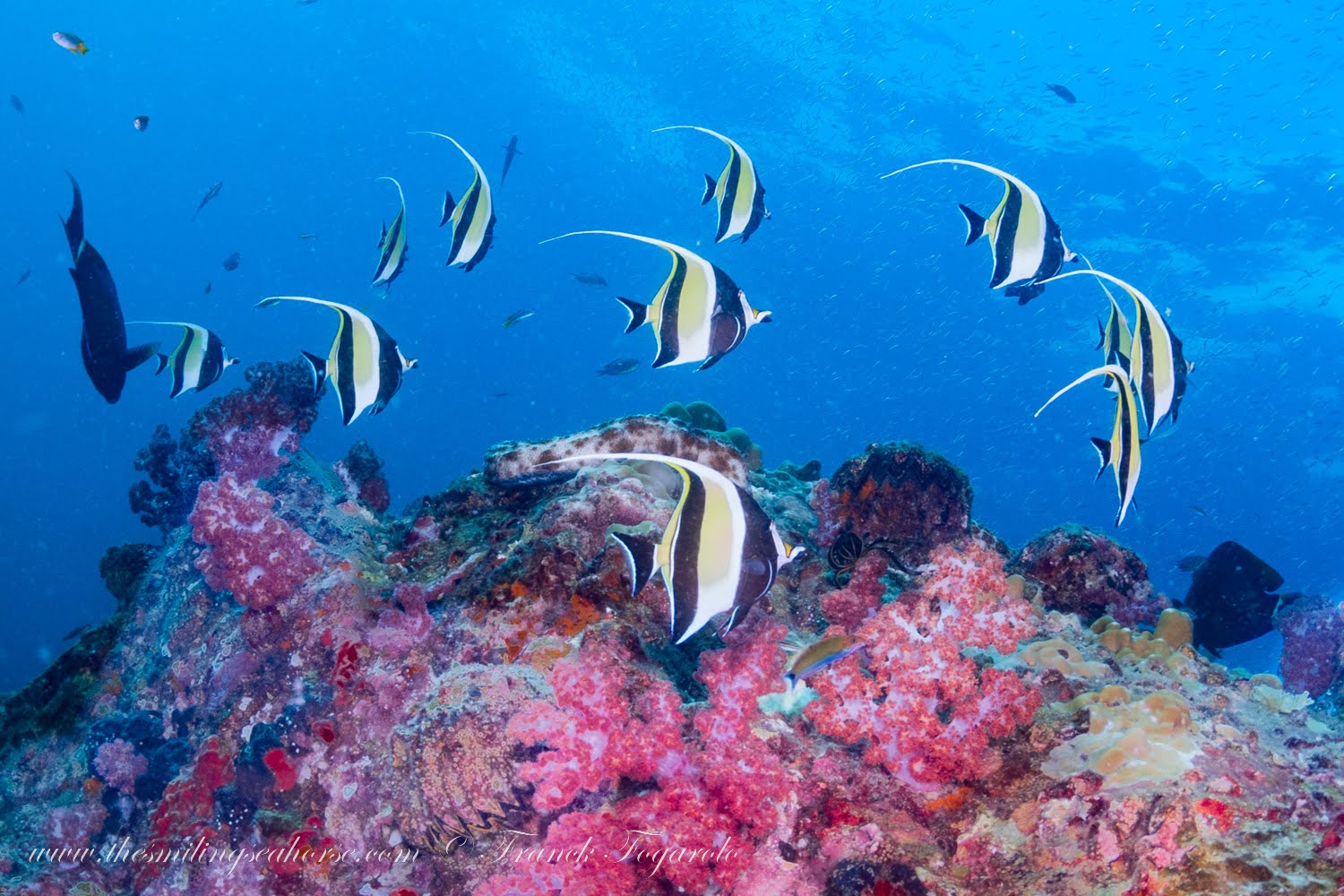
The Moorish Idol is perhaps the world’s most recognizable tropical reef fish, famously inspiring the character “Gill” in Pixar’s Finding Nemo. With its disc-like profile, elongated dorsal streamer, and proud swimming style, encountering one gliding over a reef wall is always a memorable sight.
Key Identification Features
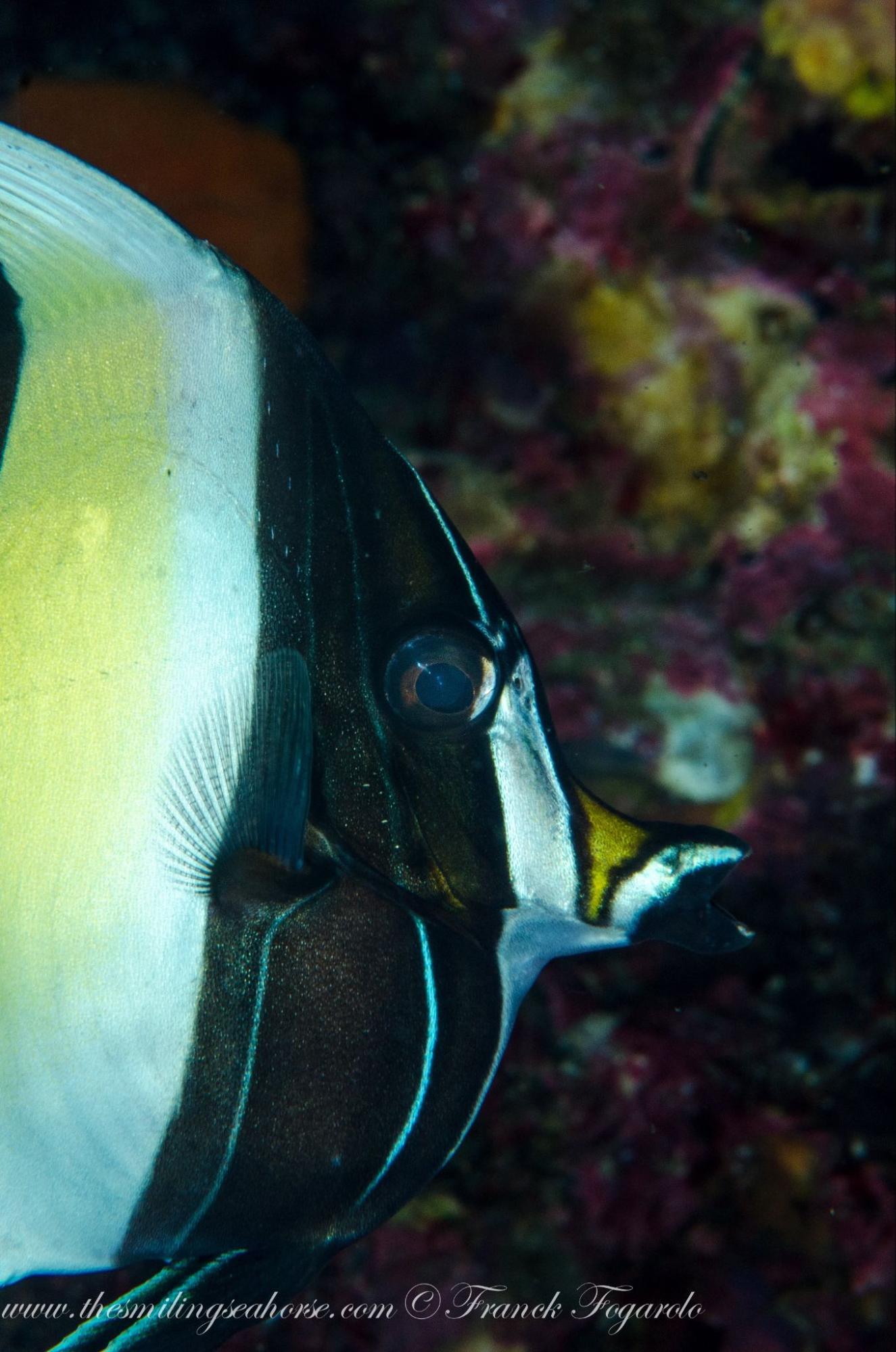
- Long, tubular snout: Extended nose adapted for picking sponges and small invertebrates from tight reef crevices.
- Bright yellow saddle: Bold yellow mask across the snout and an expansive yellow saddle over the rear body.
- Black caudal fin: A tail that is predominantly dark to solid black.
- Exaggerated streamer: A dorsal filament that can trail well past the caudal fin.
- High eye placement: Eyes positioned notably high on the head profile.
Habitat & Behavior
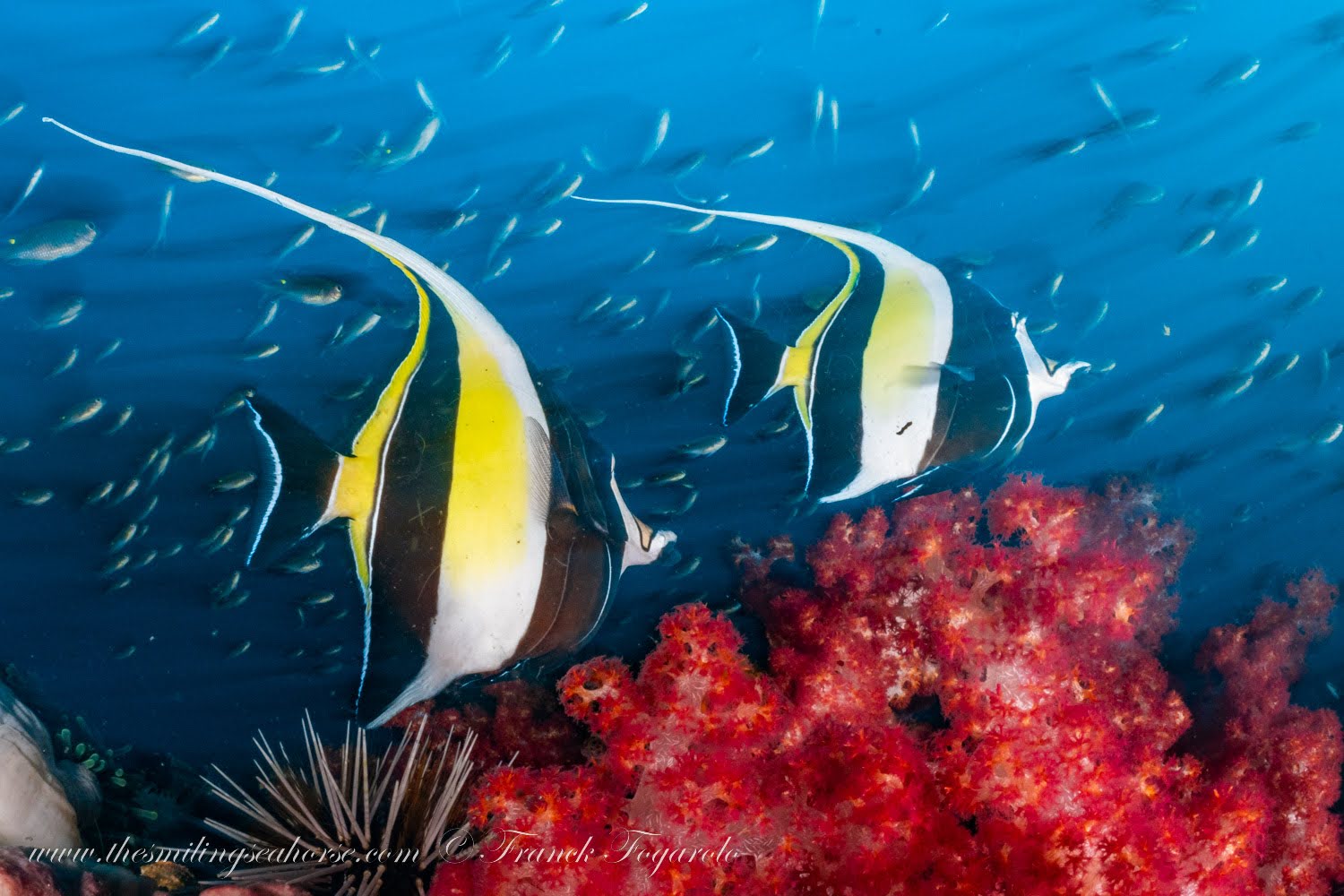
Moorish Idols inhabit tropical reefs across the Indo-Pacific, from the Red Sea and East Africa to Hawaii and the Eastern Pacific. In Thailand and Myanmar, they are common sights along shallow reef flats and coral walls. They are active during the day, picking at invertebrates, and settle into reef crevices at night where their high-contrast colours dim for camouflage.
The Longfin Bannerfish (Heniochus acuminatus)
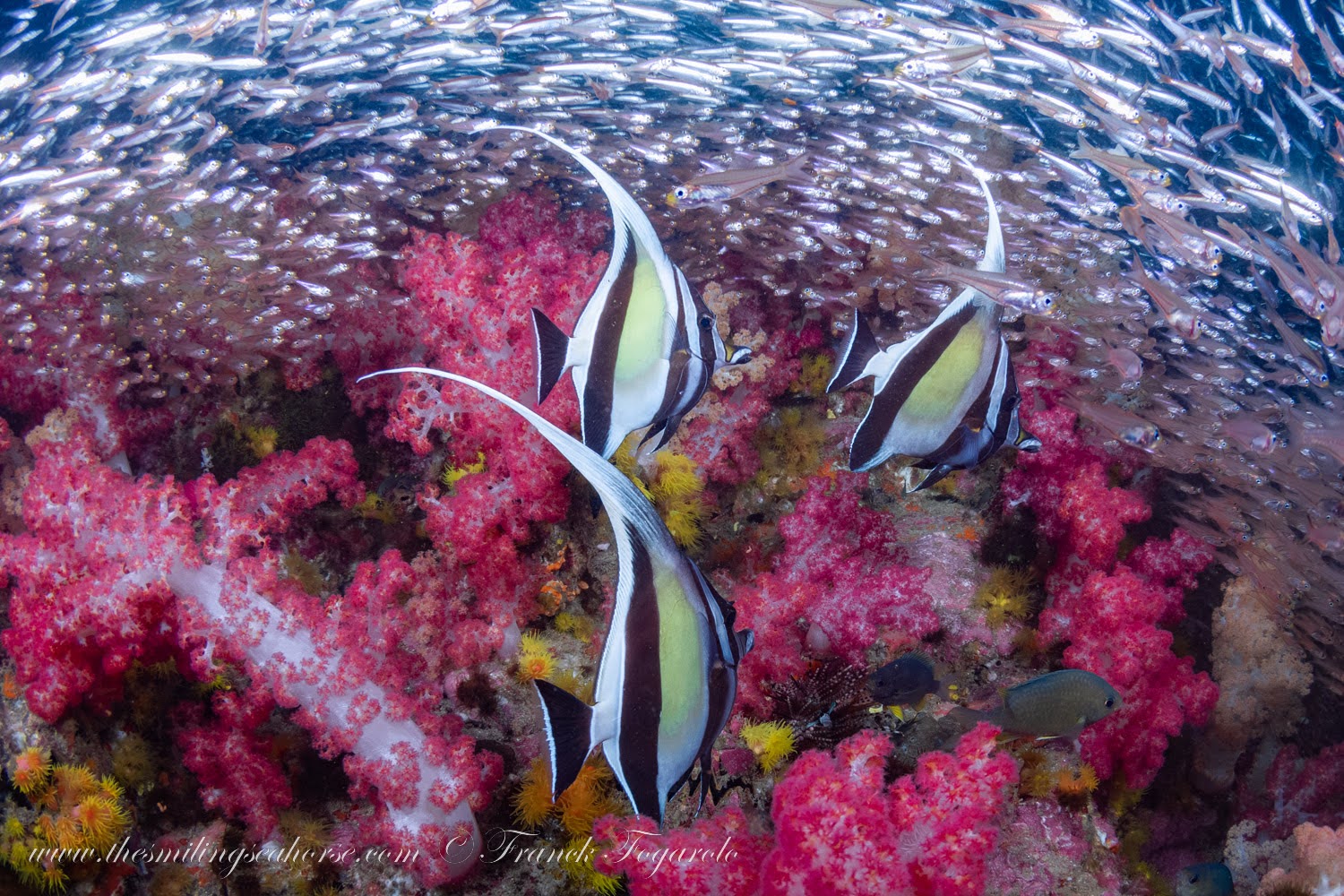
Often referred to as the Common Bannerfish, Pennant Coralfish, or False Moorish Idol, Heniochus acuminatus is one of the most widespread butterflyfish in the Indo-Pacific. It shares the white, black, and yellow colour scheme of the Moorish Idol, but a closer look reveals a distinctly different body structure.
Key Identification Features
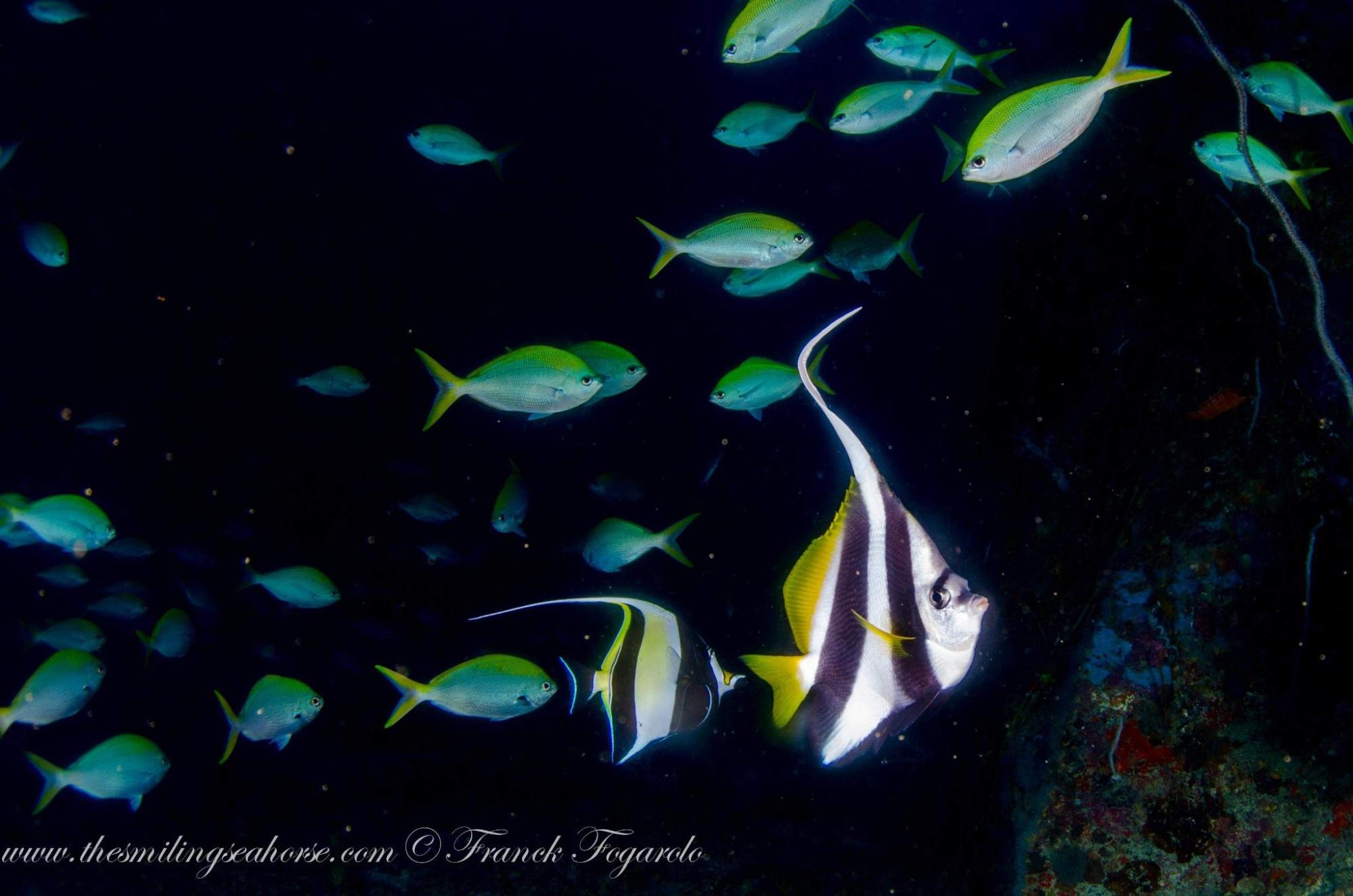
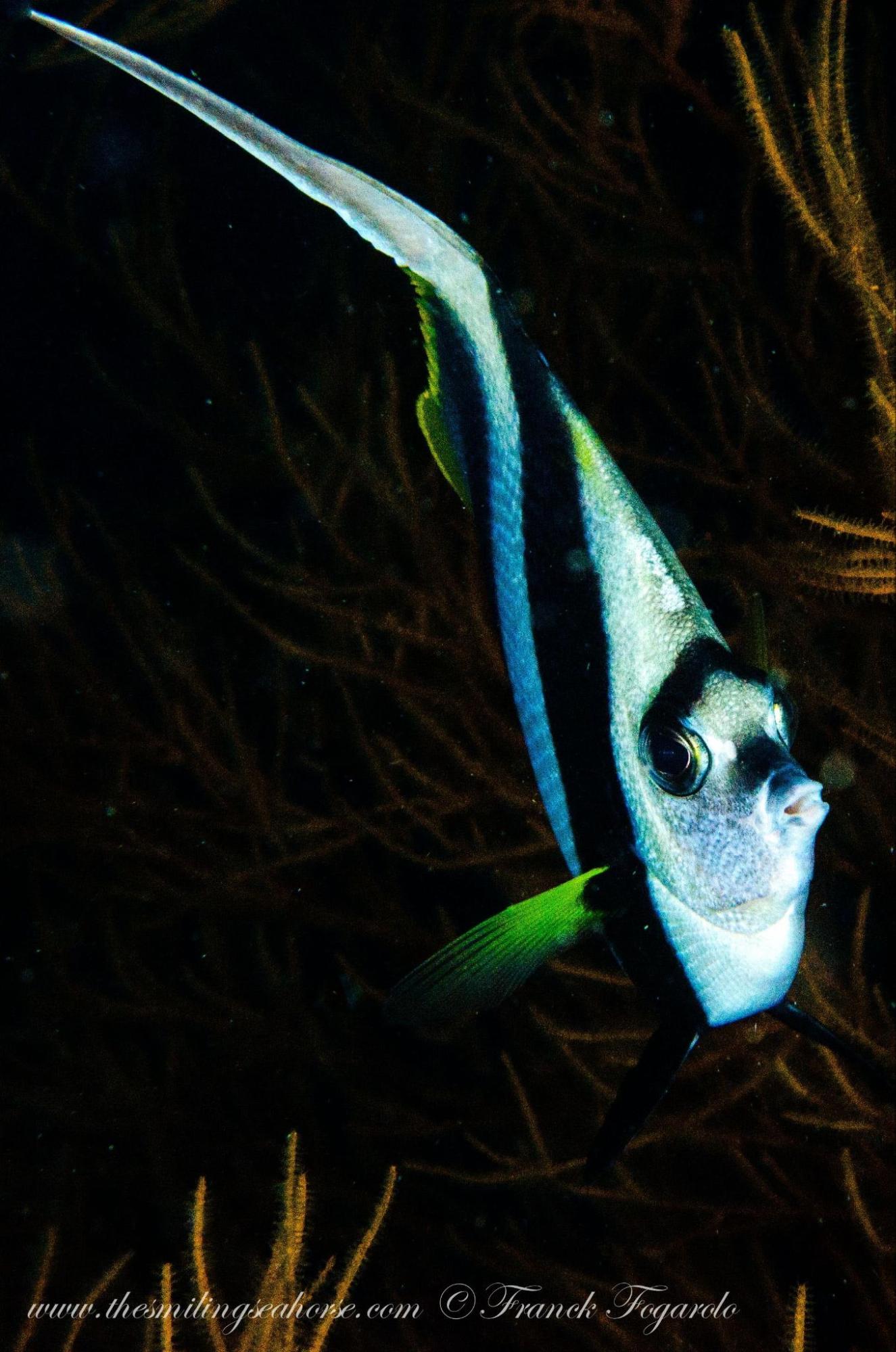
- Shorter snout & rounded forehead: A much blunter, classic butterflyfish face rather than a tubular beak.
- Bright yellow soft fins & tail: Both the caudal fin and rear dorsal fin are vivid yellow.
- White breast: The belly and chest area remain clean white between the black diagonal bands.
- Anal fin coloration: The anal fin is predominantly white.
- Solitary habits: Almost always spotted individually, in dedicated pairs, or occasionally in small groups of 3 to 5.
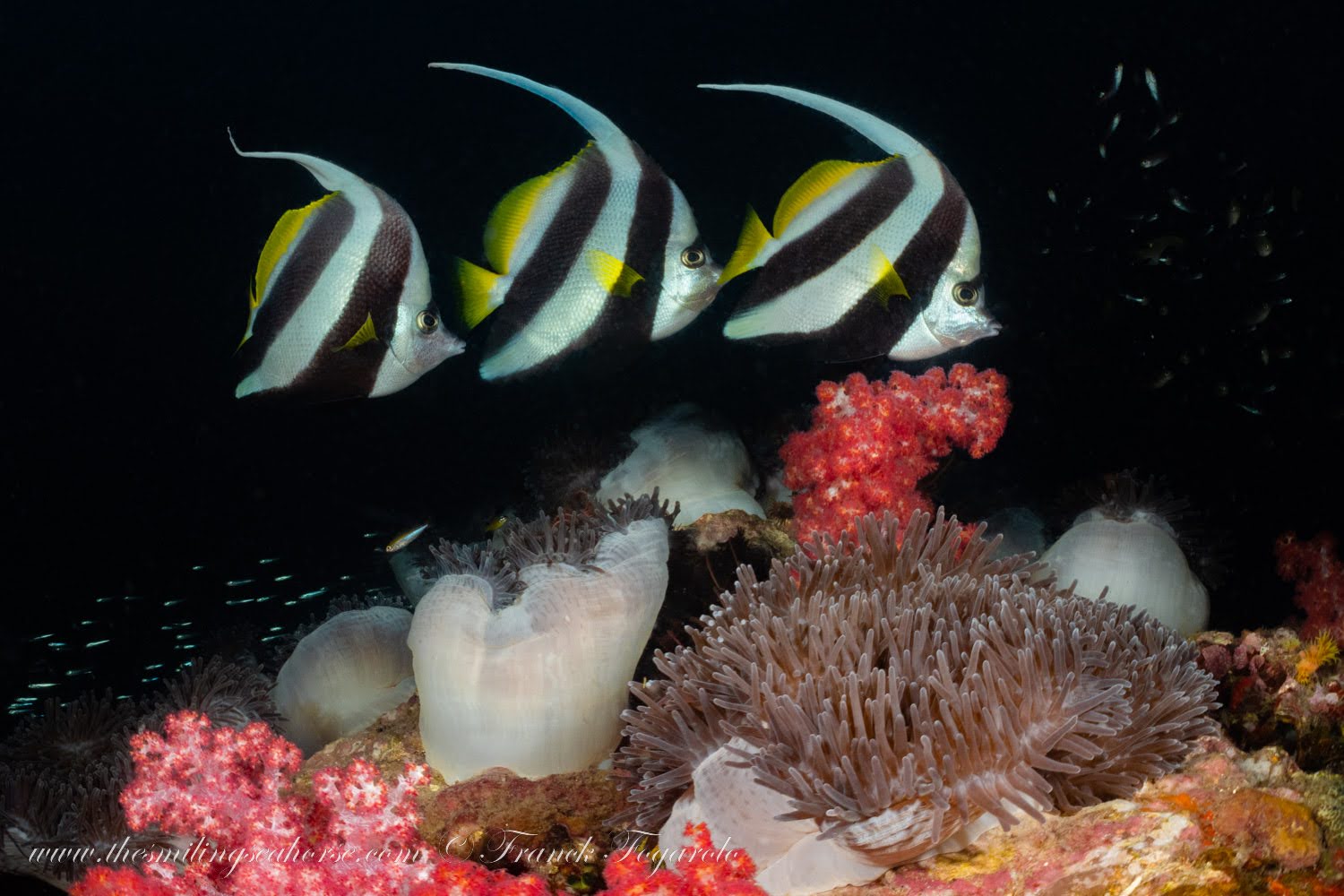
The Schooling Bannerfish (Heniochus diphreutes)
The Schooling Bannerfish is an anatomical lookalike of the Longfin Bannerfish, making them difficult to separate at a glance. However, their social lifestyle and ecological niche give them away immediately.
Key Identification Features
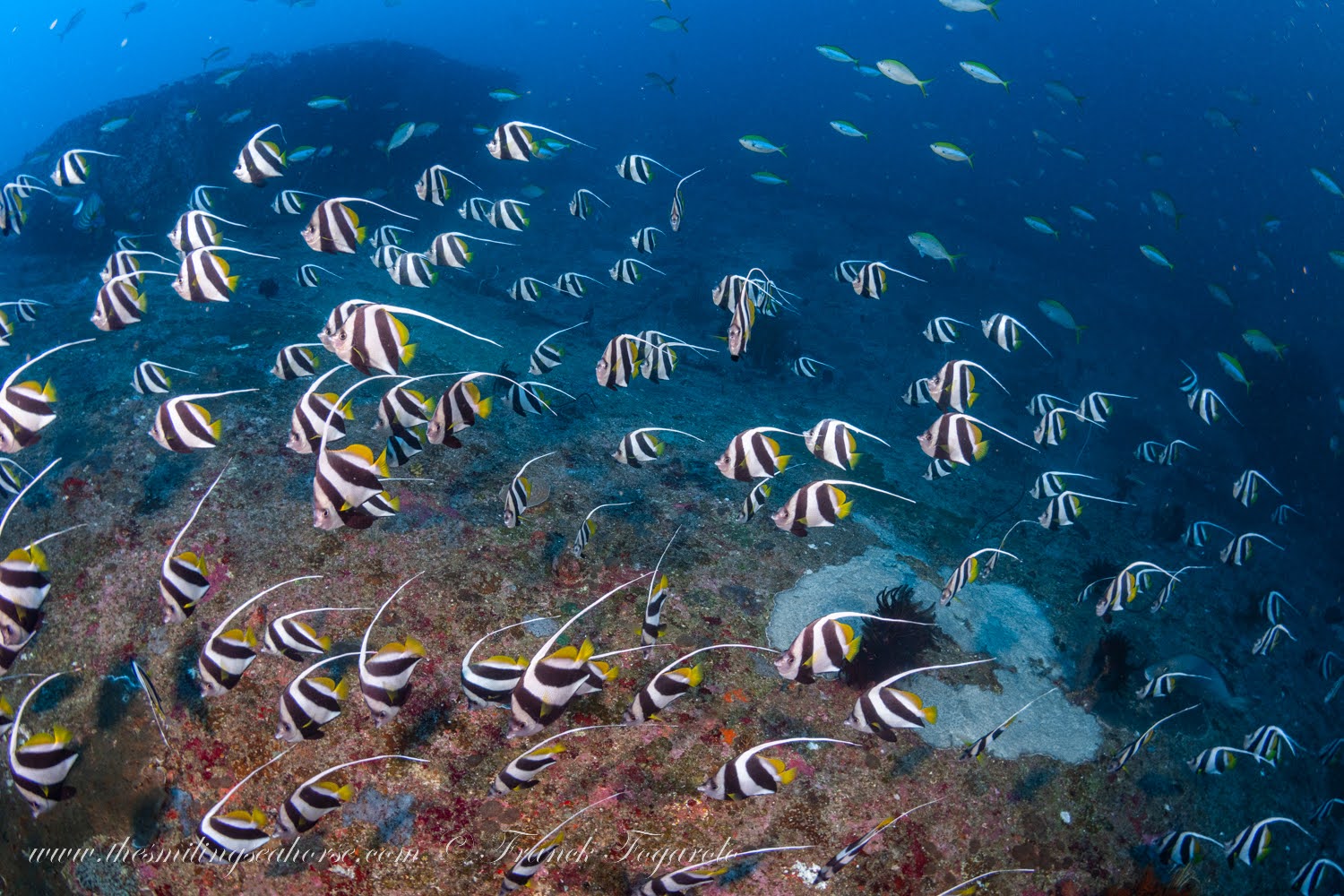
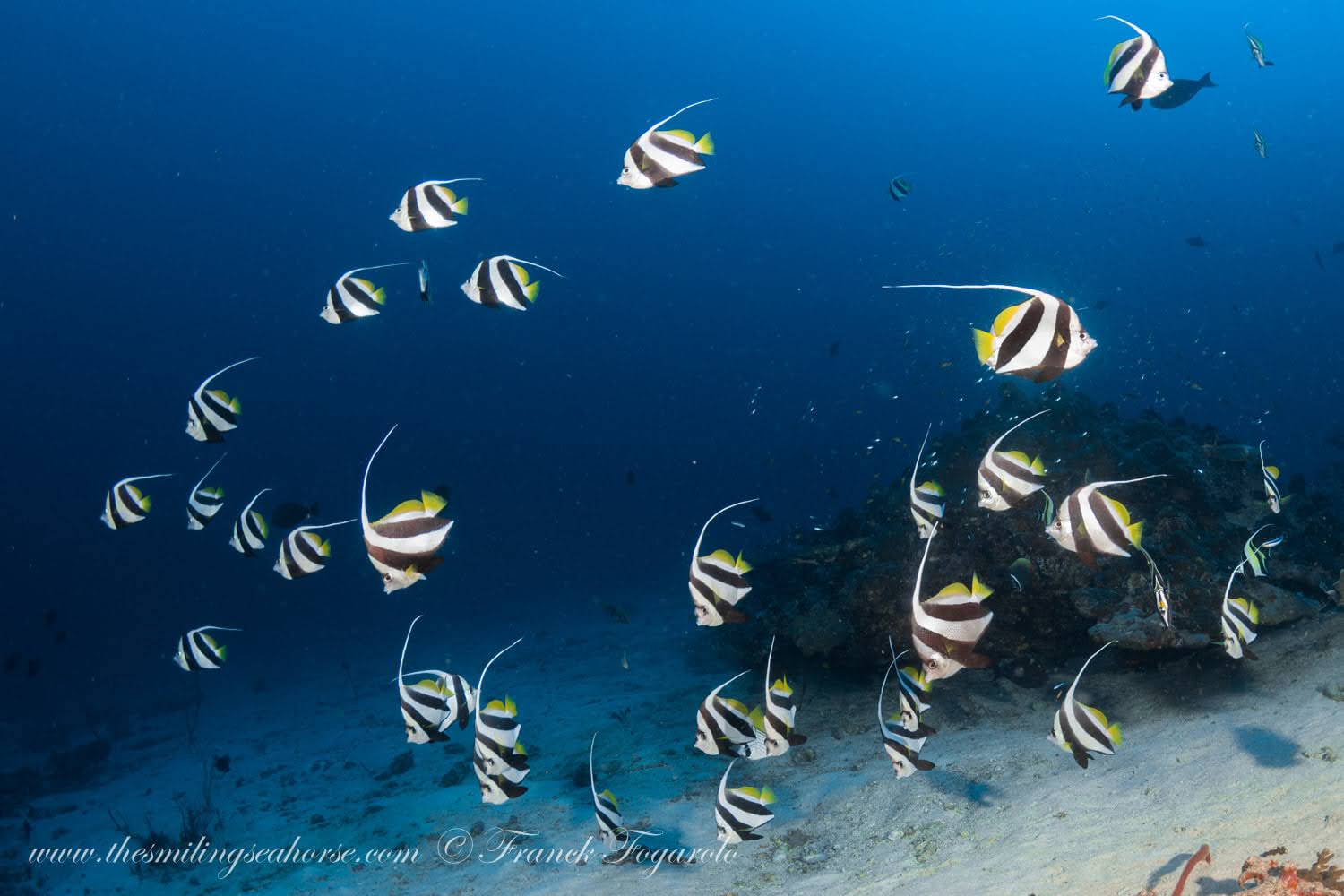
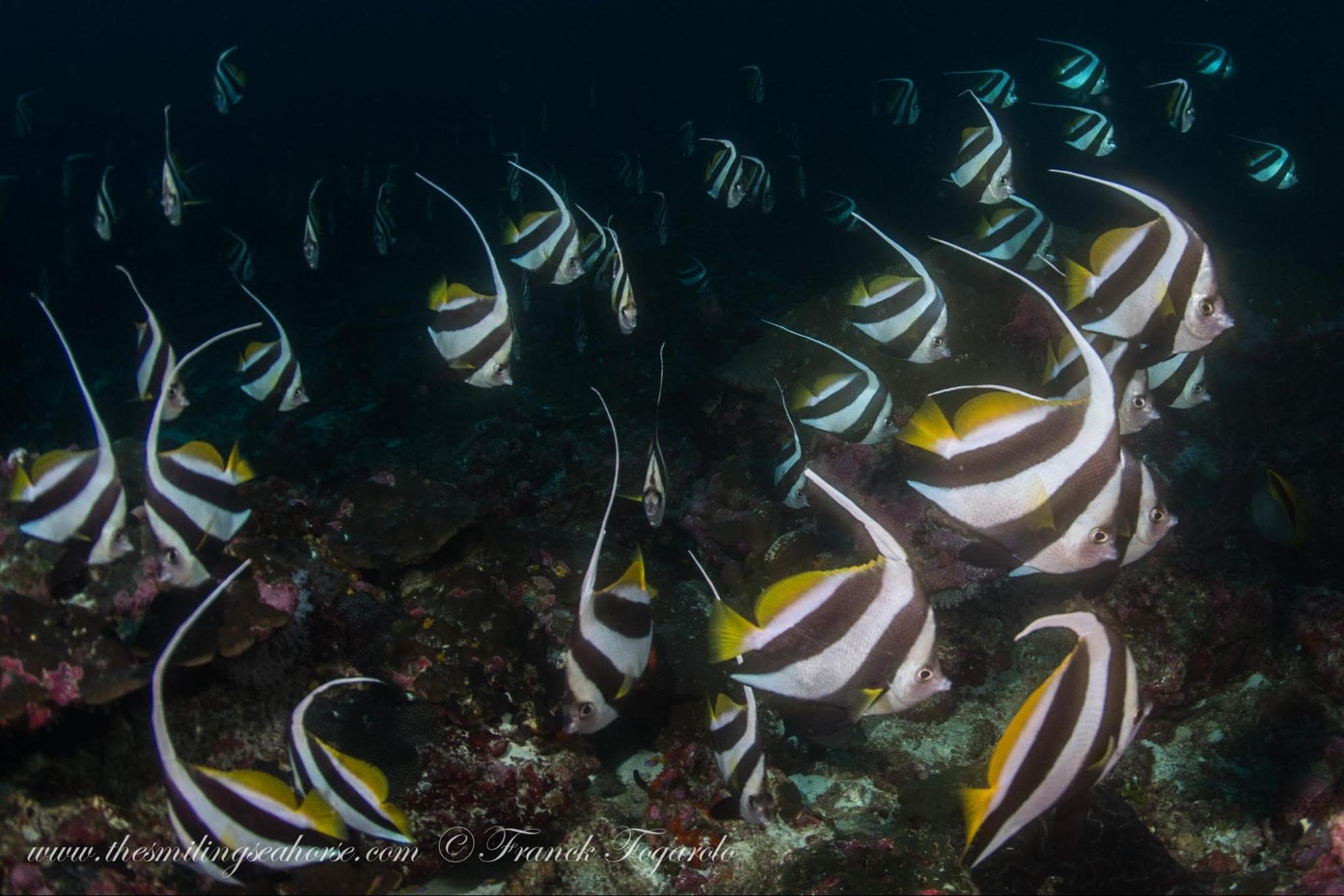
- Plankton-feeding schools: Unlike its solitary cousin, H. diphreutes regularly gathers in large aggregations numbering dozens or hundreds of individuals.
- Slightly shorter snout: An even more compact facial profile than H. acuminatus.
- More streamlined breast: The chest curves more smoothly upward, giving it an agile build suited for mid-water currents.
- Black anal fin margin: The posterior edge of the anal fin features black coloration bordered with crisp white trim.
7 Easy Ways to Tell Them Apart Underwater
Use our quick visual reference chart below to compare snouts, silhouettes, schooling tendencies, and fin coloration side-by-side:
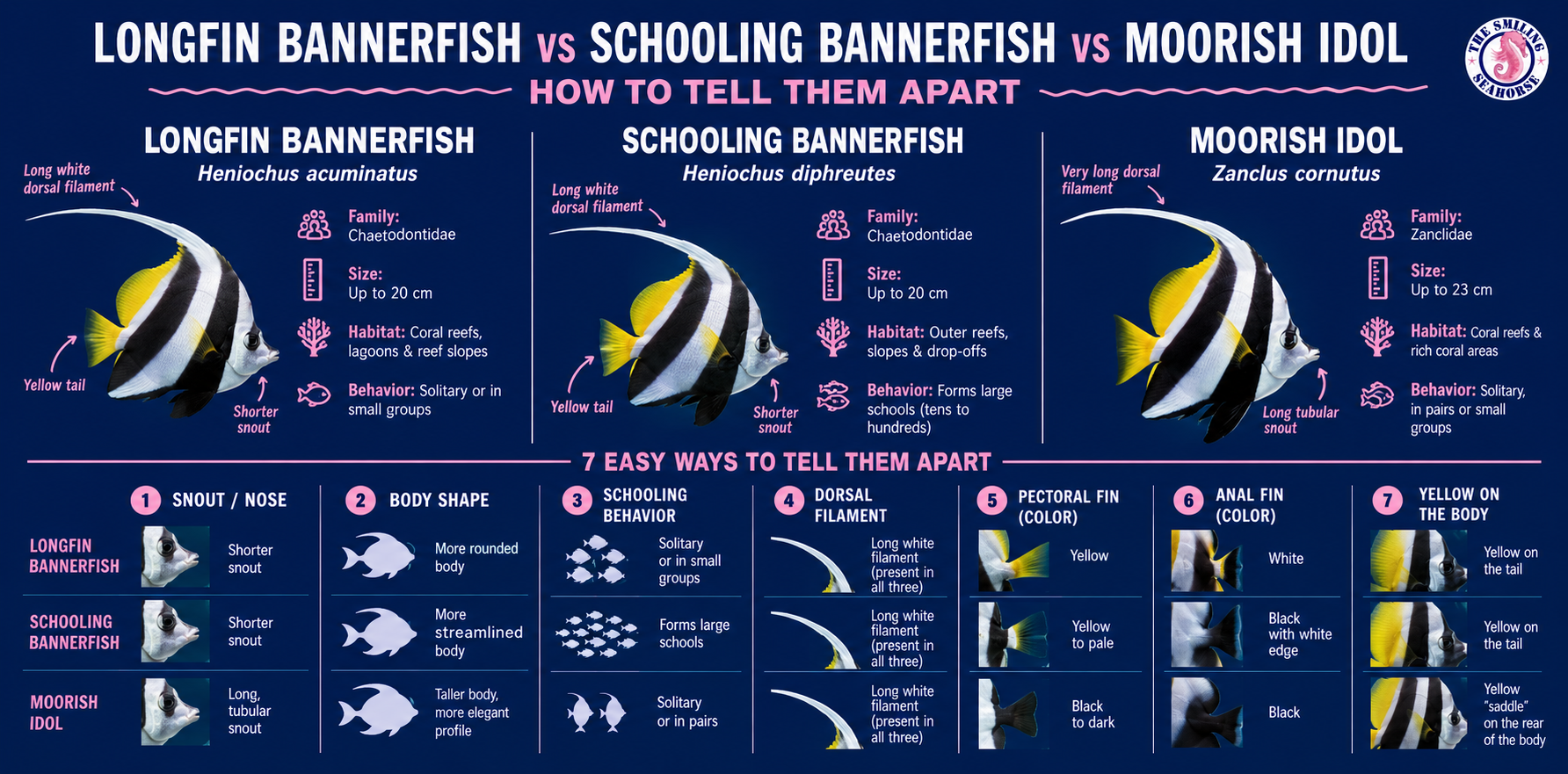
1. Look at the Snout & Nose
The snout is the single fastest anatomical giveaway. Moorish Idols possess an elongated, slender tubular beak designed to extract prey from porous coral heads. In contrast, both Bannerfish species have noticeably shorter, triangular butterflyfish snouts.
2. Observe Their Social Behavior
Behavior gives you immediate context underwater:
- Schooling Bannerfish: Swirl in synchronized formations of dozens to hundreds in open water.
- Longfin Bannerfish: Move solo, in territorial pairs, or in small groups hovering tight to substrate.
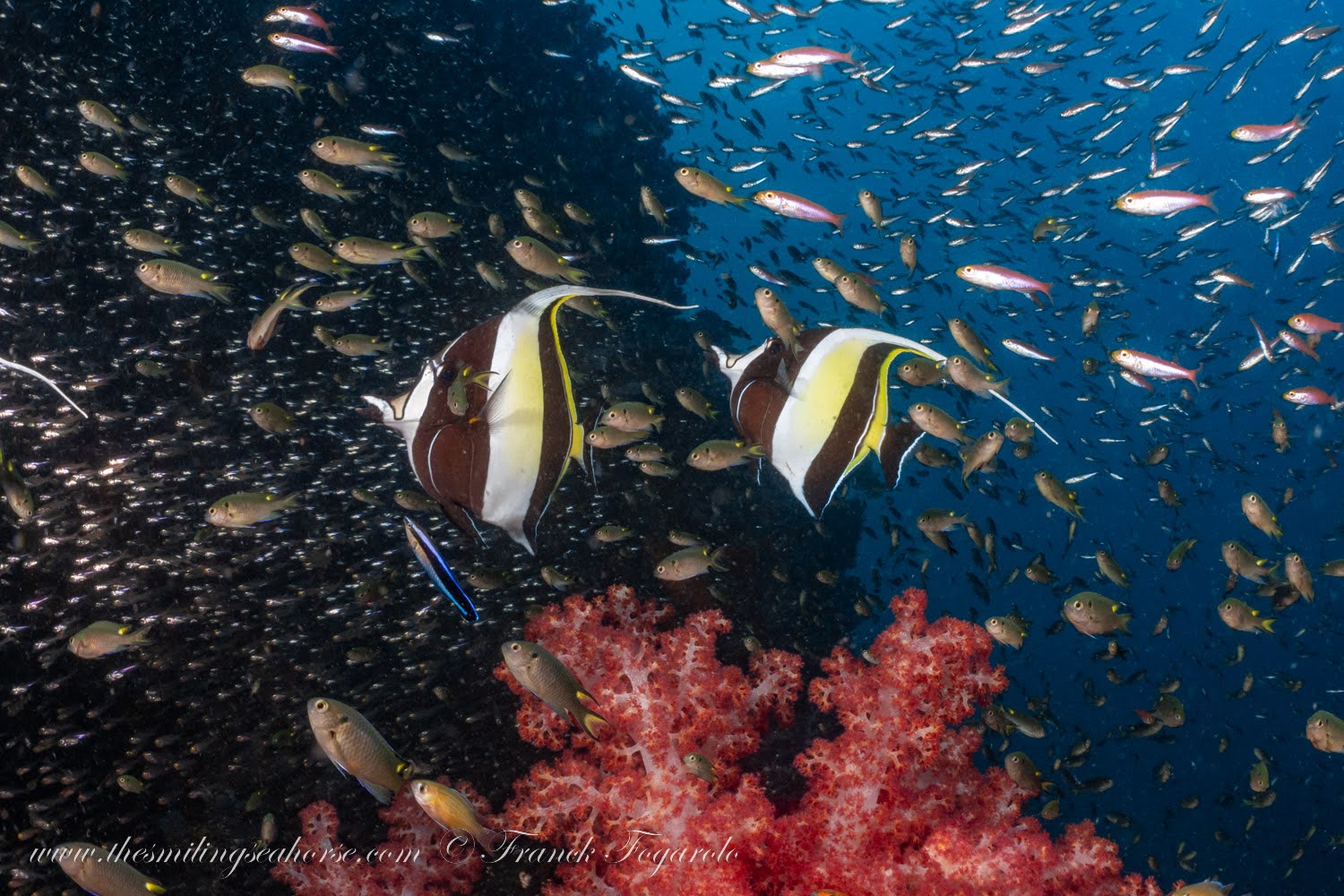
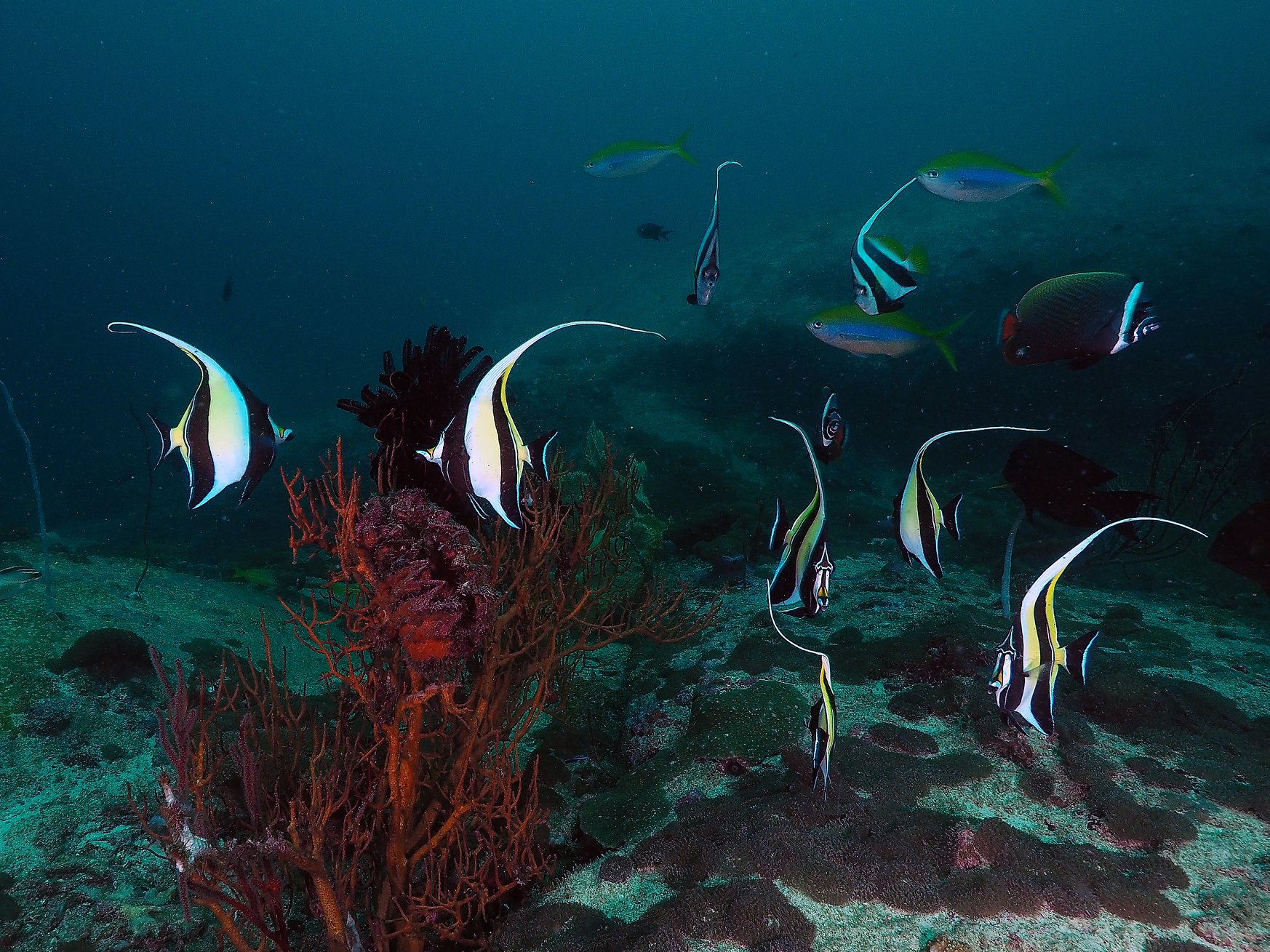
- Moorish Idol: Almost exclusively observed singly or roaming as mated pairs across the reef flat.
3. Check the Body Shape & Silhouette
Moorish Idols have a taller, disc-shaped profile with a distinct keel. Longfin Bannerfish feature a rounder, deeper belly, whereas Schooling Bannerfish are slightly more streamlined and compact from snout to tail.
4. Assess the Dorsal Filament
While all three sport an impressive white banner, its structure differs:
- Moorish Idol: The filament extends from the leading edge of the dorsal spine and often grows exceptionally long, trailing gracefully like a ribbon.
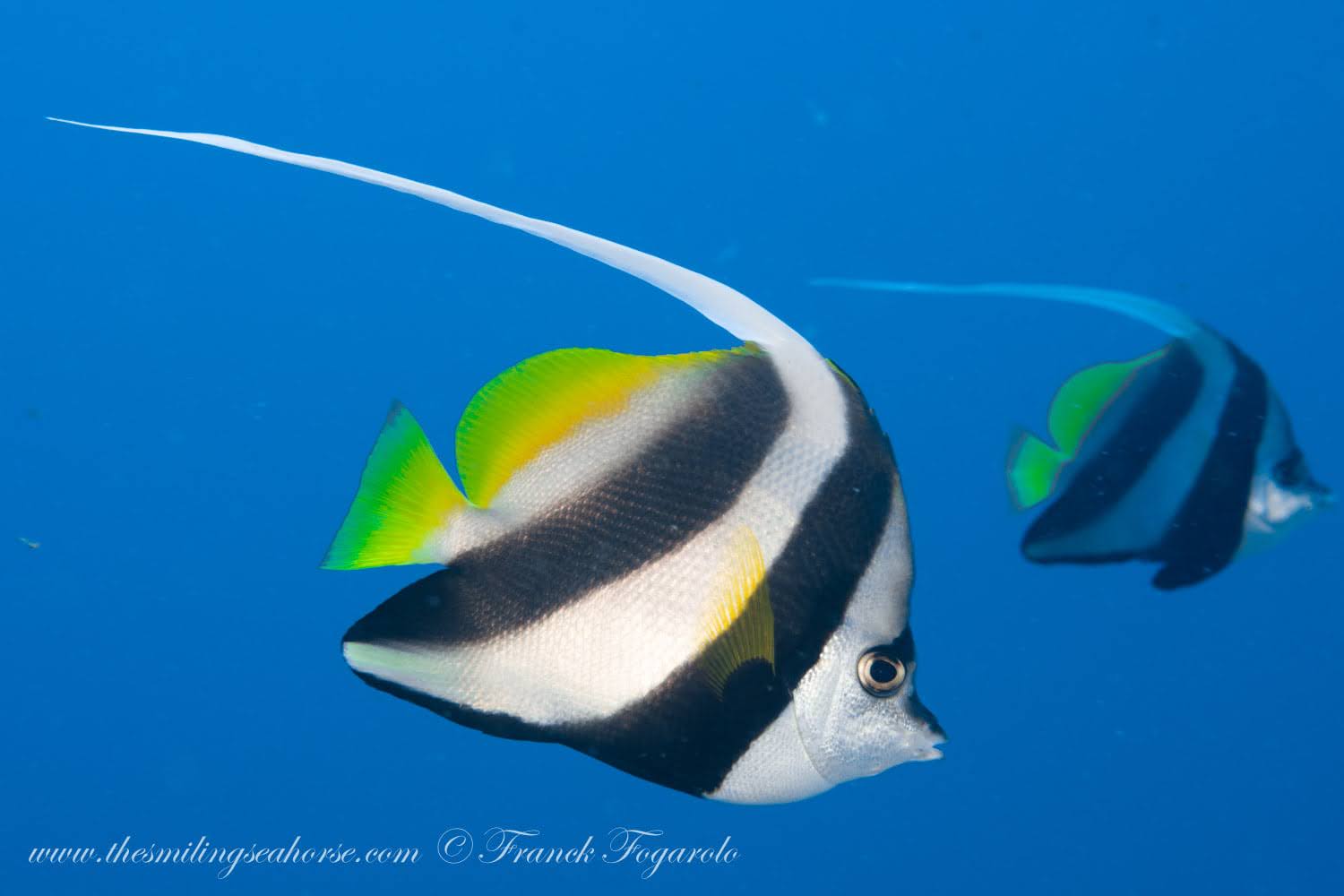
- Bannerfish: The filament is formed specifically by an elongated fourth dorsal spine. While long and elegant, it is generally stiffer than an adult Moorish Idol’s streamer.
5. Examine Pectoral Fin Color
- Moorish Idol: Dark to charcoal-black pectoral fins.
- Longfin Bannerfish: Translucent to bright yellow pectoral fins.
- Schooling Bannerfish: Yellow to pale yellow pectoral fins.
6. Inspect Anal Fin Markings
- Moorish Idol: Solid dark black anal fin.
- Longfin Bannerfish: Broadly white anal fin.
- Schooling Bannerfish: Black anal fin edged with a clean white margin.
7. Look for Yellow Markings on the Body
- Moorish Idol: Carries a vivid yellow patch on the snout mask and a large yellow saddle covering the rear half of the body. The caudal fin is black.
- Bannerfish: Their body flanks are crisp black and white; bright yellow is confined entirely to the tail and soft rear dorsal fin.
Where Can You See These Species in Thailand & Myanmar?
All three species thrive in the nutrient-rich waters of the Andaman Sea. While diving from our liveaboard, The Smiling Seahorse, we encounter them regularly across several world-class marine parks:
- Similan Islands: Moorish Idols roam the sloping hard coral reefs of Koh Miang and Koh Similan, while Schooling Bannerfish cluster over granite boulder drop-offs.
- Koh Bon & Koh Tachai: Exposed ridges with steady currents attract massive feeding clouds of Schooling Bannerfish in the blue.
- Richelieu Rock: Famed for vibrant soft corals where Longfin Bannerfish hover between anemones and Moorish Idols browse the limestone pinnacle.
- Surin Islands: Extensive shallow reef flats offer ideal feeding grounds for paired Moorish Idols.
- Mergui Archipelago & Burma Banks (Myanmar): Remote pinnacles like Western Rocky and Black Rock host dense schools of bannerfish dancing alongside pelagics in open water.
Frequently Asked Questions
Is the Moorish Idol a butterflyfish?
No. Although it resembles butterflyfish, the Moorish Idol belongs to its own monotypic family, Zanclidae, and is closely related to surgeonfish and tangs (Acanthuridae). Bannerfish belong to the butterflyfish family, Chaetodontidae.
Why are Bannerfish called “False Moorish Idols”?
Because their high-contrast black, white, and yellow coloration and sweeping dorsal streamer create a very similar silhouette to the Moorish Idol underwater, leading to frequent misidentifications.
Which Bannerfish swims in large schools?
The Schooling Bannerfish (Heniochus diphreutes) is famous for aggregating in schools numbering from dozens to hundreds of individuals, feeding on drifting plankton in open currents.
Which one is easier to photograph?
Large groups of Schooling Bannerfish create breathtaking wide-angle subjects over coral reefs and drop-offs. Mated pairs and solitary Moorish Idols make stunning macro and fish-portrait subjects due to their intricate facial patterns and bold colours.
Final Thoughts
While the Moorish Idol, Longfin Bannerfish, and Schooling Bannerfish share an unmistakable colour palette, distinguishing them is straightforward once you focus on snout length, social grouping, and fin markings.
On your next dive in Thailand or Myanmar, take a moment to look closely at that elegant black-and-yellow silhouette in the current! Ready to see these incredible reef species in person? Check out our liveaboard cruise schedule and join us aboard The Smiling Seahorse for an unforgettable diving journey across the Andaman Sea.





One Response
Thank you for writing such an informative article. Reading this article helps beginner to distinguish their differences because they almost look the same.