
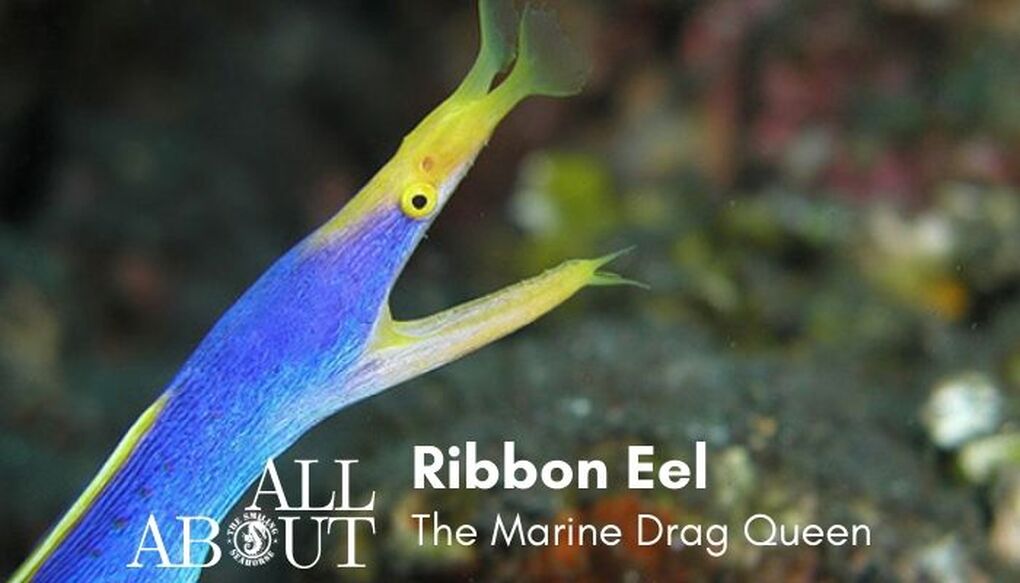
Ribbon Eels: The Andaman Sea Drag Queen!
The ribbon eel is the only member of its genus. For a long time, scientists thought there were three different types of ribbon eel: black, blue and yellow. We now know that they are all part of the same remarkable species, with individuals changing both colour and sex during their lifetime.
1. The Ribbon Eel’s Habitat
Ribbon eels can live for up to 20 years and can grow to around 1 metre long. The largest individual observed measured 1.30 metres.
You can find ribbon eels in sandy areas around reefs and lagoons throughout the Indo-Pacific. They can live in very shallow water down to around 60 metres deep.
A ribbon eel will usually stay in the same cave for months or even years. Two individuals, usually adult males, can sometimes be seen sharing the same hole.

2. The Ribbon Eel’s Behaviour
The ribbon eel is a carnivore that preys on small fish and other animals that swim too close to its hole.
They can generally be observed with their head poking out of their hole, patiently waiting to catch prey as it wanders past. Despite their spectacular appearance, ribbon eels are usually rather shy and prefer to keep most of their body safely hidden inside their burrow.

3. A Ribbon Eel’s Colour Reveals Its Age and Sex
One of the most fascinating things about the ribbon eel is that its colour changes as it matures. Even more remarkably, every individual is born male.


Juveniles and sub-adults are black with a yellow dorsal fin. When they reach adulthood, they keep the yellow fin but their body turns blue and starts developing female reproductive organs.
When they reach their full size, they become female and change colour to a completely yellow pattern. They then find a mate, lay their eggs and die within a month.
It is due to this short final stage of their life that female ribbon eels are rarely observed. The ribbon eel is a protandric hermaphrodite, meaning that individuals begin life as males and can later change sex to female.

Ever seen a ribbon eel larva? We regularly spot them on our blackwater dives!
They are totally transparent, so you could easily mistake one for some kind of jelly before seeing it swimming towards you with its bright eyes. You can even see its tube gut, appearing as the stripe running down the middle of the body.


4. The Ribbon Eel’s Major Threats
Did you know that one of the major threats to this species is the aquarium trade?
While writing this post, I found more websites giving advice about keeping ribbon eels alive in captivity, or selling them, than information about the animal itself… Better to leave them in their natural habitat and observe them while scuba diving, don’t you think?
Come and see them in Thailand and Myanmar while they are still around. Seeing a ribbon eel in its natural environment is a much more memorable experience than keeping one in an aquarium.
Ribbon eels are one of the many fascinating animals that make Thailand’s Andaman Sea marine life so special for divers and underwater photographers. If you enjoy looking for unusual marine life underwater, the morays and eels of the Andaman Sea are another fascinating group to discover.

Discover More
- Learn more about ribbon eels and their extraordinary life cycle.
- Discover blackwater diving in Thailand and the strange and fascinating creatures that appear in the darkness.
- Explore the marine life of Thailand and the Andaman Sea.
- Discover scuba diving in Thailand and the dive destinations explored by The Smiling Seahorse.




