
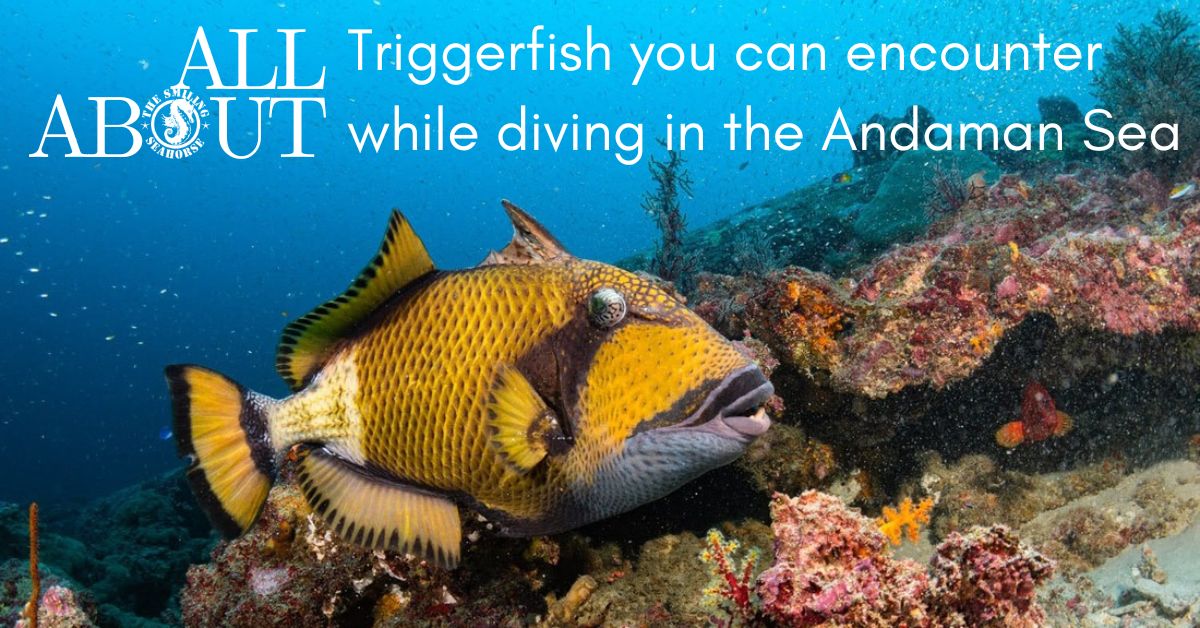
Triggerfish in the Andaman Sea: Species, Behaviour and Diving Tips
There are many species of triggerfish belonging to the Balistidae family. Most live in shallow tropical waters around coral reefs, while the oceanic triggerfish (Canthidermis maculata) spends much of its life out in the blue. Triggerfish are among the most fascinating fish to encounter while diving in Thailand, with their striking colours, powerful teeth and very distinctive behaviour.
 |
 |
Titan Triggerfish: The Famous Andaman Sea Triggerfish
The best-known triggerfish, especially because of its reputation for aggressive behaviour towards divers, is the Titan triggerfish (Balistoides viridescens). But there is a good reason for this behaviour: they are protecting their eggs.
The female lays her eggs a few days before the new and full moon. Before spawning, the male and female perform pre-spawning behaviour such as blowing and touching while preparing their nest on a sandy or rocky area. The fish blow water into the substrate to create a hole where the female will lay her eggs.
The male then protects and defends the territory from any species swimming too close, including other male triggerfish. Generally, a male will fertilise the eggs of several females within his territory.
 |
  |
How to Avoid a Titan Triggerfish Attack
Titan triggerfish are known to attack divers who swim too close to their nest, and a common diver mistake is to try to escape by swimming upwards. Their nesting territory extends upwards in a cone shape, becoming wider as it rises above the nest.
The better reaction is therefore to swim away horizontally, getting out of the triggerfish’s territory as quickly as possible while keeping your fins pointed towards the fish. This gives you a better chance of avoiding contact if the triggerfish decides to defend its nest.
Another good way to avoid an encounter becoming an attack is to pay attention to changes in the fish’s behaviour.
A Titan triggerfish may first raise its dorsal fin. It can then lean to one side as a final warning. If a diver continues getting closer, the fish may swim towards the intruder and attempt to bite whatever it can catch. This behaviour generally occurs when the triggerfish is actively guarding its eggs.
Clown Triggerfish: A Splash of Colour on the Reef
 |
 |
Another triggerfish we love is the clown triggerfish (Balistoides conspicillum), instantly recognisable by its white spots on the lower part of the body and the bright yellow markings on its back and face.
They are less common than Titan triggerfish, redtooth triggerfish or yellowmargin triggerfish, but they can still be found around the archipelago. Their spectacular pattern makes them a favourite subject for underwater photographers and a particularly memorable encounter on a reef dive.
Redtooth Triggerfish: Schooling in the Current

The redtooth triggerfish (Odonus niger) lives especially around our pinnacles and seems to enjoy areas where there is current. When it is time to rest, these triggerfish retreat into cracks and small cavities in the reef.
Unlike the solitary behaviour often associated with nesting Titan triggerfish, redtooth triggerfish can form impressive schools. They feed mainly on plankton, and watching a group of them moving together in the current can be one of those wonderfully dynamic reef scenes that makes a dive so memorable.
Yellowmargin Triggerfish

The yellowmargin triggerfish (Pseudobalistes flavimarginatus) is also very common in the archipelago. It lives around coral reefs and can grow up to 60 cm, making it another impressive member of the triggerfish family to look out for during a dive.
With so many different triggerfish species sharing the reefs, the Andaman Sea is a great place to practise identifying the subtle differences between them. From the spectacular colours of the clown triggerfish to the schooling redtooth triggerfish and the powerful Titan triggerfish, each species has its own character.
Triggerfish Encounters While Diving

Triggerfish are a perfect example of why it pays to observe fish behaviour rather than simply looking for a photograph. A fish defending a nest can behave very differently from one simply cruising over the reef or resting in a crack.
For divers, the key is simple: give nesting triggerfish plenty of space, watch their body language and avoid swimming upwards through their nesting territory. Respecting their space allows us to enjoy these remarkable reef residents without turning an interesting encounter into a stressful one for either the fish or the diver.
You can discover more triggerfish species that you may encounter while diving in the region in our guide to the triggerfish of the Andaman Sea.




