
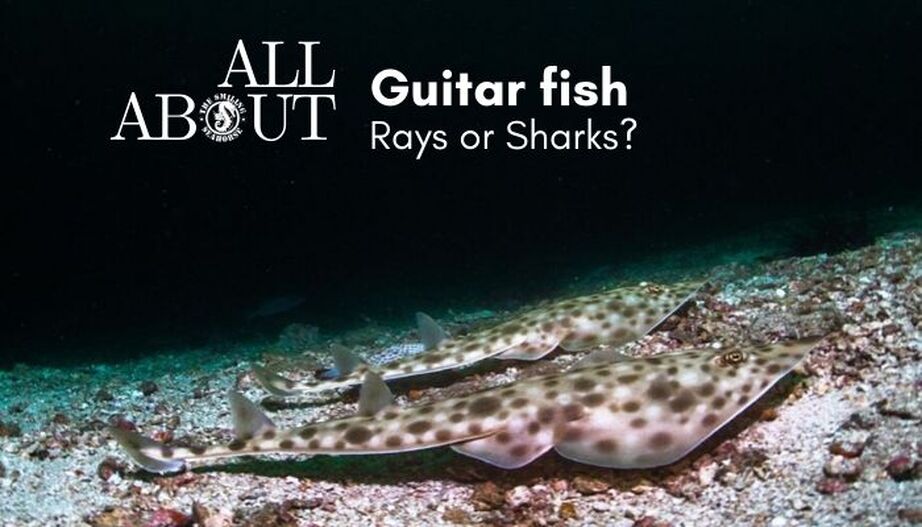
Guitarfish: A Ray That Looks Like a Shark
Guitarfish are fascinating creatures that blur the line between sharks and rays. Their distinctive guitar-shaped bodies have earned them this unusual name, while their shark-like tails and dorsal fins often make people wonder which group they actually belong to.
Guitarfish were historically grouped within the Rhinobatidae family. The name itself reflects their unusual appearance, combining characteristics that seem to belong to both sharks and rays. Despite their shark-like silhouette, however, guitarfish are rays.
While the shovelnose ray pictured below (Rhinobatos ranongensis) remains part of the Rhinobatidae, marine biologists have separated most wedgefish into the Rhinidae family. These include the bowmouth guitarfish (Rhina ancylostoma) and the giant guitarfish, also known as the whitespotted wedgefish (Rhynchobatus australiae).

Rare Encounter: Bowmouth Guitarfish at the Burma Banks
Seeing a bowmouth guitarfish underwater is always a memorable encounter, but coming across one at the remote Burma Banks made this particular dive especially exciting. The animal swam close to inspect our group, and we were possibly the first divers it had ever encountered!
Encounters like this are part of what makes diving the Andaman Sea so rewarding. Guitarfish are not animals that divers encounter on every dive, and their excellent camouflage means that even when they are nearby, they can be remarkably difficult to spot.
Anatomy and Adaptations
Guitarfish have a unique anatomy that combines features of both rays and sharks, but despite their shark-like appearance, guitarfish are members of the ray family.
Like other rays, guitarfish have their mouths positioned on the underside of their bodies. This is well suited to feeding on organisms living on the seabed, but it would make breathing difficult if they had to draw water in through the mouth while resting on sand or mud. Instead, they use spiracles — small openings on their heads — to breathe without sucking in large amounts of sand and debris.
Guitarfish do not need to keep swimming continuously. They can pump water through their gills to obtain the oxygen they need. Like sharks, and unlike many other rays that rely heavily on their pectoral fins for propulsion, guitarfish swim using their shark-like tails, giving them a distinctive movement pattern in the water.
Bowmouth guitarfish, in particular, have rows of thorn-like spikes along their backs. These provide an armour-like defence against predators and, together with their robust bodies, make this species particularly distinctive.

Diet: What Do Guitarfish Eat?
Guitarfish are bottom feeders, primarily consuming crustaceans, molluscs and small fish that inhabit sandy or muddy seabeds. Their teeth are adapted for dealing with hard-shelled prey, allowing them to feed on animals hidden in the sediment.
The rows of shark-like spines along the backs of bowmouth guitarfish are another fascinating adaptation. These spines provide a natural defence against predators such as larger sharks. Unfortunately, the same distinctive spines have also become objects of interest in the jewellery trade in parts of Asia.
Reproduction of the Guitar Rays
Like many rays, guitarfish are ovoviviparous. Their embryos develop inside eggs that remain within the mother’s body. Once the eggs hatch internally, the female gives birth to live pups, which are fully developed and ready to swim and feed independently from birth.
The number of young varies between species. The original article records litters of between 2 and 11 pups for guitarfish, while historical observations of shovelnose guitarfish have reported considerably larger numbers. Reproduction and life-history details can vary considerably between species within this unusual group.
Are Guitarfish Dangerous?
Despite their imposing size — some species, such as the giant guitarfish, can grow up to 3 metres (9.8 feet) — guitarfish are generally harmless to humans.
They are gentle creatures whose predators include larger sharks, such as tiger sharks. Humans are also a major threat because of fishing pressure. Unfortunately, many species of guitarfish are now classified as vulnerable or endangered.

Conservation Status: A Species Under Threat
Guitarfish face numerous threats, including overfishing for their meat and fins, habitat destruction from coastal development, and bycatch in commercial fisheries. Many species are now classified as vulnerable or endangered.
For instance, the bowmouth guitarfish is listed as critically endangered by the IUCN.
Alongside the damage caused by bycatch, guitarfish are targeted for their large fins by finning vessels and for their distinctive thorns. Those sharp, tooth-like spines along their backs have become sought-after items embedded into jewellery. Some people believe they provide the wearer with protective powers. This trade adds another pressure to already threatened populations.
Conservation efforts include establishing marine protected areas, enforcing sustainable fishing practices, reducing bycatch and raising public awareness about the ecological importance of these unusual rays.


Fun Facts About Guitarfish

- Targeted by Shark Finning: The large fins of bowmouth guitarfish make them highly vulnerable to the shark finning industry, which is a significant contributor to the pressures facing these threatened animals.
- From By-Catch to Delicacy: Once discarded as a worthless bycatch species, shovelnose guitarfish are now prized for their meat, which is considered a delicacy in many regions.
- Mud Skates: Giant guitarfish are sometimes called “mud skates” because of their preference for muddy or sandy habitats. These areas provide both camouflage and an abundance of prey.
- Monogamous Mating Habits: Shovelnose guitarfish have been reported to form pairs during the breeding season. Reproduction varies between species, and historical observations have recorded large numbers of live young in some shovelnose guitarfish.
- Hunting with Sensors: Shovelnose guitarfish rely on specialised sensory systems to detect changes in their surroundings, helping them locate prey even when visibility is poor.
- A Rare Encounter: With their dwindling numbers, spotting a bowmouth guitarfish is a rare privilege for divers. If you’re lucky enough to come across one, make sure to be camera ready!
Where Can You See Guitarfish?
Guitarfish inhabit warm, shallow waters of tropical and subtropical seas. They generally favour sandy or muddy seabeds where they can feed and, in some cases, bury themselves in the sediment.
The bowmouth guitarfish has first been spotted at Western Rocky, in the south of the Mergui Archipelago, and then at the Burma Banks.
On one memorable dive at the Burma Banks, a bowmouth guitarfish swam close to inspect our group. We were possibly the first divers it had ever encountered!
A group of giant guitarfish has settled down for a while around Koh Bon Pinnacle and the Surin Islands.
 Shovelnose guitarfish – Black Rock
These shovelnose rays (Rhinobatos ranongensis) were spotted by the hundreds on the deeper parts of Black Rock, north of the Mergui Archipelago. It was a carpet of them in the depths around the dive site.
They like colder water and often show up when water temperatures drop.
These rays camouflage themselves so well by burrowing into the sandy seabed that it took us a while to spot one — and then we saw so many!!!
This region of the Andaman Sea is home to a wide variety of ray species, including several species of guitarfish.
Click here if you want to know more about the marine life we see in Burma.
Or below for more details about our diving expeditions…





2 Responses
A great summation of the bowmouth guitarfish.