
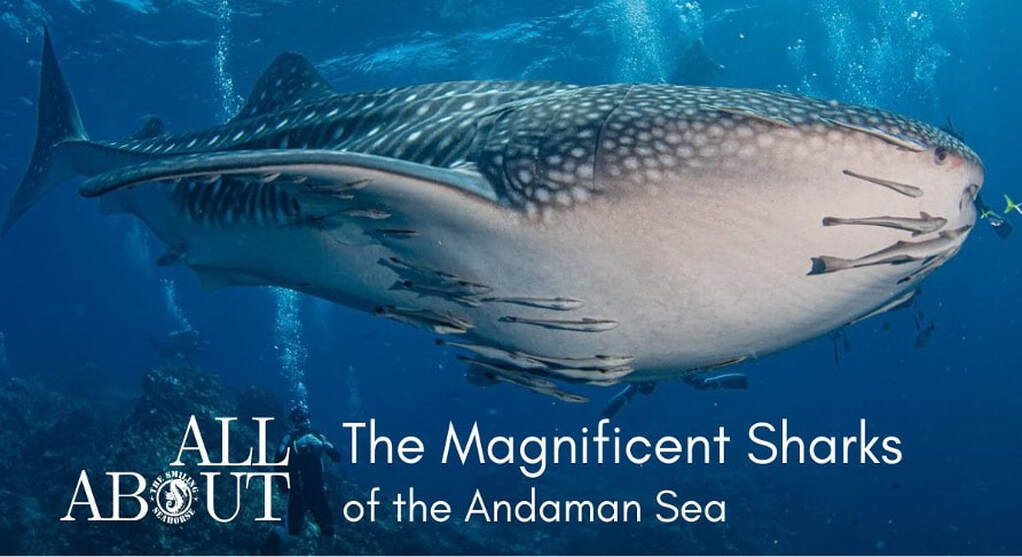
10 Species of Sharks You Can Encounter in the Andaman Sea
The Andaman Sea in Thailand and Myanmar is a paradise for diving enthusiasts, boasting a diverse ecosystem that is home to an array of captivating marine life. Among the majestic creatures that roam these waters, sharks hold a special place in the hearts of many divers.
In this article, we will delve into the fascinating world of sharks that you can encounter in the Andaman Sea.
10 Species of Sharks We Most Often Encounter in the Andaman Sea
1. Leopard Sharks (Stegostoma fasciatum)

Also known as zebra sharks, these mesmerising creatures can be found in the shallow waters of the Andaman Sea. With their distinctive patterns of dark spots and stripes, leopard sharks are a sight to behold. Despite their size, reaching up to 3 metres in length, they are generally docile and pose little threat to divers.
Type: The zebra shark is the sole member of the family Stegostomatidae.
Size: Approximately 1–3 metres.
Habitat: Zebra sharks are found throughout the tropical Indo-Pacific, frequenting coral reefs and sandy flats to depths of around 62 metres.
Where are you most likely to see leopard sharks? Divers often encounter them at Shark Point near Phuket, where they can be seen resting on sandy bottoms or gracefully gliding over the reef.
Reproduction: Zebra sharks are oviparous, meaning they lay eggs rather than giving birth to live young. They can breed throughout the year without a distinct mating season. The eggs are enclosed in distinctive brownish-purple cases often known as “mermaid’s purses”. After several months of development, the young hatch and are independent from birth.
2. Whitetip Reef Sharks (Triaenodon obesus)

These sleek and slender sharks are commonly spotted in the Andaman Sea, particularly around rocky reefs and coral formations. Named for the prominent white tips on their dorsal and caudal fins, whitetip reef sharks are nocturnal hunters and are often seen resting during the day in crevices or beneath overhangs. Although they can reach lengths of around 2 metres, they are generally timid around divers.
Type: Requiem shark in the Carcharhinidae family.
Where are you most likely to see whitetip reef sharks? Divers often encounter them close to deep drop-offs in the Similan Islands, particularly around sites such as Elephant Head Rock and Three Trees.
Reproduction: Whitetip reef sharks are placental viviparous. Fertilisation occurs internally, and the embryos initially receive nourishment from the yolk sac. Later, the yolk stalk develops into an umbilical connection and the yolk sac transforms into a placenta. This allows the embryos to receive nourishment during gestation, which lasts for at least five months. Litters generally consist of 1–5 pups, with newborns measuring approximately 52–60 cm. There is no parental care after birth.
3. Blacktip Reef Sharks (Carcharhinus melanopterus)

One of the most recognisable shark species in the Andaman Sea, blacktip reef sharks are renowned for their distinctive black-tipped fins and slender bodies. These agile swimmers are commonly found in shallow, nearshore waters, patrolling coral reefs in search of small fish and crustaceans.
Type: Requiem shark in the Carcharhinidae family.
Where are you most likely to see blacktip reef sharks? Divers often encounter them in shallow waters. Bida Nok in Phi Phi National Park can offer good opportunities to see several individuals, particularly when divers remain motionless and quiet.
Reproduction: Blacktip reef sharks are viviparous, meaning they give birth to live young. After a gestation period of approximately seven to sixteen months, depending on geographic location, females give birth to around 2–4 pups measuring approximately 30–50 cm. Females possess two separate uteri.
4. Nurse Sharks (Nebrius ferrugineus)

Nurse sharks, with their robust bodies and distinctive barbels on the lower jaw, are a memorable sight in the Andaman Sea. These bottom-dwelling sharks prefer sandy or muddy habitats and often rest during the day before becoming more active at night. Despite their size, which can exceed 4 metres, they are generally placid when left undisturbed.
Type: Carpet shark in the Ginglymostomatidae family.
Size: Around 27 cm at birth, growing to more than 4 metres.
Where are you most likely to see nurse sharks? In our area, some of the best opportunities are around the Burma Banks and in quiet caves throughout the Mergui Archipelago. While nurse sharks can also be spotted in Thailand, sightings are less predictable.
Reproduction: Nurse sharks are an aplacental viviparous species, without a yolk-sac placenta. Litters can contain around 20–50 pups. Genetic studies have also shown that a single litter can contain young fathered by multiple males.
5. Tiger Shark (Galeocerdo cuvier)

The tiger shark is a captivating and powerful predator found in the North Andaman Sea and around Burma. With its distinctive striped pattern and formidable presence, it commands attention. Known for its opportunistic feeding habits and adaptability, the tiger shark is a skilled hunter, preying on a wide variety of marine life.
Encounters are much less common than sightings of several other shark species in the region. In more than 12 years of diving in the Andaman Sea, we have encountered only three individual tiger sharks.
Type: The largest member of the Carcharhinidae family.
Where are you most likely to see tiger sharks? Tiger sharks are very rarely spotted in Thailand and Myanmar. Our encounters have occurred around the Burma Banks, the Surin Islands, and Shark Point in the south of the Similan Islands.
Reproduction: Tiger sharks are aplacental viviparous. Embryos develop inside the uterus without a placental connection and are nourished during development before being born as live young. Tiger sharks should not be confused with sand tiger sharks (Carcharias taurus), which have a very different reproductive strategy.
6. Grey Reef Sharks (Carcharhinus amblyrhynchos)

Grey reef sharks (Carcharhinus amblyrhynchos) are powerful, fast-swimming reef predators often seen patrolling drop-offs and current-swept reefs in the Andaman Sea. They may occasionally be seen in small groups, but in our area they are most often encountered around the Burma Banks.
Type: Requiem shark in the Carcharhinidae family.
Where are you most likely to see grey reef sharks? Strong currents and exposed reef edges offer good opportunities, particularly around the Burma Banks, where these sharks are known to cruise along reef slopes.
Reproduction: Grey reef sharks are viviparous and develop a yolk-sac placenta during gestation. After a pregnancy lasting around 9–14 months, females give birth to litters of approximately 1–6 pups.
7. Grey Bamboo Shark (Chiloscyllium griseum)

Let’s take a closer look at the delightful grey bamboo shark. While information about these Thailand-dwelling sharks is somewhat limited, one thing is clear: they have a knack for hiding. These elusive creatures prefer the seclusion of caves or the shelter of coral, making them challenging to observe.
The grey bamboo shark can reach a maximum length of around 80 cm and feeds mainly on shrimp, crabs, worms, and other small marine animals. These sharks move at a leisurely pace and tend to stay close to the ocean floor or inside sheltered spaces. They can sometimes be mistaken for other bamboo shark species or even their much larger relative, the nurse shark.
Type: Carpet shark in the Hemiscylliidae family.
Size: Maximum size around 80 cm; newborns are less than approximately 13–18 cm.
Where are you most likely to see grey bamboo sharks? Volcano and Square Rocks in the south of the Mergui Archipelago have plenty of hiding places favoured by bamboo sharks. Because they often retreat deep into cracks, finding them may require the help of an experienced dive guide.
Reproduction: Bamboo sharks are oviparous. A single egg case develops in each uterus, and the eggs hatch after an incubation period of approximately 14–15 weeks. One captive female has been documented storing sperm for an extended period before fertilisation.
8. Coral Catshark (Atelomycterus marmoratus)

The coral catshark is a small shark species found in the Andaman Sea, including waters around Myanmar. It is known for its distinctive marbled pattern of dark spots and blotches and typically reaches a maximum length of around 70 cm.
These sharks are primarily found in shallow tropical waters, often inhabiting coral reefs and rocky areas. Like many catsharks, they are nocturnal and spend much of the day resting on the seabed before becoming more active at night.
At night, coral catsharks hunt for small fish, crustaceans, and other invertebrates. Their slender bodies allow them to move through crevices and coral structures in search of prey.
Type: Catshark in the Scyliorhinidae family.
Where are you most likely to see coral catsharks? Steps, a dive site near Koh Lipe on our South Andaman itineraries, offers one of the best opportunities in our area to encounter coral catsharks.
Reproduction: Catsharks are oviparous, meaning they lay eggs. Their egg cases are laid in pairs and develop until the young hatch.
9. Whale Sharks (Rhincodon typus)

Undoubtedly one of the most majestic creatures in the ocean, the gentle giant known as the whale shark occasionally graces the waters of the Andaman Sea. Despite their enormous size, whale sharks are filter feeders and pose little threat to divers and snorkellers.
Encounters can be unforgettable as divers observe these magnificent animals moving through the water and feeding on plankton and other tiny organisms.
Type: Filter-feeding shark in the Rhincodontidae family.
Where are you most likely to see whale sharks? Whale sharks can be encountered at various locations in Thai waters. In the Andaman Sea, notable sites include Richelieu Rock in the north and Hin Daeng, Hin Muang and 8 Mile Rock in the south. The Mergui Archipelago in Myanmar also offers opportunities to encounter whale sharks alongside a diverse range of marine life.
Reproduction: Limited information is available about whale shark reproduction. Males are considered sexually mature when they reach approximately 8–9 metres and can be identified by the presence of claspers near the pelvic fins. The size at which females reach maturity remains uncertain.
Whale sharks are believed to be aplacental viviparous, meaning that embryos develop inside the female and hatch internally before being born live. The embryos initially rely on yolk reserves and later receive additional nourishment within the uterus.
A female whale shark caught off Taiwan was found to contain approximately 300 embryos in her two uteri. Newborn whale sharks are generally around 55–64 cm long. There is no known parental care after birth.
Learn more about the mystery of baby whale sharks here.

10. Bull Sharks (Carcharhinus leucas)

Bull sharks (Carcharhinus leucas) are powerful, adaptable sharks capable of living in both salt and freshwater. They can occasionally be found in coastal and murky waters of the Andaman region, although sightings by recreational divers are uncommon and, as with all wild encounters, never guaranteed.
Type: Requiem shark in the Carcharhinidae family.
Where are you most likely to see bull sharks? Bull sharks prefer turbid coastal waters, river mouths, and estuaries rather than clear offshore reefs. This makes sightings at typical liveaboard dive sites uncommon, although they are occasionally reported in mainland coastal areas of Thailand and Myanmar.
Reproduction: Bull sharks are viviparous and develop a yolk-sac placenta. After a gestation period of approximately 10–11 months, females give birth to litters of around 1–13 pups. Young bull sharks may spend their early life in brackish or freshwater environments before moving into marine habitats.

Final Thoughts
It’s important to note that responsible diving practices, such as maintaining a respectful distance and refraining from touching or feeding sharks, are crucial to protect both the sharks and the delicate marine ecosystems they inhabit.
Diving in the Andaman Sea presents a thrilling opportunity to witness the diversity of these fascinating sharks. As ambassadors of the ocean, it is our duty to cherish and respect these magnificent creatures and help ensure their preservation for generations to come.
If you’re eager to dive deeper into the world of gentle giants, our Whale Shark Special Expedition offers an opportunity to explore the North and South Andaman Sea while learning more about these magnificent animals.
During this expedition, marine biologist Kirsty Magson from the Thailand Whale Shark Project provides daily presentations about whale sharks, helping divers better understand these remarkable animals and the environments they inhabit.
Gear up, dive in, and discover the fascinating world of sharks in the Andaman Sea aboard the MV Smiling Seahorse.
Frequently Asked Questions About Sharks in the Andaman Sea
What shark species can you encounter in the Andaman Sea?
Divers may encounter species including leopard sharks or zebra sharks, whitetip reef sharks, blacktip reef sharks, nurse sharks, tiger sharks, grey reef sharks, grey bamboo sharks, coral catsharks, whale sharks, and, more rarely, bull sharks.
Where can you see whale sharks in the Andaman Sea?
Notable whale shark locations include Richelieu Rock in the north and Hin Daeng, Hin Muang and 8 Mile Rock in the south of Thailand. Whale sharks may also be encountered in the Mergui Archipelago of Myanmar.
Where can you see reef sharks in Thailand?
Whitetip reef sharks can often be encountered around deeper reef drop-offs in the Similan Islands. Blacktip reef sharks are commonly associated with shallow reef environments, with Bida Nok in Phi Phi National Park offering opportunities to encounter several individuals.
Where can you see nurse sharks in the Andaman Sea?
In our area, some of the best opportunities to encounter nurse sharks are around the Burma Banks and in quiet caves of the Mergui Archipelago. Sightings in Thailand are possible but less predictable.
Are sharks dangerous to divers?
Most shark species encountered by recreational divers in the Andaman Sea are not considered a significant threat when observed responsibly. Divers should maintain a respectful distance, avoid touching or feeding sharks, and follow responsible wildlife-diving practices.
Are whale sharks dangerous to divers?
Whale sharks are filter-feeding sharks and are generally considered harmless to divers and snorkellers. As with any large wild animal, divers should observe them respectfully and avoid touching or obstructing their movement.
How many shark species are found in the Andaman Sea?
The Andaman Sea supports a diverse shark fauna. This article highlights ten species that divers may encounter in Thailand and Myanmar, ranging from small reef-associated species to the enormous whale shark.
Discover More About Diving in the Andaman Sea





One Response
I admire your knowledge of the unique characteristics and behaviors of various shark species, and you have presented it very well for captivating readers. I enjoyed looking at the rich marine ecosystem of the Andaman Sea.