
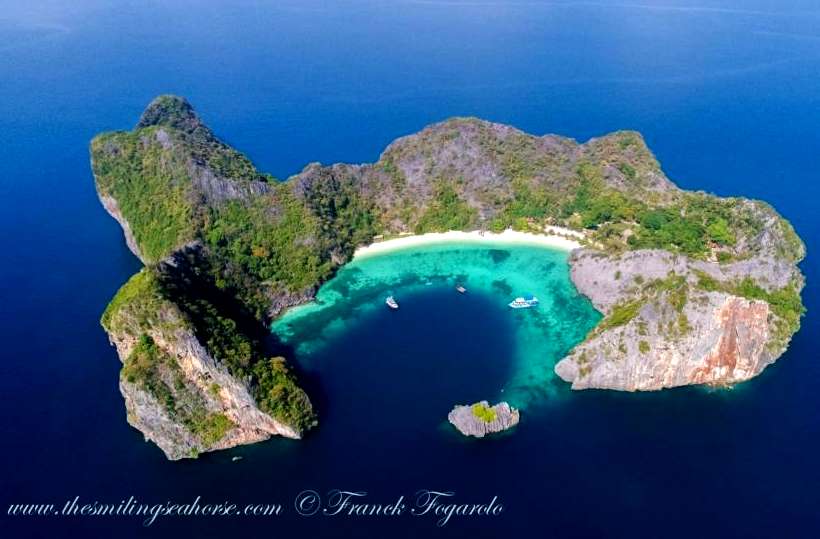
Mergui Archipelago Diving: Dolphins, Shark Cave, North Twin and Spanish Garden
The season is getting better and better, and we come back from our second trip this year feeling very lucky to be here!!!
We had a wonderful crowd onboard for this 6-day / 5-night expedition around the Mergui Archipelago. A group of five snorkellers from Hawaii joined us to enjoy the surface while we explored the underwater world.
Among the divers, we had two French couples, Anh Tu and Majdid, Cecile and Jean Luc, an American diplomat living in Oman, my dear friend Tamra, and a Dutch couple, Germa and Kamiel, who had joined us the previous year on a “Best of Thailand” safari. We were very happy to see them back onboard so soon.
Once everyone had their equipment sorted out in the office, we took a songthaew, a local minivan full of colours, to the boat. Immigration came to clear all the paperwork, and we were soon on our way towards Kawthoung, about 30 minutes away, to get our entry stamp into Burma and pay the associated fees.
It didn’t take long, and our staff gave a little ceremony onboard for their Buddha, hoping to keep bad spirits away and attract many wonderful creatures. The firecracker was particularly appreciated by our two powder addicts, Jean Luc and Cecile, fireworks specialists all around the world.
High Rock and a Morning of Dolphins
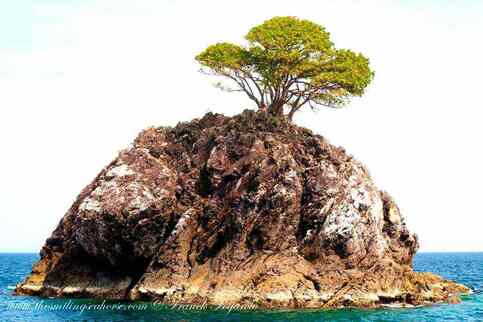
After a delicious dinner and a good night’s rest, we woke up to a stunning sunrise near High Rock. There was a big bunch of dolphins hunting nearby, at least 20 of them, less than 100 metres from the boat.
That’s a good start!
If dolphins are here, it means there must also be lots of fish underneath. Let’s go diving!!!
We geared up and jumped into the 30°C water. I must say I’m the only one able to get cold in this water. Most divers go in their shorties, some even in rash vests only, while I put on my hood. Ridiculous, I know. I just hate getting cold…
On this first dive, I stumbled into a ghost pipefish within the first few minutes. Lucky eye! Everyone stared at it in wonder and regretted the camera they had left onboard for the first dive.
There is a wonderful yellow coral garden here, dominated by green cup corals, and I love looking at the tiny yellow sea snails feeding on them and replacing the toxic flowers with their eggs to keep predators away. Smart.
Dragon Island: Tunnels Through the Reef
For the second dive, we went to Dragon Island, also called Dinosaur Island because of its long reptile-like shape undulating above the water.
The speciality of the site is its three tunnels crossing the island underwater from one side to the other. The caves themselves are quite large, and our groups of four could go side by side if they wanted to.
Lots of crabs and shrimps of all kinds scurry around the walls and dark cracks. Reaching the other side is always a great experience: as the light gets more intense, so does the density of life. Fishes are frantic above the coral garden, and the colours are nearly overwhelming after the darkness of the cave.
Tower Rock: Strong Currents and a Sea Snake
The third dive was at Tower Rock. The current was very strong, and we saw loads of scorpionfish and a sea snake hunting over the reef.
It was another reminder that the Mergui Archipelago can offer very different diving conditions from one site to the next, with currents bringing life and movement to these exposed underwater pinnacles.
Spanish Garden: A Night Dive Full of Life
The night dive was at a new spot we called Spanish Garden because of the number of Spanish dancers we saw there.
One of them gave us the pleasure of dancing right in front of our eyes, deploying its large skirt for us. Wahouh!
There was also a profusion of crabs, particularly spider crabs with their hairy legs, as well as a lovely anemone garden in which we spotted some porcelain crabs.
Night diving in the Mergui Archipelago can reveal an entirely different side of the reef. Creatures that are difficult to find during the day become active, and a site that might seem quiet in daylight can suddenly be crawling with shrimps, crabs and nudibranchs.
A Pinnacle Packed with Fish
The next day we started with a pinnacle. The current was strong again, and one of the two groups missed the pinnacle by a few metres. We saw it, though, and had a great dive.
We quickly understood what the fishermen were after: there were lots of fish around.
Schools of barracudas passed above us by the hundreds, thousands of fusiliers coloured one of the slopes, and a few batfish passed above them.
It was the kind of dive where there seemed to be fish everywhere you looked.
Shark Cave: Our Favourite Dive Site
But we only reached my favourite ever dive site at 11 that morning, for our second dive.
Shark Cave is well named.
Our friends were back for a restful nap: a 3-metre-long nurse shark was in the cave, in the company of two huge blotched stingrays.
Their size is imposing, and being inside a cave with them is for sure something to remember. If I didn’t know they were eating shrimps and shells, I would probably feel a lot less at ease looking at them in the shadows.
They let us pass through their home as if we were long-known friends, and I could only go with my heart pounding with excitement and awe.
We stayed there for two more dives, with one taking us outside the cave, around what we call Eagle Rock because of the huge eagles living on top of it.
There, life was at its most abundant. Fish were everywhere our eyes could look: yellow, blue, grey. Lizardfish and groupers watched us passing above them from the sandy bottom and the hard coral. We found some soldierfish behind the huge sea fans, and we started ignoring the scorpionfish, which were just way too many!
We went back to the cave for our night dive. The shark and rays were still there.
Whaouh, they were big.
One of the two rays was bigger than me and came towards the light a bit too much. I must say, my heart skipped a beat. I was at the same time relieved to get out of the cave and wanting to go back.
North Twin: Clear Water and Barracudas
Our boat travelled to the next spot during the night, and we reached North Twin, the furthest point of our itinerary from Ranong, all the way north and far, far away from the mainland.
The visibility was fantastic: 30, maybe 40 metres.
Barracudas were hunting above us, and we saw them several times during the dive. The dive site is a pinnacle rising to around 12 metres and surrounded by deeper water. The sandy bottom is at 35 metres, with big boulders around it.
It is the perfect spot for fish to hide when we pass by with our bubbles, but we could still find them.
South Twin: A Beautiful Island and Coral-Covered Rocks
We stopped in front of a beautiful beach at South Twin. Some went to explore the thin sandy beach, while others snorkelled around.
The diving was also excellent, with big rocks on a slope covered by hard and soft corals. After several dives surrounded by strong currents and towering pinnacles, it was a beautiful place to slow down and enjoy the underwater scenery.
Sea Fan Forest and Western Rocky
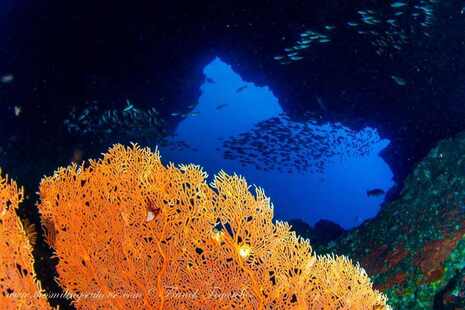
On the next day we dived Sea Fan Forest, slaloming between huge sea fans. Its pinnacle is usually a perfect spot to sight mantas, but it left us a little disappointed this time as we didn’t see any.
We continued on to Western Rocky, where the coral was stunning. There were so many different types: purple soft corals, like in a flower shop; fire coral; violet and orange hydrocoral; mushroom leather corals; and whip corals, white and black, usually hosting some small shrimps or hawkfish.
During the night dive, a cuttlefish appeared. It was definitely curious about the light and allowed us to come very close.
Volcano: Inside the Sleeping Volcano
The last day started with Volcano, an island with 10-metre-high walls all around. We can enter it through a hole at the base, opened during low tide and invisible at high tide.
Inside, some reef sharks circle, black and white tips. The snorkellers had a good look at them and even got some nice videos. The divers were less lucky this time: sharks just hate the bubbles and get away as fast as they can.
I only spotted one, about 1.20 metres long, on its way out of the volcano when we arrived.
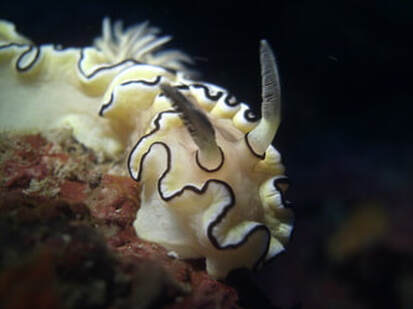
Then it was time for the small stuff: nudibranchs of weird shapes and colours, and two seahorses posing for us.
The Mergui Archipelago is particularly rewarding for divers who enjoy searching for small marine life. After looking at sharks circling inside the volcano, you can spend the same dive slowing right down to search the reef for tiny nudibranchs and seahorses.
Slope Rock: Fish Everywhere
The last dive of the trip was at Slope Rock, a wall at 15 metres below the surface.
Visibility was not at its greatest, but we could see that the fish loved the place. It was full of life. Juveniles and adults were there, going all over the place.
A small ball bounced on top of a coral table. I looked closer and recognised a small boxfish. I had never seen one that small, so round and cute.
We ended our dive surrounded by very dense schools of glassfish, and a jellyfish came by to show us its passengers: juvenile filefish on their way to another reef.
Back to Kawthoung
That’s it for this trip.
We took the way back to Kawthoung, where we stayed for an hour and enjoyed a fresh beer. We had to say goodbye to our new and old friends.
Two days in Ranong and we were off again for more adventures…
Stay tuned for more fishy-stories!




