
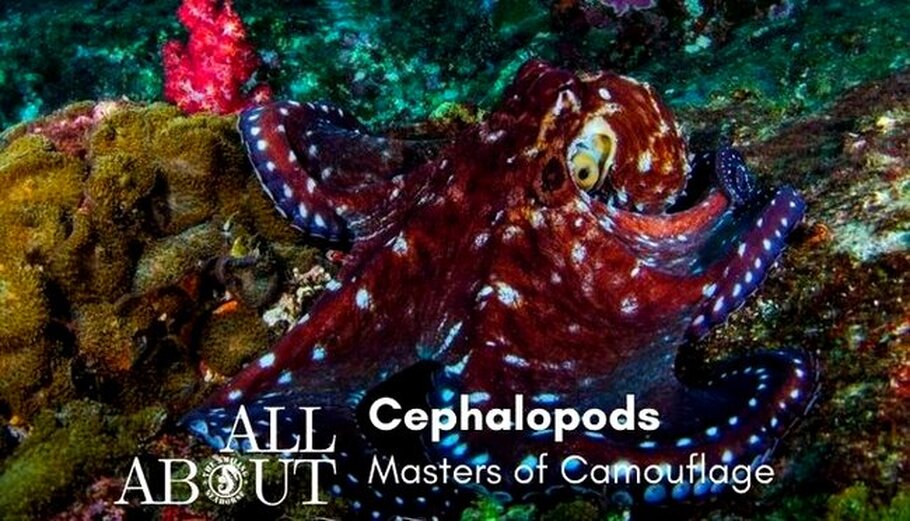
Incredible Cephalopods of the Andaman Sea: Octopus, Cuttlefish and Squid
The Andaman Sea is home to an incredible variety of cephalopods, including octopus, squid and cuttlefish, making them some of the most fascinating animals you can encounter while diving in Thailand and Myanmar.
Divers are often amazed by a cephalopod’s apparent superpower: invisibility. You can be looking directly at a reef and be absolutely certain that nothing is there, only to suddenly realise that an octopus, cuttlefish or tiny squid has been hiding in plain sight all along!
Some cephalopods can change their colour, patterns and even the texture of their skin in an instant. Others rely on their tiny size, transparency or behaviour to disappear into their surroundings.
Here is a little list of the cephalopods we most often encounter in the Andaman Sea during our dive cruises.
The Reef Octopus
Both in Thailand and Myanmar, you can encounter the big reef octopus, Octopus cyanea, a diurnal species with an amazing ability to camouflage itself.
Watching a reef octopus change appearance is one of those underwater encounters that can leave even experienced divers staring in disbelief.


The two pictures above were taken only a few seconds apart. The octopus can change not only its colour but also its skin texture in the blink of an eye, allowing it to match the reef it is sitting on.
This extraordinary ability is one reason octopus encounters can be so rewarding for divers and underwater photographers. One moment you see an obvious octopus; the next, it can seem to have completely disappeared.


While their best way to defend themselves is to blend in, octopuses can also spray a cloud of ink to surprise a predator. The dark ink creates a diversion, giving the octopus precious time to escape.
Large reef octopuses usually prefer a rather solitary life, but they can also be spotted in pairs during the mating season. So if you spot one on a reef, take a closer look: there may be considerably more going on than first meets the eye!
The Cuttlefishes
Cuttlefish are another spectacular cephalopod commonly encountered while diving in the Andaman Sea. In Myanmar, Sepia pharaonis can be seen on shallow dive sites, and during the mating season from November to January, it is not unusual to witness some kinky business while diving 😉


Often seen in pairs, it is not rare to see three or even four cuttlefish together during courtship. Usually, you see one female being courted by several males.
And cuttlefish courtship is particularly fascinating because these animals are masters of visual communication. Their bodies can display rapidly changing colours and patterns, creating a spectacular underwater show even when the animals are simply sitting on the reef.
FUN FACT: Some smaller males, seeing their chance in a battle against a larger male, play a funny game! They act like a female to get closer to the “real female” and manage to discreetly inseminate her before the alpha male notices!
Pygmy Squids


The pygmy squid, Idiosepius paradoxus, is hard to see because of its microscopic size. At around 5 mm, these tiny cephalopods are easy to overlook, even when they are right in front of you.
They live around coral reefs and can be seen at night, hanging onto corals or floating away with the current. Finding one is a real treat for divers who enjoy searching for the smaller creatures of the Andaman Sea.
They are among the smallest cephalopods and also one of the cutest, don’t you think?
Squids of the Andaman Sea


This pelagic kind of squid is usually seen in schools in mid-water. Unlike reef-dwelling octopuses and cuttlefish, these squid spend much of their time swimming through the open water.
They usually team up in order to hunt cooperatively, using active communication. Seeing a group of squid moving together is very different from the solitary camouflage behaviour of a reef octopus, and it is another reminder of just how varied the cephalopods of the Andaman Sea can be.
Why Cephalopods Are So Fascinating to Divers
Octopus, cuttlefish and squid may all belong to the cephalopod family, but their lifestyles and behaviour can be remarkably different. From an octopus disappearing against a reef, to cuttlefish communicating through constantly changing patterns, to tiny pygmy squid barely a few millimetres long, there is always something new to discover.
For divers exploring Thailand’s Andaman Sea and the remote waters of the Mergui Archipelago in Myanmar, cephalopods are among the marine animals worth slowing down for. Sometimes the best encounter is not the biggest animal on the reef, but the one you almost failed to see.
Discover More Marine Life in the Andaman Sea
Want to know more about what you can encounter during our dive cruises?




