
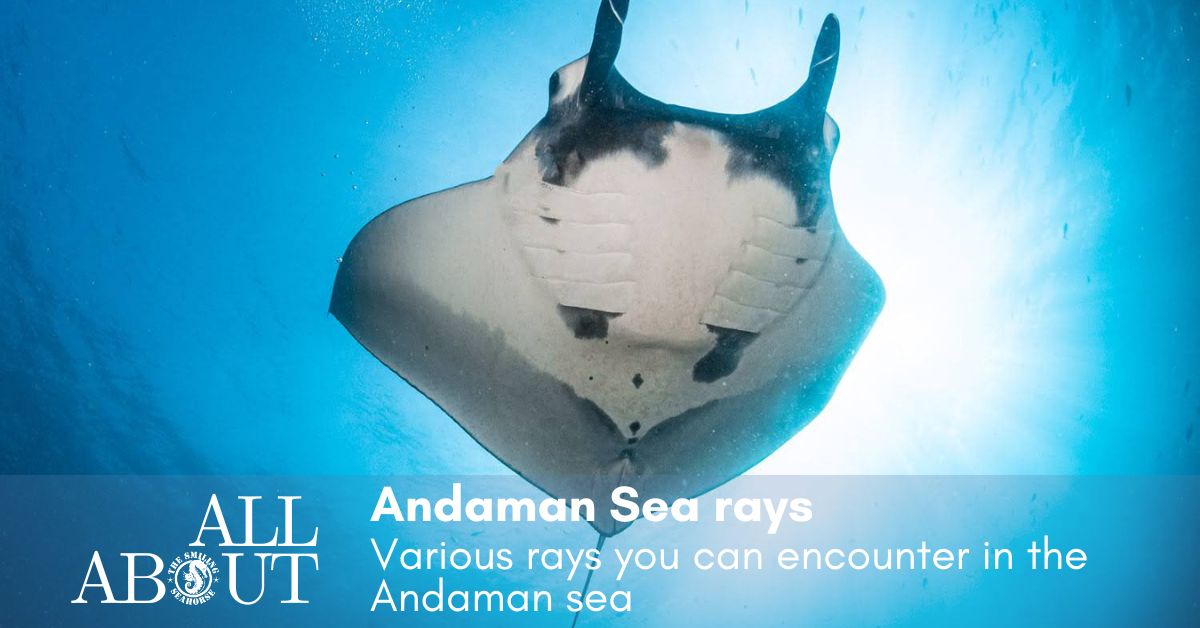
Guide to the Rays of the Andaman Sea: From Seafloor Dwellers to Pelagic Giants
Rays spend their time in different ways across our waters—some spend most of their time lying on the sea floor, such as stingrays, while pelagic rays swim mid-water from the depths all the way to the surface, travelling long distances like eagle rays and manta rays!
Just like sharks, rays have no bones, instead possessing a skeleton made up entirely of cartilage. Large pectoral fins linked to their body and head give rays a range of shapes—from round to triangular and sometimes even diamond shapes—that help us identify each species. They use these fins like a bird flapping its wings, flying through the water with calm, hypnotising movements.
Although they all have flattened, plate-like bodies, they each have unique traits that characterise them. Sometimes nicknamed “sea flap-flaps”, rays are never aggressive to divers. They are shy creatures, usually avoiding confrontation and preferring a “running away” strategy.
FAQ – Rays of the Andaman Sea
- What kinds of stingrays live on the Andaman Sea seafloor?
- What pelagic rays can divers encounter in Thailand and Myanmar?
- Where is the best place to see giant oceanic manta rays in the Mergui Archipelago?
- Are guitarfish rays or sharks?
Andaman Sea Rays Found on the Seafloor
Stingrays
Often hiding under the sand, blue-spotted stingrays are usually spotted darting away from divers who get a little too close to their resting spots…


Every diver has a favourite when it comes to marine life, whether you want to be dwarfed by massive whales, or dazzled by the camouflage and colours of cephalopods.
Each individual has creatures that float their boat more than others, but one of the more common fascinations amongst divers is with rays. In the earth’s waters, approximately 630 species of rays and skates exist in all shapes and sizes.
The Mergui Archipelago is a paradise rich in biodiversity that proudly puts a variety of spectacular marine species on parade, and blotched stingrays are some of the most popular in the Andaman Sea.


The Jenkins whipray (Himantura jenkinsii) is another species frequently found lying on sandy seafloors. They can be found alone or in small groups at similar depth ranges to marbled rays, growing up to 150cm wide.


Pelagic Rays in the Andaman Sea
Eagle Ray

While primarily a pelagic ray, surprisingly, in Myanmar, we have a resident eagle ray living in one of our secret caves! She passes by quite close when divers enter her home, and we find her in the same cave week after week. This makes for some fantastic photo opportunities, allowing us to capture close-up portraits of this lovely eagle ray.


Oceanic Manta Rays


Moving in groups ranging from small numbers up to 50 individuals, they can be quite playful with one another. Breaching the surface to dislodge parasites is also a common sight.


Guitar Rays
The Andaman Sea also hosts several species of guitarfish. For a closer look at these unique animals, read our dedicated guide on guitarfish, guitar rays, and guitar sharks present throughout the Mergui Archipelago.


Explore More of the Andaman Sea
- Andaman Sea marine fauna – discover the incredible species, sharks, and rays inhabiting these waters.
- Mergui Archipelago – explore the remote islands and pristine dive sites of Myanmar.
- Giant oceanic manta rays – learn more about these gentle giants.
- Cruises, schedules & itineraries – plan your next liveaboard dive expedition with us.




