
Tiger-Tail Seahorse Guide: Habitat, Behaviour, and Identification
Along with other types of seahorses, pipefish, and seadragons, the tiger-tail seahorse belongs to the Syngnathidae family. They can grow up to 18.7 cm and have a lifespan of 1 to 5 years.
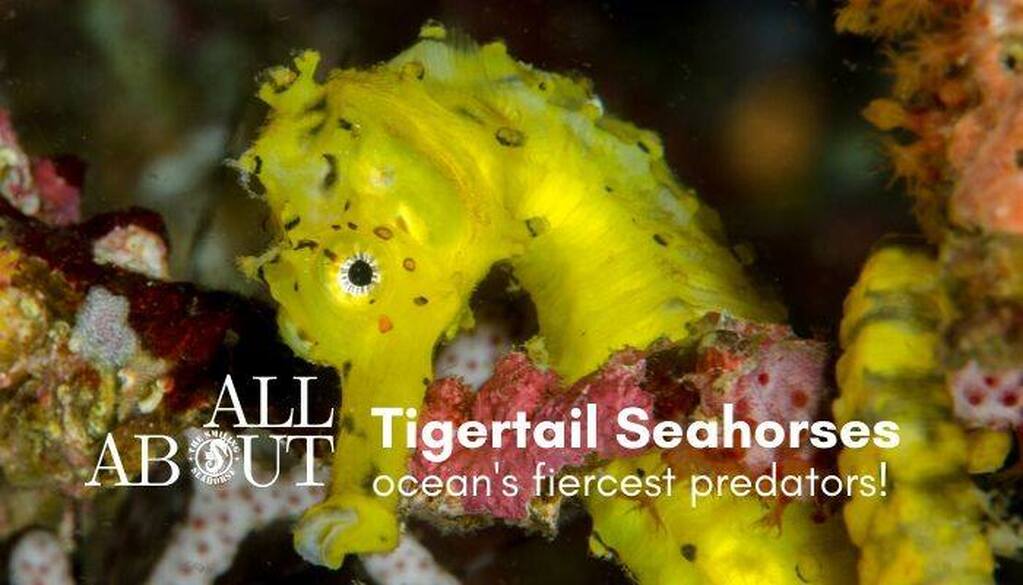
They can sport different patterns, but the most commonly seen is alternating yellow and black.
FAQ – Tiger-Tail Seahorse
- Where do tiger-tail seahorses live? (Habitat)
- What do tiger-tail seahorses eat and how do they behave?
- How do tiger-tail seahorses reproduce?
- What are the main threats to tiger-tail seahorses?
- How can you identify a tiger-tail seahorse?

Habitat of the Tiger-Tail Seahorse
You can find tiger-tail seahorses in the waters of the Western Central Pacific: Western Thailand, Myanmar, Malaysia, Singapore, Vietnam, the Philippines, and Indonesia.
Adults prefer to live in pairs on coral reefs, sponges, and kelp between 10 and 30 metres deep, but juveniles will often cling to a type of seaweed called Sargassum.

Behaviour
Seahorses in general are more active at night.
- Tiger-tail seahorses swim vertically with only the dorsal fin for propulsion, so they aren’t holding any records for speed. Their pectoral fins below the gill are used for stability and steering.
- Seahorses are very shy animals, usually found hiding in bushy coral reefs. They tend to stay in the same area for feeding, reproducing, and nesting, which means that once we find their home, we can see them cruise after cruise at the same spot.
- Juveniles feed on zooplankton (small water invertebrates), while adults feed on small benthic animals like crabs, shrimps, and clams. Benthic animals, as opposed to pelagics, live close to or on the bottom of the oceans.
- They have no stomach or teeth and feed entirely through suction.
- Despite this, their sneaky hunting techniques give them a 90% kill rate.
- They are the only fish with a neck and a prehensile tail they can use to grab onto anything.
- They are masters of disguise and can change the shape and colour of their skin to blend into their environment.

Reproduction
Tiger-tail seahorses are monogamous! The male accepts eggs only from one female, and both male and female are faithful partners. Their courtship dance can last for a week before mating.
The female deposits up to 2,000 eggs into the male’s brood pouch to be fertilised. The male protects and nourishes the young in his pouch for 1 to 4 weeks. When the babies are born, they are left to fend for themselves.

Threats
- The tiger-tail seahorse is in high demand as medicine and street food in China, as well as for the aquarium trade. Although CITES has controlled their import and export since 2014, 20 million seahorses a year are fished and sold to the Chinese market.
- Thailand is the world’s largest exporter of seahorses, which is very sad to hear. There is a silver lining, however, as this is a good indication of the large number of seahorses in the area.
- Habitat damage: The coral reefs have been experiencing bleaching phases due to climate change and are frequently destroyed by dynamite fishing.
How to Identify the Tiger-Tail Seahorse from Other Seahorses
Project Seahorse, a marine conservation group dedicated to seahorse and ecosystem protection, published a lovely chart to identify the various species we can find in Asia. Thailand is home to seven of the 14 seahorse species found in Southeast Asia.

The tiger-tail seahorse has a spiny body (with blunt spines), a high nose spine, and double cheek spines. Its striped tail is also a great way to differentiate it from other seahorses.

The biodiversity of the Mergui Archipelago in Myanmar is no longer a secret. For diving and photography lovers looking for rare species and unique experiences, the region is sure to deliver an unforgettable adventure. Sightings of tiger-tail seahorses are a sure thing here if you go with the right guides!
As you probably guessed from this article, we are big fans of seahorses… We have been in contact recently with Project Seahorse and iSeahorse and will start uploading our regular sightings to their worldwide database. Would you like to participate in this citizen science project?
Explore More of the Andaman Sea
- Tiger-tail seahorse facts – learn more about our signature mascot.
- Mergui Archipelago – discover the remote islands and pristine dive sites of Myanmar.
- Andaman Sea marine fauna – explore the rich biodiversity inhabiting Burmese waters.
- Cruises, schedules & itineraries – plan your next liveaboard expedition with us.




