
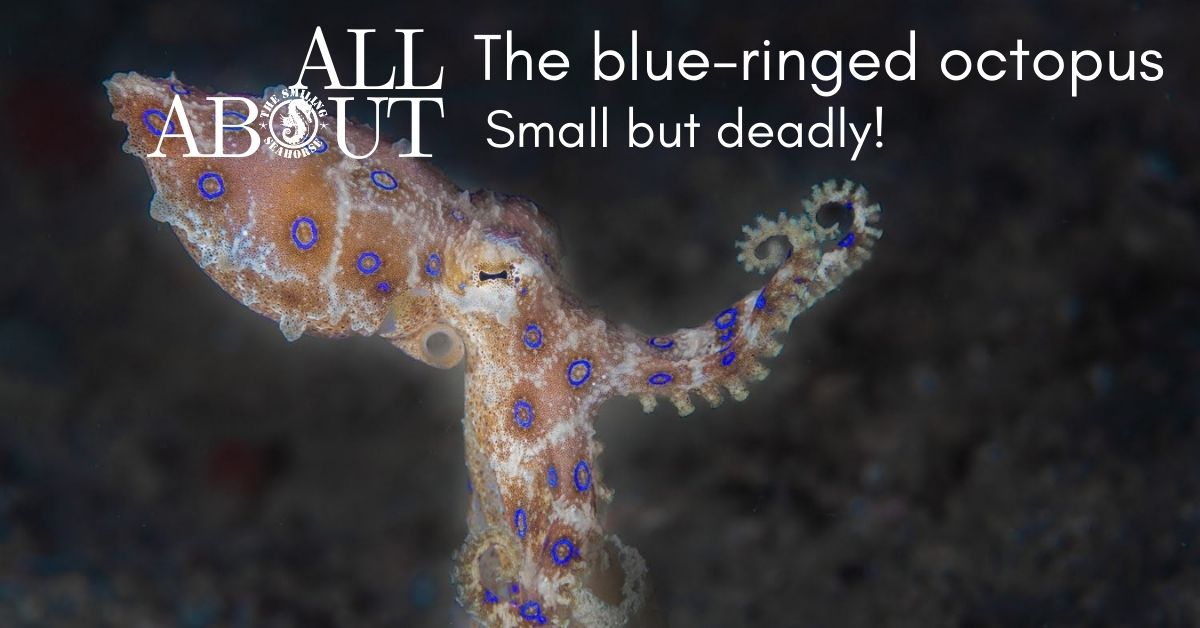
Blue-Ringed Octopus: Facts About One of the Ocean’s Smallest and Deadliest Animals
The blue-ringed octopus is a perfect example of why size means very little in the underwater world. Tiny, shy and beautifully patterned, these remarkable cephalopods are among the most venomous marine animals on Earth.
How small is the blue-ringed octopus?
Does size really matter?
Blue-ringed octopuses are surprisingly small. Depending on the species, they can grow to roughly the size of a chicken egg, with some individuals measuring only around 10 cm and weighing just a few dozen grams.
Yet despite their tiny size, they possess a powerful venom containing tetrodotoxin, a neurotoxin capable of causing severe paralysis in humans. This is one of those underwater encounters where the best approach is definitely to admire the animal without touching it.

Where can you find blue-ringed octopus?
Blue-ringed octopuses are found throughout parts of the Indo-Pacific, including Australia, Indonesia, the Philippines, Papua New Guinea, the Solomon Islands and Vanuatu. Some species are also regularly encountered on muck-diving sites in Thailand.
They are generally associated with shallow coastal environments, sandy bottoms, rubble and muddy or silty habitats. These little octopuses are bottom dwellers rather than open-water animals, and their ability to hide among rocks, shells and debris makes them easy to overlook.
For divers, muck dives can be particularly rewarding when looking for unusual creatures such as blue-ringed octopuses. Their small size and cryptic behaviour mean that a slow and observant dive can reveal animals that would otherwise remain completely hidden.

Is the blue-ringed octopus dangerous?
This shy little octopus is among the most venomous animals in the ocean.
That being said, blue-ringed octopuses are not aggressive animals. They generally try to avoid humans and will only display their spectacular blue rings when they feel threatened or disturbed.
Their venom contains tetrodotoxin, a potent neurotoxin that interferes with the nervous system and can cause progressive muscular paralysis, including paralysis of the muscles needed for breathing and swallowing.
Most encounters between divers and blue-ringed octopuses are completely uneventful because the animals simply want to be left alone. Bites are rare, and the vast majority of sightings involve an animal quietly going about its business on the seafloor.
There is currently no specific antidote for tetrodotoxin poisoning. Treatment is supportive, and serious envenomation can require assisted breathing until the effects of the toxin wear off.
And if you think a wetsuit will protect you, remember that an octopus has a hard, sharp beak capable of penetrating skin and potentially wetsuit material. So please admire these fascinating little animals without touching or handling them.
What does a blue-ringed octopus eat?
 Close-up of a blue-ringed octopus eye. Close-up of a blue-ringed octopus eye. |
Like most cephalopods, blue-ringed octopuses are carnivores. They feed on small marine animals such as crabs, shrimps and other crustaceans, as well as small molluscs and other suitable prey. The octopus uses its arms to capture its prey and its powerful venom to immobilise it before feeding. Despite their tiny size, blue-ringed octopuses are efficient predators perfectly adapted to hunting on the seafloor. |
What predators can eat a blue-ringed octopus?
Blue-ringed octopuses are dangerous prey for many animals because of their venom. However, some marine predators can still feed on cephalopods. Moray eels, for example, are known to prey on octopuses, while larger marine predators such as seals and other marine mammals may also consume cephalopods.
 Photo by Camille – TG6
How do blue-ringed octopus reproduce?
Blue-ringed octopuses have a fascinating reproductive cycle. Like other octopuses, they are semelparous, meaning that they reproduce only once during their lifetime.
After mating, the female lays a clutch of eggs and dedicates herself to protecting them. During this period she stops feeding and remains with the eggs until they hatch. By the end of the process, the female dies, completing her short but remarkable life cycle.
Females can lay dozens of eggs, and the hatchlings emerge as tiny miniature octopuses. From the moment they hatch, they are independent and must fend for themselves.
The mating behaviour of blue-ringed octopuses is also unusual. The male uses a specialised arm called a hectocotylus to transfer spermatophores to the female. In some cases, males may attempt to mate with other males because determining the sex of a potential partner is not always straightforward before mating begins.
 Blue-ringed octopuses have a very short life cycle. Blue-ringed octopuses have a very short life cycle. |
 A female blue-ringed octopus guarding her eggs. A female blue-ringed octopus guarding her eggs. |
How long do blue-ringed octopus live?
Blue-ringed octopuses have a remarkably short lifespan. From a tiny hatchling only a few millimetres across, they grow to approximately the size of a fingernail or chicken egg and generally live for around two years.
During that short life, they must grow, mature, find a mate and reproduce before the cycle comes to an end.
Like other octopuses, they are considered highly intelligent animals, capable of learning and solving problems. Their short lifespan makes their intelligence even more fascinating: unlike humans and many other long-lived animals, they have very little time in which to learn from experience.
 Blue-ringed octopus close-up by Franck Fogarolo.
How many species of blue-ringed octopus are there?
Divers often simply call these fascinating animals BROs, or blue-ringed octopuses, but the name actually covers several closely related species.
Four species traditionally associated with the blue-ringed octopus group include:
- Hapalochlaena lunulata – greater blue-ringed octopus, recognised for its relatively large blue rings.
- Hapalochlaena maculosa – lesser or southern blue-ringed octopus.
- Hapalochlaena fasciata – blue-lined or blue-ringed octopus.
- Hapalochlaena nierstraszi – a much less frequently encountered species.
Species identification can be difficult from photographs alone, and scientists continue to study the diversity and distribution of these tiny but remarkable cephalopods.
Discover More About Cephalopods
 |
Incredible Cephalopods of the Andaman Sea
The Andaman Sea is home to many fascinating cephalopods, including octopuses, squid and cuttlefish. Their extraordinary camouflage and behaviour make them some of the most fascinating animals to encounter underwater. |




