
Sea Snakes of the Andaman Sea: Facts, Behaviour and Fascinating Adaptations
The vast oceans are home to a multitude of captivating and unique creatures, and among them are the enigmatic sea snakes. These serpentine reptiles have adapted to life in marine environments and are renowned for their remarkable features. In this blog post, we will delve into the intriguing world of sea snakes and explore their fascinating characteristics.
Sea snakes belong to two subfamilies, Hydrophiinae (true sea snakes) and Laticaudinae (sea kraits, which are semi-aquatic).
In Thailand and Myanmar, we have the chance to encounter representatives of both of these groups:

The yellow-bellied sea snake (Hydrophis platurus) is a true marine snake from the Hydrophiinae family that leads a pelagic life and never goes on land. We have only encountered this snake during our blackwater dives, offshore and never on the reef.

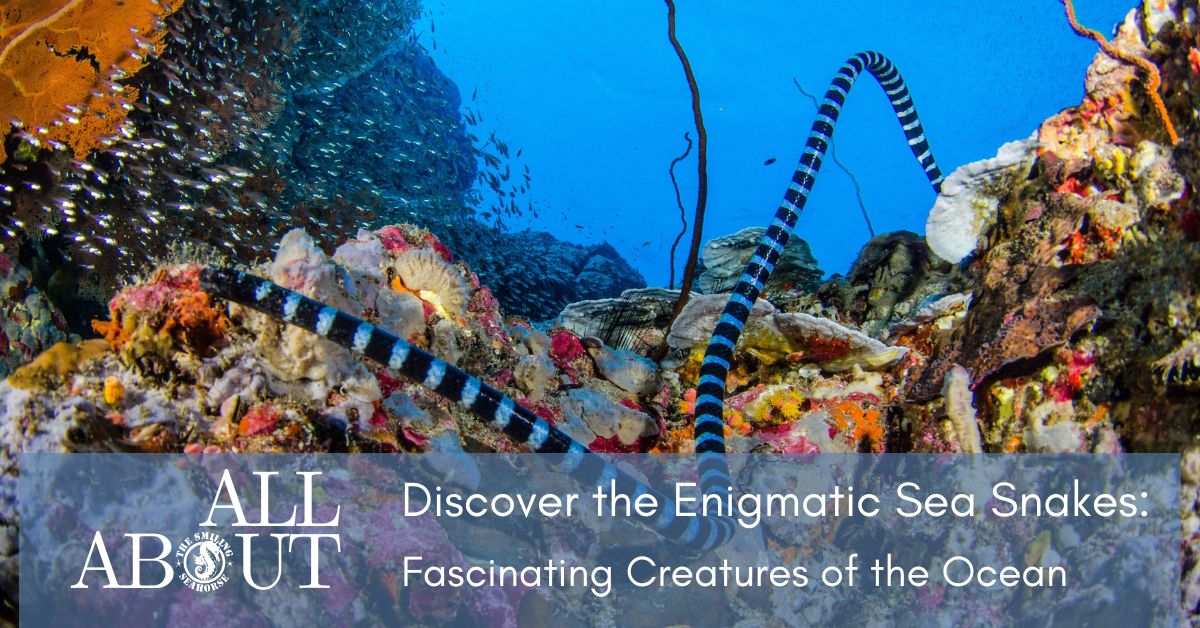
The banded sea krait (Laticauda colubrina), on the other hand, belongs to the Laticaudinae family. They are semi-aquatic, with features adapted to a life between land and the ocean. These are the sea snakes we most often see while diving on the reef.
Frequently Asked Questions About Sea Snakes
Diversity and Distribution

True sea snakes comprise as many as 53 species, whilst the partially terrestrial Laticauda, or sea kraits, comprise five species.
Both can be found in the warm waters of the Indian and Pacific Oceans, particularly in regions such as the Coral Triangle, the Andaman Sea and the Great Barrier Reef.
Curiously, they are not found in the Red Sea, Atlantic Ocean or Caribbean Sea. Their distribution ranges from coastal shallows to deeper offshore waters, and they exhibit various ecological adaptations to their preferred habitats.
Both true sea snakes and sea kraits inhabit the sea, but sea kraits can also be observed on land, while true sea snakes are fully adapted to a pelagic life.
Both sea snakes and sea kraits feature a flattened tail that helps them swim. Sea kraits have cylindrical bodies, enabling them to crawl on land, while true sea snakes have more ribbon-like bodies, making them even stronger swimmers.
On average, adult sea snakes, including sea kraits, measure between 1 and 1.5 metres in length.
Can Sea Snakes Breathe Underwater?
We recently came across another really cool “true sea snake” on a blackwater dive in Myanmar, a slender-necked sea snake (possibly Hydrophis nigrocinctus). Like other true sea snakes, it is a highly adapted aquatic species, spending most of its life in the ocean.
This species, found in tropical waters of the Indian Ocean near Southeast Asia and northern Australia, remains mysterious due to its elusive nature and vast habitat. Despite being known to science, much about its distribution and behaviour remains unknown, making it a compelling subject for further research. Studying it could reveal valuable insights into its biology, behaviour and interactions with other marine species.


Snakes, much like turtles, are reptiles, not fish. They must periodically swim to the water’s surface to replenish their oxygen supply before descending back into the depths.
While many sea snakes, including sea kraits, need to resurface every half an hour to breathe, certain species of sea snakes, including the yellow-bellied sea snake, possess an extraordinary ability to remain submerged for up to eight hours.
This superpower is made possible by their unique capability to absorb approximately 33% of their required oxygen and eliminate around 90% of carbon dioxide through their skin. The nostrils of a true sea snake, positioned on top of their snout, have the ability to close when the animal is underwater.
Can Sea Snakes Die of Thirst?
Yes! While surrounded by seawater, sea snakes can die of thirst.
While they live in the oceans, sea snakes cannot extract fresh water from saline seawater. Kraits may drink water from land or the sea surface, but true sea snakes, while they have the ability to expel part of the salt they ingest, must wait for rain to drink the relatively fresh water floating on the sea’s surface.
Are Sea Snakes Venomous or Poisonous?

Sea snakes are extremely venomous creatures, however, they are not considered aggressive towards humans and will only bite if they feel threatened or provoked.
It’s important to maintain a respectful distance and avoid handling or disturbing these fascinating creatures if encountered in their natural habitat. The same applies to all underwater creatures: Do not touch!
The same caution should be exercised with snakes found washed up on beaches. Snakes may feign death as a defence mechanism, and even a deceased or decapitated snake can still reflexively bite.
Survival tip: In the event of being stranded at sea, sea snakes can be consumed for sustenance. They are not poisonous in the sense that their flesh is inherently toxic to eat, but to survive, you would certainly be better off avoiding a bite!
Diet and Predation for Sea Snakes

True sea snakes are skilled predators that primarily consume small fish, fish eggs and young octopuses. These sea snakes can be active either during the day or at night, displaying versatility in their feeding habits.
On the other hand, sea kraits are nocturnal feeders that primarily target eels as their preferred prey. They supplement their diet with crabs, squid and fish that they find while exploring the reef and crevices.
While there have been no observations of sea kraits feeding on land, we know that they do return to land to facilitate the digestion of their prey.
In their natural habitat, sea snakes face predation from eels, sharks, rays and other large fish.
Reproduction and Life Cycle of Sea Snakes and Sea Kraits
Reptiles, including sea snakes, reproduce using different strategies, including viviparity and oviparity.
Oviparity is the reproductive method observed in species such as sea kraits. Oviparous reptiles lay eggs externally, usually in a safe location where the eggs can develop. The mother does not provide direct nourishment to the developing embryos; instead, the eggs contain a yolk sac that provides the necessary nutrients for their growth.
The banded sea krait, much like turtles, usually returns to the same beach where it was born to lay its own clutches of up to 10 eggs. These eggs are then left to develop independently and rely on environmental conditions such as temperature and humidity for proper incubation. Once the embryos have fully developed, they hatch and the young reptiles emerge.
Viviparity is a reproductive strategy seen in other reptiles, including yellow-bellied sea snakes. In viviparous species, the embryo develops inside the mother’s body and receives nourishment during development. The mother provides a protected environment for the embryos until they are ready to be born as fully developed offspring.
This adaptation allows newborn yellow-bellied sea snakes to feed from their very first day and gives them a better chance of survival in the open ocean.


In summary, while reptiles, including sea snakes, use different reproductive strategies, viviparous species such as yellow-bellied sea snakes give birth to live young after internal development, while oviparous species such as sea kraits lay eggs externally and the embryos develop inside the eggs using nutrients from the yolk sac until they hatch independently.
Conservation and Threats
Like many marine species, sea snakes and kraits face various threats due to human activities and habitat degradation. Pollution, overfishing and habitat destruction pose significant challenges to their survival. Some species are also at risk from accidental bycatch in fishing nets.
It is crucial to raise awareness and take steps to protect these remarkable creatures and the delicate marine ecosystems on which they depend.
Sea Snakes Superpowers
Sea snakes possess some truly fascinating superpowers! Just like their land-dwelling relatives, they use their tongues to gather vital information about their surroundings. But here’s the cool part: sea snake tongues are actually shorter than those of regular snakes. Why, you ask?


Well, it turns out that it’s much easier for them to “taste” molecules in the water than in the air. Talk about a handy adaptation!
But wait, there’s more! Sea snakes have a nifty trick up their scaly sleeves when it comes to dealing with salt. Since they ingest salt along with their prey, these clever creatures have special sublingual glands located beneath their tongues. These glands help the sea snake remove excess salt from its body and expel it.
It’s like having a built-in salt filter – pretty impressive, right?
Now, when it comes to sea snake vision, scientists are still unraveling the mysteries. While it seems that their vision plays a limited role in hunting and finding mates, sea snakes have other extraordinary sensory abilities. They possess special mechanoreceptors that help them sense vibrations and movement, giving them a heightened awareness of their aquatic surroundings. Some sea snakes also respond to pheromones to identify potential mates.
But hold on tight, because the superpowers of sea snakes don’t stop there. These incredible creatures may have the ability to detect electromagnetic fields and pressure, although the exact cells responsible for these senses are still a mystery to scientists.
Imagine having a sixth sense that lets you perceive things beyond what meets the eye! Sea snakes truly embody the wonders of the underwater world, showcasing a range of remarkable abilities that make them stand out in the snake kingdom.

Look at This Incredible Video!
Brace yourselves for an extraordinary journey into the depths of the ocean aboard The MV Smiling Seahorse. Get ready to embark on an awe-inspiring underwater adventure where you’ll have the chance to encounter an array of remarkable marine life, including these superstars of the sea: sea snakes!




