
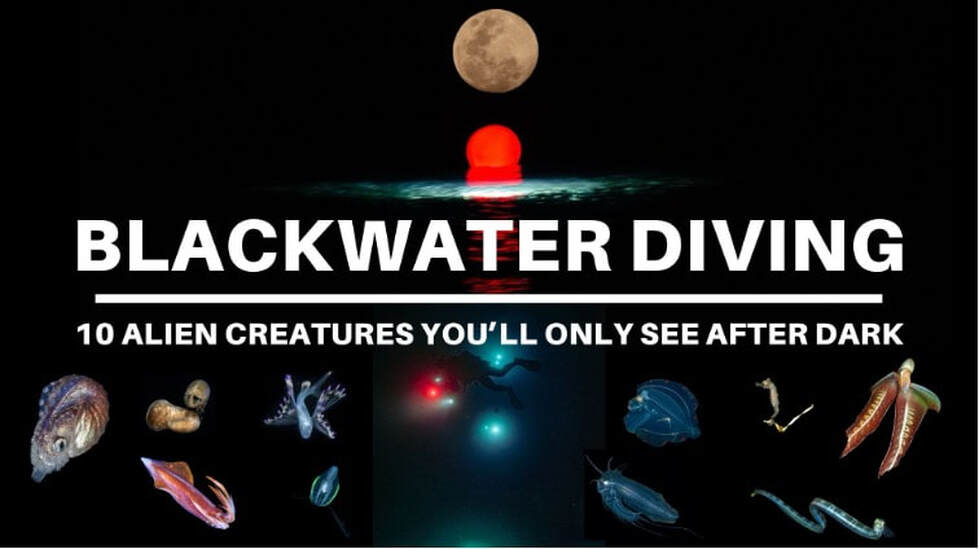
10 Extraordinary Creatures You May Encounter While Blackwater Diving
After sunset, the Andaman Sea between Thailand and Myanmar transforms into a mysterious, living galaxy. Beneath the surface, beyond coral reefs and moonlit shallows, unfolds one of the planet’s greatest nightly migrations — as billions of deep-sea creatures rise from the abyss towards shallower water in search of food.
Blackwater diving offers a front-row seat to this breathtaking phenomenon. Suspended in the inky darkness by a tether line and surrounded by carefully placed lights, divers float above hundreds of metres of open ocean — face-to-face with glowing jellyfish, larval fish, paper-thin cephalopods and other strange, rarely seen life forms.
What Makes Blackwater Diving So Special?
Because it is offshore, blackwater diving isn’t your regular night dive. It is a window into the mesopelagic zone — the twilight zone of the ocean where very little sunlight penetrates and bioluminescence becomes an important part of life in the water column.
Every night, marine larvae and deep-sea organisms make brief appearances near the surface. The result is an unpredictable dive filled with fleeting encounters that might never happen again.
Whether you’re in the Andaman Sea or blackwater diving elsewhere, here are 10 of the most extraordinary pelagic creatures divers may encounter on blackwater dives.
1. Blanket Octopus (Tremoctopus spp.)


The Blanket Octopus (Tremoctopus spp.) is a striking pelagic cephalopod known for the large, web-like membranes that trail from the arms of females, giving the animal its extraordinary blanket-like appearance.
Females are dramatically larger than males, making the blanket octopus one of the most striking examples of sexual size dimorphism in the animal kingdom. These open-ocean octopuses are rarely encountered and are capable swimmers, drifting through the water column rather than living on the reef.
When threatened, a blanket octopus can spread its webbing to appear much larger. Some species are also known for their remarkable relationship with the Portuguese man o’ war, using detached stinging tentacles as a defence against predators and potentially as a hunting tool.
2. Ctenophores (Comb Jellies)


Comb jellies are among the most delicate and mesmerising animals encountered during blackwater dives. These gelatinous predators use eight rows of cilia-bearing plates, known as comb rows, to propel themselves through the water.
When illuminated by a diver’s light, the moving cilia can create spectacular shimmering or rainbow-like effects. Their bodies are composed mostly of water, giving them an almost invisible appearance until the light catches them.
Ctenophores are carnivorous predators. Some species use sticky cells called colloblasts to capture prey, while others, such as species of Beroe, are specialised predators of other gelatinous animals, including other ctenophores.
3. Eel Larvae


Eel larvae, known as leptocephali, are the transparent, ribbon-like early life stage of many marine eel species.
Unlike typical fish larvae, leptocephali are laterally compressed and leaf-shaped, with remarkably transparent bodies that provide excellent camouflage in the open ocean. They drift with currents for extended periods while feeding on tiny particles and organisms suspended in the water.
During this extraordinary pelagic phase, the larvae grow before undergoing metamorphosis into the more cylindrical “glass eel” stage. From there, they begin their migration towards coastal habitats. Seeing one during a blackwater dive gives you a glimpse of a normally hidden stage in the complex life cycle of an eel.
4. Paper Nautilus (Argonauta argo)


The Paper Nautilus (Argonauta argo) is a rare pelagic octopus known for the delicate, paper-thin egg case produced by females. Despite its common name, it is not a true nautilus at all — it is an octopus.
The female creates the beautiful shell-like structure to protect her eggs. It can also help with buoyancy, making it perfectly suited to an animal that spends its life in the open ocean.
Females are considerably larger than the tiny males, and argonauts feed on small prey including crustaceans. They are graceful swimmers and are often seen drifting through warm and temperate ocean waters.
The combination of an octopus and a fragile-looking “shell” makes the paper nautilus one of the most extraordinary animals a blackwater diver can encounter. You can discover more about these fascinating cephalopods in our article about incredible cephalopods.
5. Tripod Fish Larvae


Tripod fish larvae are the juvenile form of deep-sea tripod fish, typically belonging to the genus Bathypterois. Unlike the adults, which live on or close to the seafloor and use elongated fin rays to support themselves, the larvae are pelagic and drift in the open ocean.
They have delicate, almost transparent bodies adapted to life in the water column. As they develop, the characteristic elongated fins of the adults begin to form, eventually allowing these extraordinary fish to adopt their distinctive tripod-like stance.
The transformation from a free-floating larva to a deep-sea bottom-dweller is one of the many remarkable developmental journeys revealed by blackwater diving.
6. Snake Blenny Larvae


Snake blenny larvae are the early life stage of elongated, eel-like fishes in the family Stichaeidae. Unlike the benthic adults, which live close to rocky or sandy substrates, the larvae are pelagic and drift in the upper ocean.
Their slender, lightly pigmented bodies make them remarkably difficult to spot without the focused lights used during blackwater diving. As they grow, they gradually develop the elongated dorsal and anal fins characteristic of the adults.
This transformation from a tiny drifting larva to a bottom-dwelling fish is another reminder of just how different the juvenile stages of marine animals can look from the adults we know on the reef.
7. Amphipods

Amphipods are small, shrimp-like crustaceans found in marine, freshwater and even terrestrial environments. They are an extraordinarily diverse group, ranging from tiny benthic species to pelagic forms that spend their lives drifting through the water column.
Amphipods play important roles in marine food webs as scavengers, herbivores and prey for larger animals. Their laterally compressed bodies and specialised limbs are adapted to a remarkable variety of lifestyles.
During blackwater dives, pelagic amphipods can appear almost alien under the lights. Their unusual shapes and movements are a perfect example of the tiny creatures that make the open ocean such a fascinating place to explore.
8. Pelagic Seahorses (Hippocampus spp.)


Pelagic seahorses (Hippocampus spp.) are among the most unexpected animals that can appear during a blackwater dive. Unlike the seahorses we usually associate with seagrass, coral reefs or other structure, pelagic individuals can spend time drifting through the open ocean.
Seahorses are perfectly recognisable by their upright posture, bony plates and prehensile tails. They feed on tiny planktonic crustaceans, sucking prey through their tubular snouts.
The open-ocean environment makes these seahorses particularly difficult to study and encounter. Finding one suspended in the darkness is therefore a very special blackwater moment.
9. Larval Flounder


The larval stage of flounders marks the beginning of one of the strangest transformations in the fish world.
After hatching, flounder larvae are symmetrical and free-swimming, with an eye on each side of the head. As they develop, a remarkable metamorphosis takes place: one eye migrates towards the opposite side of the head and the body becomes increasingly flattened as the young fish prepares for a life on the seafloor.
During this pelagic stage, the larvae drift in the upper ocean and feed on microscopic organisms. Their largely transparent bodies offer camouflage from predators. Eventually, the young flounder settles towards the seabed and adopts the unmistakable body shape of an adult flatfish.
10. Squid Larvae


Squid larvae, more accurately called paralarvae in many cephalopods, emerge from their eggs as tiny, free-swimming animals. They spend their early lives in the plankton, drifting through the upper layers of the ocean while developing the features that will eventually make them recognisable as adult squid.
These tiny cephalopods can be transparent or semi-transparent and often have disproportionately large eyes and developing arms and tentacles. As they mature, they develop the muscular mantle, chromatophores and jet propulsion that make adult squid such efficient swimmers.
Seeing a squid at this early stage is one of the great rewards of blackwater diving: you are looking at an animal that would be almost impossible to recognise if you only knew its adult form.
Blackwater Dive Briefing – Safety, Awareness & Expectations

Blackwater diving is a thrilling and unique experience, but it requires preparation, awareness and respect for others in the water to ensure a smooth and enjoyable dive for everyone.
What to Expect
You’ll be tethered to a central downline, suspended in open water hundreds of metres deep, surrounded by darkness and illuminated only by strobes or torches. The environment can be disorienting at first, but it’s also incredibly exhilarating — offering glimpses of rare pelagic life.
Safety & Prerequisites
- This dive is not for beginners — advanced certification and solid buoyancy control are essential.
- Prior night diving experience is strongly recommended.
- Always stay aware of your depth and proximity to the downline.
- For underwater photography, use a red focus light to avoid disturbing the animals.
Diver Etiquette & Spatial Awareness
- Be mindful of your light control. Waving your torch around can disturb marine life and irritate other divers. Avoid shining it in other people’s eyes, especially when pupils are fully dilated in the dark.
- Always be conscious of your 3D space: move slowly, maintain vertical awareness and never swim directly under another diver — your bubbles can scare off the subjects they are observing.
- It’s helpful to coordinate depth zones among divers during the briefing, allowing everyone enough room and reducing overlap. Agreeing on a depth rotation plan can also enhance everyone’s experience.
Personal Tip

There’s no perfect depth — what works for one diver may not work for another. I find it useful to explore away from the group and return regularly to the main line. This gives space for quiet observation while maintaining a safe reference point.
Stay calm, be respectful and enjoy the mysterious magic of the blackwater world.
When and Where to Dive

In the Andaman Sea, between Thailand and Myanmar, we’ve been spotting more critters during the full moon — when tidal movement is at its peak.
While blackwater diving is technically possible year-round, we only offer it during the national park season, which runs from October to May.
All our cruises include one FREE blackwater dive when conditions are safe and suitable!
Book Your Blackwater Adventure!
Ready to go beyond the reef and into the unknown? Blackwater diving is an unforgettable highlight of any dive trip — a surreal mix of science, mystery and raw ocean wonder. Witness alien-like creatures rise from the depths in an experience like no other.
Check our cruise schedule and find the perfect departure to experience this one-of-a-kind dive…




