
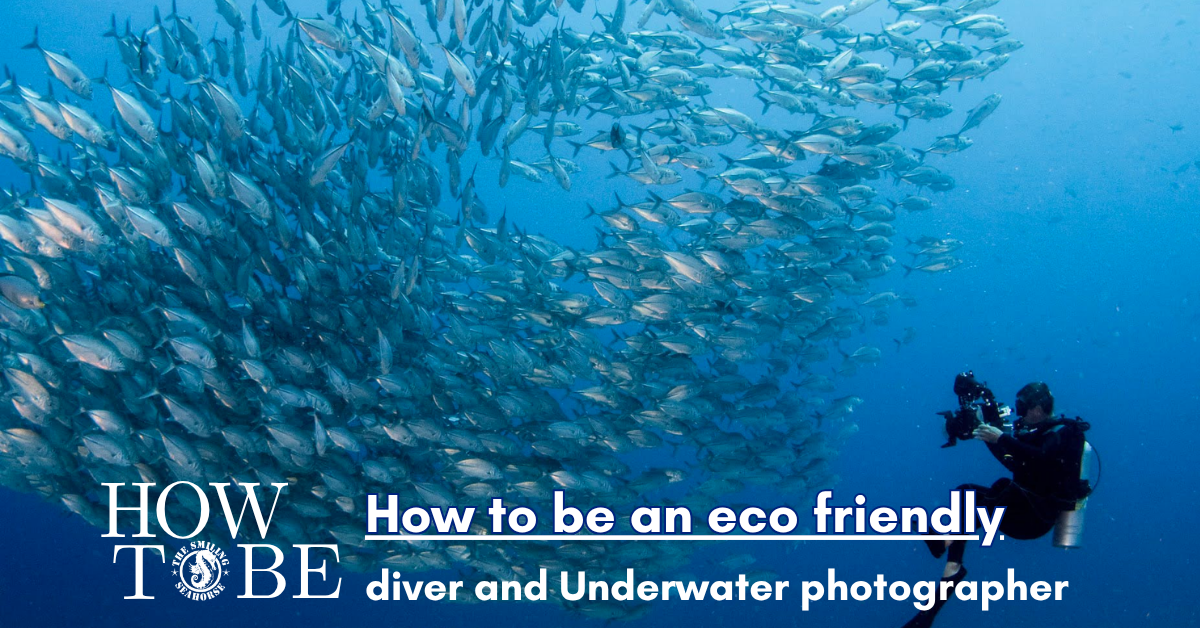
Ethical Underwater Photography: Protecting Marine Life While Taking Better Photos
Now, more than ever, travellers are becoming conscious of their impact on the planet and its ecosystems. New steps are being taken every day towards more sustainable travel and lifestyles, and that is just amazing.
That being said, there’s still a long way to go in terms of humans reconnecting with nature, and we must change as many behaviours as possible in many aspects of our lives. Here, we are going to discuss responsible scuba diving. Basically, are you an eco-friendly diver?
Let’s bring to light some considerations you should be aware of the next time you visit the underwater world. From fin kicks to photography skills, we’ve got you covered!
Contents
Eco-Friendly Scuba Diving
Being an eco-friendly scuba diver is easier than it sounds. Indeed, it starts with good scuba diving training. So, if you are a snorkeller who wants to become a diver, or a new scuba diver, make sure you choose a proper dive centre to fulfil your training needs.
Sadly, not all scuba diving centres promote the safest, best and most environmentally friendly practices… and those that don’t are often the cheapest. Basically, simply be aware and discuss the dive centre’s values before registering with them for your training. Quality over money in this case.
Furthermore, assuming you are well trained, the other steps towards being an eco-friendly diver should be a piece of cake!
First, it’s all about having good buoyancy control so you don’t accidentally hit and damage the coral reef, for example.
Secondly, it’s about knowing that underwater we touch nothing and we leave nothing… but bubbles! In third position comes the fact that a well-trained scuba diver knows how to properly choose and handle their equipment. Indeed, this means that if you choose wisely and then wear your scuba diving equipment properly, nothing should be bothering you or hitting the reef while you swim.
Obviously, following the dive leader and the dive plan is also what any well-trained diver would do, and it comes in handy to protect the environment. In fact, just like with buoyancy control, following the plan and leader will reduce the chances of accidentally hitting the reef, or finding yourself in an unexpected and possibly dangerous situation.
After more than a decade operating dive cruises in Thailand and Myanmar, we’ve noticed that most accidental reef damage isn’t caused by careless divers. It usually happens when photographers become so focused on their subject that they lose awareness of their surroundings.

“`

“`
Eco-Friendly Underwater Photography
During our cruises in the Mergui Archipelago and Thailand’s islands since 2012, we have occasionally seen photographers accidentally damage soft corals while concentrating on their viewfinder. This is why we encourage guests to perfect their buoyancy skills before carrying a camera underwater.
Take nothing but pictures, they say, but we would rather say: “Take nothing but eco-friendly pictures!”
Indeed, it is legitimate to consider whether the light from camera strobes can harm critters and fish, big or small. That said, there’s very little data to support anything serious as to whether strobes hurt marine life, and if so, to what extent.
As an example, there was a study discussed in The Conversation which aimed to investigate whether light strobes were harming seahorses. Thankfully, the study appeared to demonstrate that the seahorses’ hunting and feeding behaviour was not impacted, even when exposed to bright and direct strobe light. Still, the study highlights that we don’t know the effect of flashes on other creatures, and that more is to be discovered in this field of research.
Knowing this, it seems reasonable to say that the approach we use should be the safe one: moderation. Indeed, better safe than sorry! So, next time you are scuba diving in Indonesia or taking diving photos in Myanmar, looking for seahorses as well as other unique macro-life critters… think about how you can protect them while enjoying their presence.
First, we suggest considering this: the light from a strobe is not necessarily more damaging or tolerable to fish eyes than it is to human eyes. So, who likes to have 10 flashes in a row in their eyes? Not you? Then think about the critter or fish you are photographing next time.
If you have been to an aquarium or a zoo, you have probably noticed that in most of them, camera flashes are prohibited. Moreover, some dive centres and dive schools will impose or “highly recommend” either a flash ban or a maximum number of pictures per fish. Thus, without saying that strobes should be banned for scuba divers, we can at least use them moderately in a way that respects marine life.
Available evidence indicates that the impacts of underwater photographic strobes are often negligible when compared with the effects of diver presence and physical interaction with marine organisms. While flash photography has not been shown to cause significant ocular damage or major behavioural changes in several studied fish species, underwater photographers may increase environmental impacts by spending extended periods close to wildlife and sensitive habitats. Consequently, researchers recommend minimising disturbance, avoiding physical contact, and maintaining appropriate distances while acknowledging that further research is needed to assess long-term and species-specific effects.
Furthermore, it’s the photographer’s behaviour that can be more damaging than the strobe itself. Let’s put this in perspective: it’s hard enough to have any diver understand not to touch marine life at all. Imagine if you hand the diver a camera and let them into the blue to get the best shot… Chances are they will be very tempted to create movement around some critter, or touch a fish so it reacts or moves.
This is a behaviour related to underwater photography which can put marine life in harm’s way. How? Either by stressing the creature, changing its behaviour or simply harming it through physical contact.

“`

“`
Common Mistakes to Avoid
We hope this helps on your path to becoming a responsible scuba diver who protects and cares for the marine environment. We want to keep our playground healthy and lively, so raising awareness and sharing best practices for eco-friendly scuba diving is a little step for humanity and a big step in the scuba diving community!
The future of diving depends on the health of our oceans. Every careful fin kick, every responsible photography decision, and every choice to support environmentally conscious dive operators helps protect the underwater world we love.
The best divers are not only skilled explorers — they are ambassadors for the ocean. By practising sustainable diving and ethical underwater photography, we can continue to enjoy extraordinary encounters with marine life while helping to ensure these ecosystems remain healthy for generations to come.
Although concerns about underwater strobes are common, current scientific evidence suggests that physical disturbance from divers generally represents a greater threat to marine life than camera flashes themselves. Researchers nevertheless recommend responsible photography practices, as the long-term effects of repeated exposure remain insufficiently studied and may vary between species.

“`

“`
References and Sources
- This is a guest article written by Myryame Sawyer.
- Flash photography doesn’t harm seahorses — but don’t touch
- Another well-documented article by Anthony B. Rouphael and Graeme J. Inglis: ScienceDirect research article
Frequently Asked Questions About Eco-Friendly Diving
What are the most common mistakes eco-conscious divers should avoid?
Even well-intentioned divers can accidentally harm marine ecosystems. Common mistakes include:
- Touching or standing on coral reefs.
- Holding onto reefs during strong currents.
- Poor buoyancy control that causes accidental contact with marine life.
- Allowing gauges, cameras, or hoses to drag across the reef.
- Chasing turtles, sharks, or other animals for photographs.
- Moving marine creatures to improve a photo composition.
- Using excessive flash photography on sensitive subjects.
- Collecting shells, coral fragments, or marine souvenirs.
Why is buoyancy control important for eco-friendly diving?
 Good buoyancy helps divers avoid accidental contact with coral reefs, marine life, and the seabed. It is one of the most effective ways to reduce your environmental impact underwater while also improving your di
ving experience.
Is it okay to touch coral if I am careful?
No. Coral reefs are living organisms that can be damaged by even brief contact. Touching coral may break delicate structures, remove protective mucus layers, or introduce harmful bacteria and contaminants.
Can underwater photography harm marine life?
Underwater photography itself is not harmful when practised responsibly. Problems arise when photographers chase, corner, touch, manipulate, or stress animals to obtain a shot. Ethical underwater photography prioritises the well-being of the subject over the image.
Should divers move marine animals for a better photo?
Never. Moving marine creatures can disrupt their natural behaviour, expose them to predators, increase stress, and damage sensitive habitats. A responsible photographer adapts their position rather than altering the environment.
Are camera strobes harmful to marine life?
Current research suggests that occasional strobe use is generally less harmful than physical disturbance caused by divers. However, it is best practice to avoid excessive flashing, especially with sensitive species, and to l
 imit the number of exposures whenever possible.
What equipment habits help protect coral reefs?
Divers should secure all hoses, gauges, pointers, and accessories to prevent them from dragging across the reef. Keeping equipment streamlined reduces the risk of accidental damage and improves underwater safety.
How can I become a more eco-friendly underwater photographer?
Focus on excellent buoyancy control, maintain a respectful distance from wildlife, avoid manipulating subjects, take only a reasonable number of photos, and capture natural behaviour rather than creating it. The best underwater photographs are those taken without impacting the marine environment.





One Response
Hii
Good Afternoon
I read your article you explained in a simple way. It is easy to understand. Thanks for sharing these articles with us. I shared your article with my friends. keep posting such informative articles.