
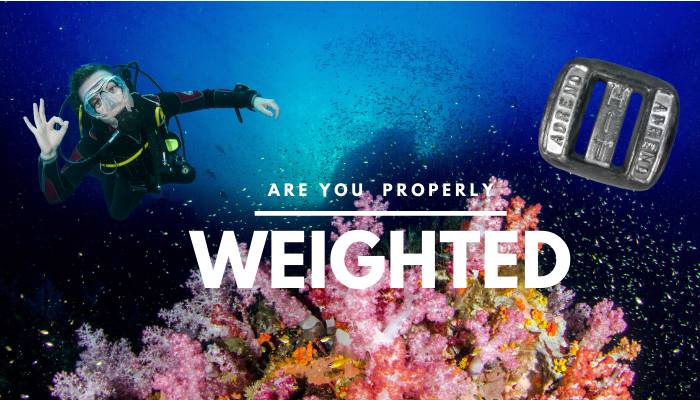
How to Master Scuba Diving Buoyancy: Are You Overweighted or Underweighted?
Proper buoyancy control is one of the most essential skills for any scuba diver. Good buoyancy protects fragile marine ecosystems, helps you conserve air, improves your trim and makes your dives infinitely more relaxed and enjoyable. It also allows you to move around the reef with much less effort and reduces the risk of accidentally touching the bottom.
But how can you tell if your weight check was accurate, or if you are carrying too much lead? Finding the right amount of weight is not about simply copying what another diver is wearing. Your exposure suit, cylinder, equipment, body composition, experience and the water you are diving in all influence your buoyancy.

How Do You Know If You Took Way Too Much Weight for Your Dive?
Being overweighted is surprisingly common, especially among newer divers. Carrying extra lead may make it easy to descend, but it forces you to compensate by putting more air into your BCD, which can make your buoyancy less stable and your dive less efficient.
- At the surface, with a fully inflated BCD (Buoyancy Control Device), do you need to kick constantly to keep your head above water?
- While descending, do you have trouble controlling your speed? Do you have trouble equalizing because you are sinking like a stone?
- At the bottom, do you have to add a lot of air to your BCD?
- Do you have a hard time maintaining a horizontal trim position?
- Does it take a lot of energy to move? Do you frequently make unwanted bottom contact with the reef when you dive in Thailand or explore Burma?
- Do you often have a yo-yo profile, going up and down frequently? Do you have to regularly add and remove air from your BCD?
If your answer is yes to any of these questions, you may be carrying too much weight on your weight belt or in your weight pockets.
Too much weight creates a cycle: the additional lead makes you sink, so you add more air to your BCD to compensate. That extra air expands and contracts as you change depth, making your buoyancy more sensitive and potentially contributing to repeated ascents and descents.

How Do You Know If You Are Underweighted?
Being underweighted creates the opposite problem. You may struggle to descend or maintain your position at depth, particularly towards the end of a dive when your cylinder is becoming more positively buoyant.
- Do you have trouble descending, even with your lungs and BCD fully emptied?
- Do you have trouble staying at the bottom without any air in your BCD?
- Do you tend to float up towards the surface unexpectedly?
- Do you find it impossible to remain stable during your safety stop?
If your answer is yes to any of these questions, you may be carrying too little weight on your weight belt or in your weight pockets.
The goal is not to carry as much weight as possible simply to make descending easy. The goal is to carry the minimum amount of weight needed to remain comfortably neutral throughout the dive, including during the final part of the dive when your cylinder contains less gas.
How to Find the Right Amount of Weight You Need
In theory:
- With a 3mm wetsuit in salt water, using a 12L aluminium tank, you will need around 5% of your body weight.
- With a 5mm wetsuit in salt water, using a 12L aluminium tank, you will need around 8% of your body weight.
Example: A diver of 75kg with a 3mm wetsuit and a 12L aluminium tank needs roughly 4kg. A diver of 60kg with a 5mm wetsuit and a 12L aluminium tank needs roughly 5kg.
These figures are only a starting point, however. You must adapt your weighting depending on whether you are diving in salt or fresh water, using an aluminium or steel tank, choosing a 12L or 15L capacity, and, most importantly, accounting for each individual diver’s experience level and equipment configuration.

Difference Between Steel and Aluminium Tanks
Your cylinder can have a major influence on your weighting requirements. Aluminium and steel tanks behave differently as they are filled and emptied, which is particularly noticeable towards the end of a dive.
- 12L Aluminium Tank: Is 0.75kg negatively buoyant when full, and becomes 1.25kg positively buoyant when it reaches 35 bar.
- 12L Steel Tank: Is 4kg negatively buoyant when full, and remains 1.3kg negatively buoyant when empty.
Because steel tanks maintain negative buoyancy, you will generally need less additional weight than with an aluminium tank (about 2.5kg less according to these figures). This can be particularly useful when diving with a thicker exposure suit.
If You Dive with a 15L Tank
- Remove 0.5kg if using an aluminium tank.
- Remove 1 to 2kg if using a steel tank.
Again, consider these numbers as guidelines rather than fixed rules. The correct weighting should always be confirmed with a proper buoyancy check in the water and adjusted for your complete equipment configuration.
Difference Between Fresh Water and Salt Water
If you are used to diving in salt water, remember to remove around 2 to 3kg when switching to fresh water. Fresh water is less dense than salt water, so the amount of ballast required can change significantly.
There are also variations in salinity across different oceans and seas. Always check and ask your local guides whenever you visit a new diving destination. They know the local conditions and can help you determine an appropriate starting point for your weight check.

Consider the Weight of Your Gear
Your BCD and the rest of your equipment also influence your overall buoyancy. BCDs vary significantly in weight depending on their style. For instance, a lightweight travel BCD will weigh much less than a technical wing setup featuring a steel or aluminium backplate.
Your regulator, fins, torch and underwater camera setup can also make a noticeable difference. A large camera housing, strobes and arms can alter your trim and buoyancy considerably compared with a simple recreational setup.
This is why your weighting should be checked with the equipment you are actually going to use. Changing your BCD, cylinder, exposure suit or camera system can mean that your previous weight configuration is no longer appropriate.
In Practice, How Do You Know That You Are Perfectly Weighted?
A perfectly weighted diver will be able to enjoy their dive effortlessly and finish it with a stable safety stop while using an empty BCD.
“Ok, so I managed to do my safety stop properly, now, how do I know if I can still shed another weight for the next dives?”
At the end of your dive, you can check the accuracy of your weighting with a proper weight check:
- With roughly 50 bar left in your tank at the surface, deflate your BCD completely.
- Hold a normal breath without moving or kicking.
- You should be able to float comfortably at eye level.
- When you gently exhale, you should sink slowly.
This check is particularly useful because your cylinder is close to its lowest pressure at this point in the dive. If you can comfortably remain at the surface with an empty BCD and a normal breath, your weighting is much more likely to be appropriate for the dive.
When you find the right amount of weight, it is completely normal to begin your dive by adding a small amount of air to your BCD to achieve neutral buoyancy at depth. As you ascend and consume the air in your cylinder, you will need to release small puffs of air to remain neutral throughout the dive.

Use Your Breathing to Fine-Tune Your Buoyancy
With experience, you will grow more comfortable understanding how to use your breathing for buoyancy control, and it will become as natural as walking. Using your lungs to make small adjustments to whether you rise or descend is the key to gliding around the reef with ease.
Just remember: never hold your breath! Always breathe continuously while scuba diving and allow your breathing pattern to remain natural. Your BCD is there to make larger buoyancy adjustments, while your breathing can help you make subtle changes to your position in the water.
And remember that the inflator button on your BCD is not an elevator and should be used sparingly. Good buoyancy comes from a combination of correct weighting, proper trim, controlled breathing and small, deliberate BCD adjustments.
Better Buoyancy Means Better Diving
Once you have found your ideal weighting, the difference can be remarkable. You use less energy, your air consumption can improve, you can maintain a more comfortable horizontal trim and you are much less likely to accidentally touch the reef. For underwater photographers, good buoyancy is especially important because it allows you to position yourself carefully without damaging the environment or disturbing marine life.
We hope these tips help improve your buoyancy control! If you want to refine your skills further, consider joining us on a liveaboard trip or explore our safety standards and equipment guidelines.
See you next season with perfect buoyancy!!

Explore More Diving Tips & Adventures
- Thailand diving – discover top dive sites across the Similan Islands, Richelieu Rock, and more.
- Myanmar diving – explore pristine reefs and remote islands in the Mergui Archipelago.
- Myanmar liveaboard diving holidays – find your next dream expedition with us.
- Safety equipment and procedures – learn more about our on-board safety standards.




