
Shaded Batfish: The Incredible Transformation of Platax pinnatus
The shaded batfish, Platax pinnatus, is a favourite among divers and underwater photographers. However, this beautiful fish is not always easy to observe in its juvenile form, which looks dramatically different from the adult.
Why Is It Called Shaded Batfish?
Platax pinnatus, also known as the red platax or shaded platax, is a species of marine fish belonging to the family Ephippidae.
The origins of its scientific name are particularly appropriate:
- Platax: from the Greek platos, meaning flat or wide.
- Pinnatus: from the Latin pinnatus, meaning winged or feathered, referring to the long fins, especially prominent in juveniles.

Where Do Shaded Batfish Live?
The shaded batfish is found throughout the Indo-Pacific and is regularly sighted in the Andaman Sea, including both Thailand and Myanmar.
Unfortunately for underwater photographers, the juvenile stage is the most spectacular and only lasts for a few months. As the fish grows, its appearance changes dramatically, eventually becoming the much more familiar rounded, silvery adult.
Its adult counterpart may be less striking than the juvenile, but it remains an impressive fish to encounter while diving in tropical waters.

How to Recognise Platax pinnatus at Different Stages of Its Life
The shaded batfish is a fascinating example of how dramatically a fish can change as it grows. The small juvenile looks almost nothing like the adult.
The Juvenile Shaded Batfish
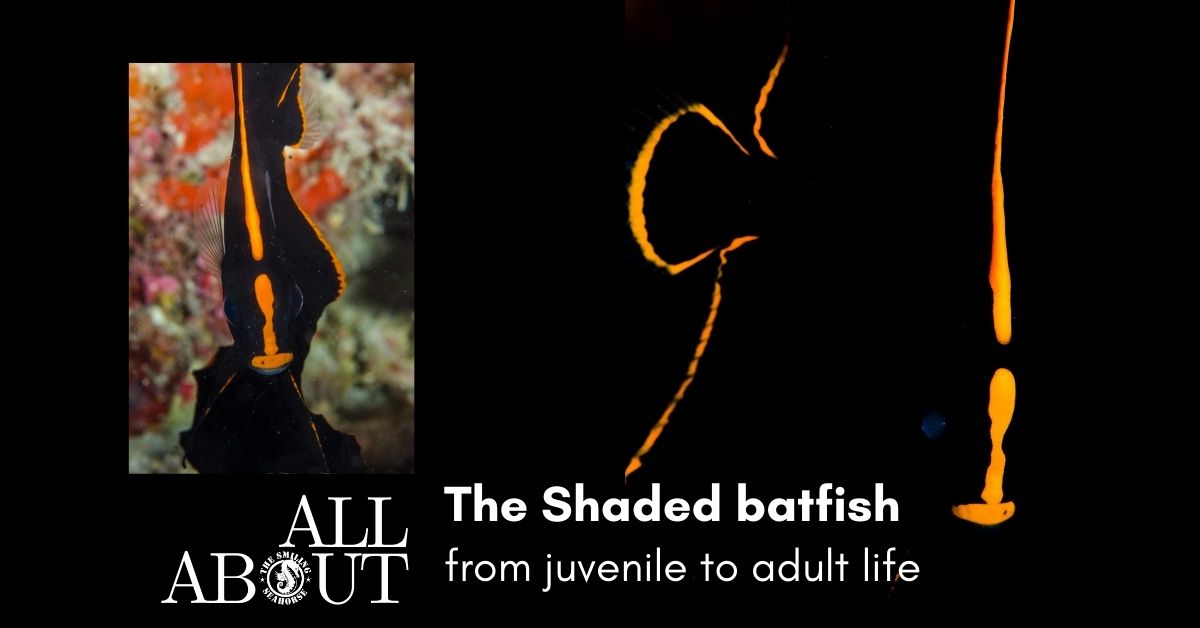
Small juveniles are black with a bright orange-red border around the body and fins. Their fins have a scalloped outline and they swim with exaggerated, almost floating movements.
These unusual colours and movements are thought to help the small juveniles mimic similar-looking flatworms, providing them with an effective form of protection from potential predators.

The Transformation Begins
As the fish grows, a grey patch begins to appear on its side, starting behind the pectoral fin. At the same time, the dorsal and anal fins become longer and more pointed.
This marks the beginning of its remarkable transformation from a black, elongated juvenile into the much rounder, grey adult fish.


The Adult Shaded Batfish
Once fully grown, two distinctive black bars appear: one at the level of the eyes and another just before the pectoral fin. The dorsal and anal fins have elongated considerably and develop a slightly yellowish colour, while the body becomes predominantly silver.
The shaded batfish can reach around 40 centimetres in length, making the transformation from its tiny, black-and-orange juvenile form into the rounded adult particularly remarkable.
Batfish Reproduction
The sexes are separate and there is no obvious sexual dimorphism. Platax pinnatus is ovuliparous, meaning that eggs and sperm are released into the water and fertilisation takes place externally in open water.
The larvae remain pelagic for a few days before undergoing their final metamorphosis. The young juvenile then begins its life closer to the bottom, where its spectacular black-and-orange appearance makes it one of the more unusual fish to encounter while diving.
Shaded Batfish and Other Batfish in the Andaman Sea
There are several species of batfish found in tropical waters. One of the most commonly encountered in Thailand and Myanmar is Platax teira, also known as the longfin batfish or longfin spadefish.
Interestingly, although adult Platax teira are relatively common, we do not often encounter their juveniles.
Behaviour can also help distinguish the two species. If a Platax teira is not afraid of you, it can even become curious and approach divers. The shaded batfish, Platax pinnatus, is quite different: it tends to be much more cautious and usually keeps its distance.


The shaded batfish is a perfect example of why it pays to look closely during a dive. The tiny black juvenile with its vivid orange-red outline can be almost unrecognisable compared with the large, silver adult. Finding one at the right stage of its life is a real treat for divers and underwater photographers exploring the marine life of the Andaman Sea.




