
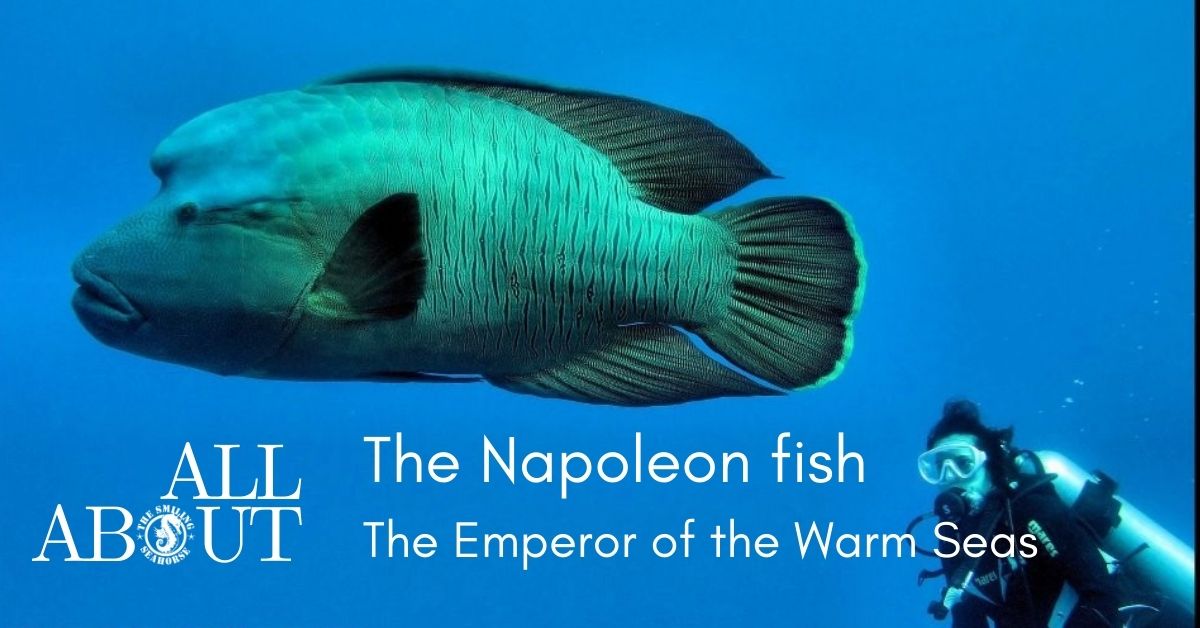
Napoleon Wrasse: Facts About the Giant Humphead Wrasse
If you are passionate about colourful coral reefs, you have probably encountered the Napoleon wrasse! Also known as the humphead wrasse or giant wrasse (Cheilinus undulatus), this spectacular reef fish is one of the most recognisable species in the tropical Indo-Pacific.
Its impressive size is one of the reasons it has become such an emblematic reef fish. Adults commonly reach around 60 cm, but exceptional individuals can grow to approximately 2.3 metres long and weigh more than 200 kg. Seeing a fully grown Napoleon wrasse underwater is therefore quite an experience!
 |
Napoleon – what a funny name!
The common name Napoleon wrasse is inspired by the prominent hump above the head of adult fish, which is said to resemble the distinctive bicorne hat associated with Napoleon Bonaparte. Its scientific name, Cheilinus undulatus, refers to its undulating or wavy appearance. The species is also famous for its thick, protruding lips, which give this enormous wrasse a very distinctive face. Whatever name you choose, there is no mistaking this impressive reef giant! |
Where do Napoleon wrasse live?
The humphead wrasse is found across the tropical and subtropical Indo-Pacific, including parts of the Indian Ocean, Southeast Asia and the western and central Pacific. It is associated with coral reefs and other reef habitats, where adults can be encountered in lagoons, channels and along reef slopes.
Although they can occur from shallow water down to around 100 metres, they are often seen by divers on reef slopes and around coral outcrops. Their enormous size, striking colours and characteristic hump make them one of the most memorable encounters for divers exploring the reefs of Thailand and the wider Andaman Sea.
Napoleon wrasse are also remarkably long-lived fish. Estimates commonly put their lifespan at around 25 to 30 years, although some individuals may live considerably longer. Growing to such a large size takes time, which makes the loss of mature adults particularly significant for wild populations.
 During its development, the giant wrasse changes sex.
The Napoleon wrasse changes sex
One of the most fascinating things about the Napoleon wrasse is its reproductive biology. The species is a protogynous hermaphrodite, meaning that individuals begin life as females and some later change sex and become males.
Sexual development is closely linked to age and social structure. Some females eventually transition into males, and males can develop a more striking adult appearance as they mature. Their colouration may become increasingly blue-green, while the characteristic hump on the forehead becomes more pronounced with age.
This remarkable life cycle is one of the many reasons why protecting large adult Napoleon wrasse is important. The biggest individuals are not simply spectacular to see; they are also an important part of the species’ reproductive population.
 Male Napoleon wrasse.
The humphead wrasse diet: a reef predator
The Napoleon wrasse is an important predator on tropical coral reefs. It has a varied diet that can include molluscs, crustaceans, fish and other reef animals.
It is also one of the reef predators known to eat crown-of-thorns sea stars (Acanthaster species), which prey heavily on hard corals. The relationship between predators and coral-eating crown-of-thorns sea stars is complex, but the feeding behaviour of large reef predators such as the Napoleon wrasse forms part of the natural balance of reef ecosystems.
The powerful jaws and thick lips of an adult humphead wrasse allow it to tackle prey that many other reef fish could not handle. It may also consume animals that are protected by spines, shells or other defensive structures.
 The humphead wrasse is a powerful reef predator.
Why is the Napoleon wrasse endangered?
Despite its impressive size and wide distribution, the Napoleon wrasse has faced serious pressure from fishing. Its slow growth, long lifespan and relatively low reproductive turnover make populations particularly vulnerable when large adults are removed from the reef.
The species is listed as Endangered on the IUCN Red List and is also protected through international trade regulations under CITES. Fishing and international trade restrictions have been introduced in a number of countries, although enforcement and protection levels vary across its range.
The Napoleon wrasse has historically been highly valued as a food fish, particularly in parts of Southeast Asia and the Hong Kong live reef fish trade. Its large size and reputation as a luxury food have unfortunately made mature individuals especially valuable targets for fishermen.
For divers, seeing one of these enormous wrasses in its natural environment is a reminder that healthy reefs depend on maintaining the full range of marine life, from tiny reef organisms to their largest predators.
 Protecting large Napoleon wrasse is important for healthy reef ecosystems
Please don’t feed Napoleon wrasse!
There is another important message for divers and dive operators: please don’t feed wild Napoleon wrasse – or any other reef fish, for that matter.
At some tourist destinations, wild animals have been deliberately fed from boats or by divers in order to attract them closer to people. This may look entertaining, but feeding can alter the natural behaviour of wild animals.
Fish that become accustomed to receiving food from humans may start approaching boats and divers instead of maintaining their normal distance. They can also become dependent on artificial food sources and may associate people with feeding rather than behaving naturally around the reef.
One of the best ways to enjoy an encounter with a Napoleon wrasse is therefore to let the fish decide where it wants to go. Keep a respectful distance, avoid chasing it, and simply enjoy watching this extraordinary animal behaving naturally.
 Please don’t feed Napoleon wrasse!
A giant of the tropical reefs
The Napoleon wrasse is much more than a large and colourful fish. Its unusual life cycle, impressive longevity, specialised feeding behaviour and important place within reef ecosystems make it one of the most fascinating species encountered by divers in the Indo-Pacific.
Whether you spot a smaller juvenile hiding around the reef or a huge adult cruising past a dive site, encountering a humphead wrasse is always a special moment. If you are exploring the marine life of the Andaman Sea, keep your eyes open – you never know when the reef’s giant might appear.

If you enjoyed this article, please share it with your fellow divers. And if you have your own memorable Napoleon wrasse encounter, tell us about it!




