
Peacock Mantis Shrimp: 10 Fascinating Facts About the Ocean’s Colourful Super Predator
If you’ve never heard of the peacock mantis shrimp, you’re in for a real treat! These striking and enigmatic creatures are like the rock stars of the ocean. Their scientific name is Odontodactylus scyllarus, and they combine spectacular colours with extraordinary vision and one of the fastest strikes in the animal kingdom.
Let’s dive into their vibrant world and uncover the answers to some of the most fascinating questions about these incredible marine crustaceans.
Before we get into the fun facts, let’s give credit where it’s due: the Latin name. Odontodactylus scyllarus may sound like a mouthful, but when you break it down, it makes sense. “Odontodactylus” refers to a toothed finger, while “scyllarus” is a reference to Scylla, a sea monster from Greek mythology. In other words, even its scientific name hints at the mantis shrimp’s formidable appendages and mythical appearance.
 |
 |
In the world of marine biology, peacock mantis shrimp are the embodiment of beauty, strength and mystery. Their striking appearance, lightning-fast strikes and extraordinary vision make them a true wonder of the ocean. The more you learn about them, the more you’ll realise that there is never a dull moment in the colourful world of the peacock mantis shrimp.
Whether you’re a marine enthusiast, an underwater photographer or simply curious about the wonders of the sea, the peacock mantis shrimp never fails to captivate with its kaleidoscope of colours and extraordinary abilities.
4 Incredible Fun Facts About the Peacock Mantis Shrimp
Fun Fact #1: The Peacock of the Sea
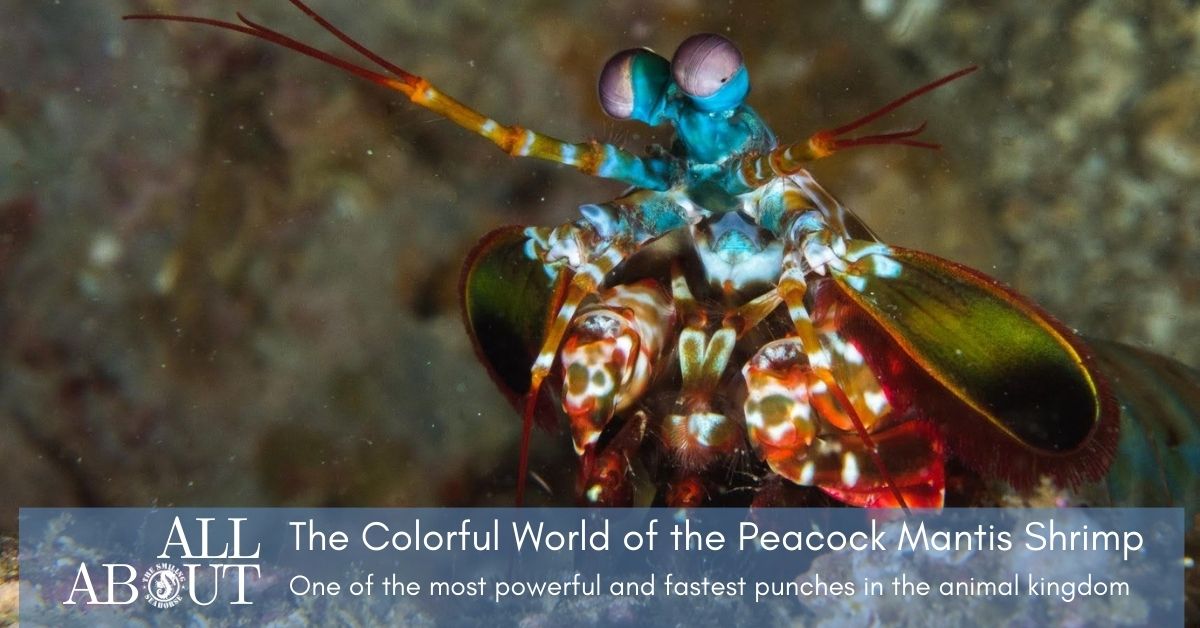
The peacock mantis shrimp earns its dazzling nickname thanks to its vibrant and iridescent coloration. These marine gems can display spectacular shades of green, blue and fiery red, with intricate patterns covering their bodies. Against a colourful coral reef, they can look almost unreal.
Their appearance is one of the reasons they are such a favourite subject for underwater photographers. Finding one peeking out from its burrow can turn an ordinary reef dive into a memorable encounter.
 |
 |
Fun Fact #2: Super Smashers of the Ocean
Peacock mantis shrimp are not just pretty. They are ferocious predators equipped with specialised front limbs called raptorial appendages. In peacock mantis shrimp, these appendages are adapted for smashing and can accelerate incredibly quickly.
Their club-like appendages can deliver an astonishingly powerful strike, allowing them to break open hard-shelled prey such as crabs and snails. The mechanics behind the strike are particularly impressive: the shrimp stores energy in specialised structures and releases it extremely rapidly, producing a blow far beyond what you might expect from such a relatively small animal.
They are so powerful that mantis shrimp have even become famous for their ability to damage aquarium glass. It is certainly not something you’d want to test with your fingers!
Fun Fact #3: Extraordinary Colour Vision
Mantis shrimp vision is the stuff of science fiction. Their eyes contain numerous specialised photoreceptors and allow them to detect wavelengths of light that humans cannot see, including ultraviolet light. They can also detect polarised light, giving them a visual system that is remarkably different from our own.
This extraordinary visual system helps mantis shrimp detect prey, predators and potential mates. Their eyes are among the most fascinating sensory organs found in the marine world.
Fun Fact #4: Mantis Shrimp Are Neither Mantis Nor Shrimp!
While the name “mantis shrimp” might suggest a curious fusion of a praying mantis and a shrimp, they are neither related to mantises nor true shrimp. These captivating animals belong to the Stomatopoda, a specialised group of marine crustaceans that has followed its own evolutionary path.
So, the next time you’re pondering their peculiar name, remember that mantis shrimp are in a league of their own, with a unique combination of anatomy, behaviour and sensory abilities.
An Interesting Mantis Shrimp Life Cycle
Mantis shrimp have a fascinating life cycle. After fertilisation, the eggs are attached to specialised swimmerets on the female’s abdomen using a sticky secretion. The female protects and fans the eggs, helping maintain oxygen circulation and keeping them clean during the incubation period, which can last several weeks.
Once they are ready to hatch, the young are released into the water column as tiny larvae. They pass through several developmental stages, feeding on plankton and other small organisms as they grow. Eventually, they settle onto the reef and begin their adult lives.
We can see mantis shrimp larvae very regularly on our blackwater dives, where the tiny animals drift through the darkness of the open ocean at night. For underwater photographers, these dives can reveal some truly bizarre and beautiful stages of marine life that are almost impossible to see during a normal reef dive.
Mantis Shrimp Larvae on Blackwater Dives


Smasher vs Spearer Mantis Shrimp
The raptorial appendages of mantis shrimp have different shapes depending on the species. Some have claw-like appendages known as spearers, while others have powerful hammer-like appendages that give rise to the name smashers.
Peacock mantis shrimp are smashers. They are particularly fascinating because they can produce an incredibly powerful strike despite their relatively small size. Their specialised anatomy uses a spring-like mechanism and a locking system to store and release energy extremely rapidly.
Below are a few photos of spearing mantis shrimp (Lysiosquilla maculata). They are much lighter in colour and live in vertical burrows in the sand, whereas peacock mantis shrimp generally prefer rocky areas around the reef.
Spearing Mantis Shrimp


Frequently Asked Questions About Peacock Mantis Shrimp
- Can peacock mantis shrimp see more colours than humans?
- How fast is a peacock mantis shrimp’s punch?
- Are peacock mantis shrimp dangerous to humans?
- How do peacock mantis shrimp communicate?
- What are some interesting behaviours of peacock mantis shrimp?
- Can peacock mantis shrimp regenerate their limbs?
- Where can you find peacock mantis shrimp in the wild?
1. Can Peacock Mantis Shrimp See More Colours Than Humans?

- Humans have three types of colour-sensitive cone cells, allowing us to perceive a broad range of colours.
- Mantis shrimp have a much more complex visual system, with numerous specialised photoreceptors that allow them to detect ultraviolet light and polarised light as well as visible wavelengths.
- This remarkable vision gives mantis shrimp a completely different way of experiencing their underwater environment.
2. How Fast Is a Peacock Mantis Shrimp’s Punch?
The peacock mantis shrimp has one of the fastest and most powerful strikes in the animal kingdom for its size. It possesses specialised raptorial appendages that it uses to strike prey with extraordinary acceleration.
The club-like appendage can reach speeds of around 23 metres per second. The combination of speed, strength and the spring-loaded mechanism behind the strike allows the shrimp to produce an extraordinary amount of force, helping it smash the shells of hard-bodied prey.

Bullet-fast punch!
3. Are Peacock Mantis Shrimp Dangerous to Humans?
While their powerful strike can break shells and has been known to damage aquarium glass, peacock mantis shrimp are not considered a threat to divers. Nevertheless, it is wise not to put your fingers too close to those powerful hammers! As with any wild marine animal, observation from a respectful distance is the best approach.

4. How Do Peacock Mantis Shrimp Communicate With Each Other?
Mantis shrimp can use visual signals and body language when interacting with one another. Colour patterns, movements and postures can communicate information about their intentions, including territorial behaviour and courtship.
5. What Are Some Interesting Behaviours of Peacock Mantis Shrimp?
Peacock mantis shrimp are known for their burrowing behaviour. They can construct and maintain burrows that provide shelter and a place from which to ambush prey. They are also territorial and can defend their burrow against other animals.
6. Can Peacock Mantis Shrimp Regenerate Their Limbs?
Like other crustaceans, mantis shrimp can regenerate lost or damaged appendages through the process of moulting. Regeneration is part of their remarkable ability to recover from injuries, although the replacement limb develops progressively through subsequent moults rather than instantly returning to its original size.
7. Where Can You Find Peacock Mantis Shrimp in the Wild?
Peacock mantis shrimp inhabit warm tropical waters of the Indian and Pacific Oceans, particularly around coral reefs and rocky habitats. They can often be found sheltering in burrows, cracks and crevices on the seafloor.
They are also regular stars of our diving in the Andaman Sea. Our guides frequently encounter mantis shrimp during our dives, making these colourful crustaceans one of the fascinating pieces of marine life to look out for beneath the surface.
Want to discover more? Explore our guide to the marine life of the Andaman Sea.

Why Mantis Shrimp Are So Special for Divers and Underwater Photographers
For divers, the appeal of mantis shrimp goes far beyond their colours. They are a perfect example of the strange and wonderful animals that can be found when you slow down and look carefully at the reef.
A peacock mantis shrimp may spend much of its time partially hidden inside a burrow, appearing only briefly before disappearing again. Spotting one often requires patience, good observation skills and a guide who knows where to look. For photographers, their brilliant colours, unusual eyes and unmistakable body shape make them particularly rewarding subjects.
And then there are the larvae. During a blackwater dive, the tiny planktonic stages of mantis shrimp can look completely different from the colourful adults we see on the reef. These encounters are a reminder of just how much marine life is drifting through the open ocean every night.




