
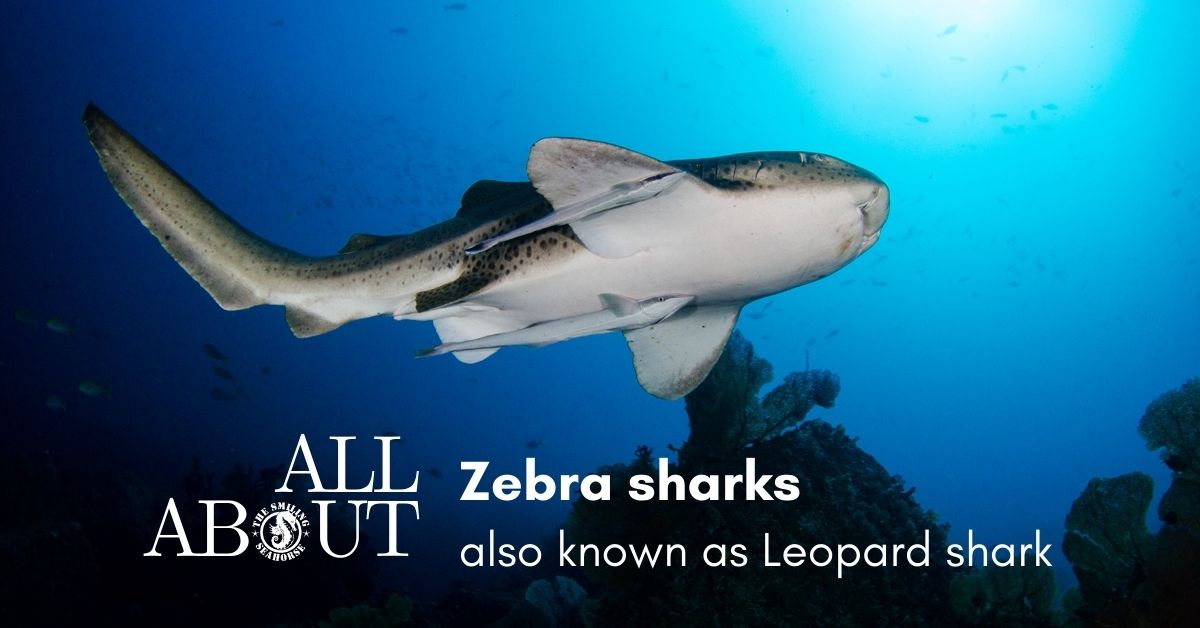
Zebra Shark: One of the Cutest Sharks in the Indian Ocean
In this article:
Zebra Sharks or Leopard Sharks?
 |
 |
The most common confusion among divers concerns the Leopard Shark, which is very often confused with the Zebra Shark, a species frequently encountered when diving in tropical areas.
Both species have the particularity, in adulthood, of sporting a spotted coat similar to that of the African leopard. However, the two species are biologically different and very easily distinguishable.
On the left, the Zebra Shark is born with “zebra lines”, which change into leopard-like spots when they reach adulthood. Their cylindrical bodies measure from 50cm at birth to 3.50m when fully grown, with prominent ridges along the flanks. The upper lobe of the caudal fin is very long.
On the right, the Leopard Shark has a unique spotted grey coat and can measure up to 1.80m, so it is a little smaller than its congener, the Zebra Shark. It lives in the cold to temperate waters bordering the United States, from the Gulf of Mexico to Oregon. Its favourite areas are the turbid, shallow and rough areas of the seaside, sandy bottoms and the rocky substrates of kelp forests.
This lovely little shark is probably the reason why American divers call Stegostoma tigrinum “zebra shark”, while the rest of the world, diving in warmer waters and hence never coming into contact with Triakis semifasciata, simply calls it “Leopard Shark”…
 Stegostoma tigrinum – Zebra Shark AKA False Leopard Shark (adult) Stegostoma tigrinum – Zebra Shark AKA False Leopard Shark (adult) |
 Triakis semifasciata – Leopard Shark (Adult) Triakis semifasciata – Leopard Shark (Adult) |
So what does a Zebra Shark, or false Leopard Shark, look like when they are younger?
Rarely photographed in the wild, Zebra Sharks look black with white zebra markings at birth and develop their “leopard” patterns after a few weeks.
 |
 |
Where can Zebra Sharks be found?
The Zebra Shark can be found in shallow waters all around the Indian Ocean and West Pacific, from South Africa to the Red Sea, from India to northern Australia, and from China to New Caledonia and southern Japan. They usually hang out on sandy patches near coral reefs, where they can find their food.
|
Map of zebra shark habitat by Sharksider.com
|
 |

The Zebra Shark’s diet: what do they eat?
The Zebra Shark is known for its foraging habits; it feeds and moves mostly at night, foraging for crabs, sea urchins, small fish, snails and other invertebrates hiding in holes and crevices.
They have great whisker-like organs, called barbels, in front of their snout, which help them seek out their prey. They are also equipped with a small mouth and strong gill muscles to snatch up prey, but they are not as strong or active as fish hunters as many other sharks.
They prefer to rest on the ocean floor during the daytime, where they can breathe and pump water through their gills while remaining motionless. When there are strong water currents, they might seem to be surfing as they adjust their fins to stay motionless in the open water.
 |
 |
Zebra Shark reproduction
Stegostoma tigrinum usually lives a solitary life and only seeks out other individuals during the mating season. During courtship, the male Zebra Shark will follow the female and bite vigorously at her pectoral fin and tail, with occasions where he holds her fins down.
These encounters usually happen at the bottom, and a long time before mating, the male curls his body around the female’s and joins his claspers with her cloaca. The mating usually lasts about five minutes.
Females lay about four eggs at a time, but some studies show they can lay up to 46 eggs over 112 days. The egg cases are usually between brown and dark purple, with fine hairs around them, helping them stay anchored or secured while developing. Eggs may hatch in between four to six months.
 |
 |
Zebra Shark asexual reproduction?
(CNN) A female Zebra Shark in an Australian aquarium has astounded scientists by producing live offspring asexually, three years after being separated from her long-term mate. […] It is only the third documented case of a vertebrate of any species switching its reproductive strategy from sexual to asexual.
The shark had earlier reproduced after mating with a male, so it was shocking that it managed to lay fertilised eggs again after so many years without any sexual intercourse.
This asexual reproduction, which exists in the reproduction of other animals such as the spotted eagle ray and Colombian rainbow boa, had never been seen in sharks before. Studies are ongoing to understand this phenomenon, but some scientists believe that it might be a natural adaptation to the lack of sexual partners.

Are Zebra Sharks dangerous? How to approach them?
Are Zebra Sharks dangerous?
Zebra Sharks are non-aggressive and can be easily approached when underwater. Divers visiting the Koh Bon Pinnacle or Koh Tachai in Thailand, as well as North Twin in Myanmar, have a good chance of meeting one of these fascinating sharks.

How to approach them without disturbing them?
Zebra Sharks are relatively easy to approach, but they will run away from you if you don’t do it right!
Approach them from the side, where they can see you. Don’t pass over the top of them or approach them from behind. If you are in their “dead angle”, they will swim away.

Zebra Shark conservation
 |
ZEBRA SHARK CLASSIFICATION:
LATIN NAME: Stegostoma tigrinum (fasciatum) FAMILY: Stegostomatidae PHYLUM: Chordata CLASS: Chondrichthyes |
Today, Zebra Sharks are endangered: humans are the driving factor that might drive extinction in the future. Usually, inshore fisheries use them for their meat, which is either salt-dried or fresh. The traditional Chinese delicacy also uses Zebra Sharks, particularly their fins, for making shark fin soup, a delicacy in China.
Is Zebra Shark a fish?
All sharks are cartilaginous fish (their skeleton is made of soft cartilage, not bones). These fish all fall into the group of fish called the elasmobranchs, like rays.
We hope you liked this blogpost and found the information you were looking for. Check out our Marine Life section for more fun facts about Andaman Sea life!
What else do you know about Leopard Sharks? Share your thoughts in the comment section below!




