
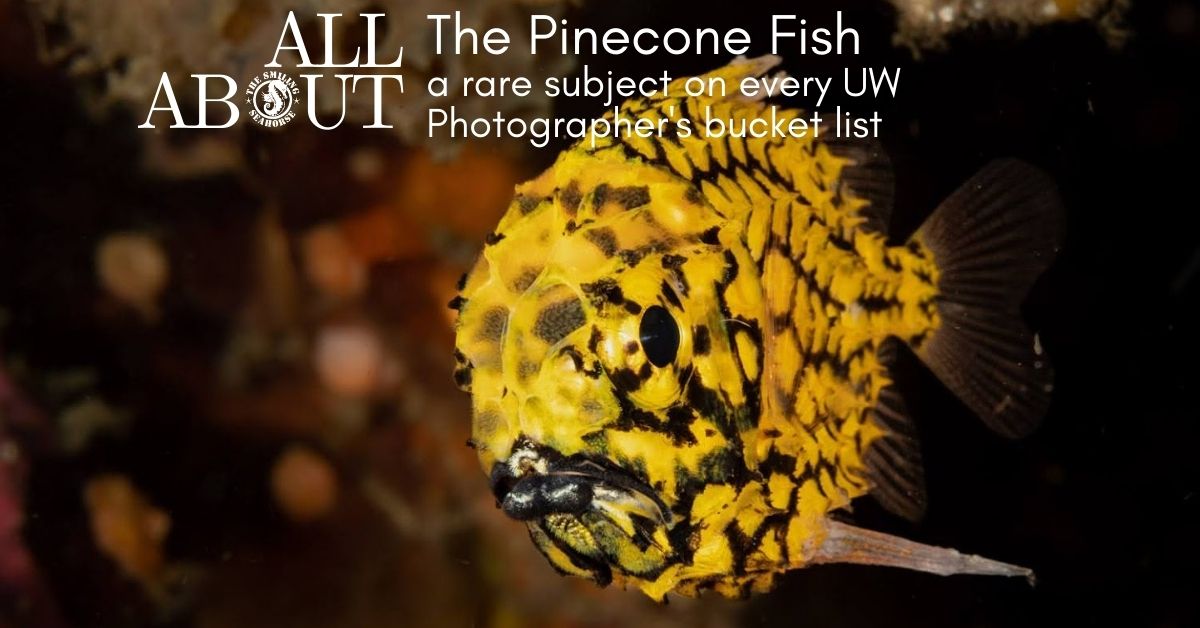
Pinecone Fish: Monocentris japonica Facts, Identification and Behaviour
The pinecone fish (Monocentris japonica) is one of the most unusual fish you can encounter while diving in the tropical Indo-West Pacific. With its rounded body, heavy armour-like scales and remarkable luminous organs, this small nocturnal fish looks more like a living piece of medieval armour than a typical reef fish.
It is also a favourite subject for underwater photographers. Pinecone fish are not always easy to spot because they spend the daylight hours hiding in caves, cracks and beneath rocky ledges. During a night dive, however, they may venture out onto the reef or sandy bottom in search of food.
If you enjoy searching for unusual marine life, the marine life of the Andaman Sea offers plenty of opportunities to encounter fascinating species like this one.

Where does the name Monocentris japonica come from?
The pinecone fish is also known as the knightfish and lighthouse fish. Its common names refer to its unusual appearance and its pair of bioluminescent organs. The large, overlapping scales covering the body resemble the armour of a knight, while the luminous organs beneath the lower jaw are reminiscent of the navigation lights found on ships.
The scientific name is Monocentris japonica, and the species belongs to the family Monocentridae. Its thick scales and strong spines give it a distinctive appearance that makes it relatively easy to recognise once you know what you are looking for.
Pinecone fish vs pineapple fish: what is the difference?
The pinecone fish should not be confused with the Cleidopus gloriamaris, commonly called the pineapple fish. The two species look remarkably similar, which can make identification difficult, particularly when looking at photographs.
They are nevertheless different species. Differences in body proportions, scale patterns, size and habitat can help with identification, while the location and depth of the sighting can also provide useful clues. The pineapple fish generally grows larger and is associated with deeper habitats.
In the waters of Thailand and Myanmar, the pinecone fish we encounter can also appear particularly bright compared with individuals photographed in other parts of its range. This makes local observations especially interesting for divers and underwater photographers.
Where does the pinecone fish live?
Monocentris japonica is found across the tropical Indo-West Pacific, including the waters around Japan, Southeast Asia, Australia and the Indian Ocean. It can inhabit rocky and coral reef environments and has been recorded from relatively shallow water down to considerably deeper reef habitats.
The pinecone fish is primarily nocturnal. During the day, it tends to remain hidden inside caves, beneath overhangs or in other sheltered parts of the reef. This secretive daytime behaviour is one reason why a dedicated night dive can be the best time to look for one.

The Andaman Sea is particularly rich in marine biodiversity, and marine life in Thailand’s Andaman Sea includes an impressive variety of reef fish, invertebrates and larger pelagic species. Our scuba diving trips in Thailand regularly explore different reef environments where unusual nocturnal species can be found.
How to recognise a pinecone fish
The pinecone fish can reach approximately 17 cm in length. Its most obvious characteristic is its compact, rounded body, which is covered almost entirely by large, rough scales. These scales overlap to form a strong protective armour, with sharp spines pointing backwards.
The head is large and heavily armoured, with prominent bony structures and mucous pits lined with rough ridges. The snout is blunt and extends over a relatively wide mouth, while the jaws contain numerous small, thin teeth.

The pinecone fish’s bioluminescent organs
One of the most fascinating features of the pinecone fish is hidden beneath its lower jaw. On either side of the mouth are paired photophores, specialised light-producing organs containing symbiotic luminous bacteria.
These organs are concealed when the fish closes its mouth. In young individuals, the light can appear greenish, while the colour may become more reddish as the fish matures. The result is an extraordinary natural light that gives the species its lighthouse fish nickname.
The pinecone fish’s bioluminescence is particularly fascinating to observe during a night dive, when the contrast between the dark reef and the small luminous organs becomes much more noticeable.
What is the behaviour of the pinecone fish?
Because of its small fins and rigid, heavily armoured body, the pinecone fish is not a particularly powerful swimmer. Instead, it tends to move slowly and deliberately, spending much of its time close to shelter.
During daylight hours, it hides in caves, crevices and beneath rocky ledges. Once darkness arrives, it becomes more active and may move over the reef or sandy areas to search for small prey such as crustaceans.
The luminous organs beneath the jaw are closely associated with the fish’s nocturnal lifestyle. Their light is produced through a remarkable symbiotic relationship with luminous bacteria living inside the photophores. This is one of the most unusual examples of biological light production that divers can encounter on a tropical reef.
Although pinecone fish can be encountered in several parts of the Indo-West Pacific, they remain a relatively special sight for recreational divers. Their secretive daytime behaviour means that finding one often requires a careful eye, especially when searching among dark caves and overhangs.

Pinecone fish in Thailand and Myanmar
For divers exploring the Andaman Sea, the pinecone fish is one of those small discoveries that can turn an ordinary reef dive into something memorable. They can be encountered in both Thailand and Myanmar, including the rich reef environments of the Mergui Archipelago.
The combination of healthy reefs, rocky structures, caves and night diving opportunities makes the region particularly interesting for divers who enjoy looking beyond the better-known marine life. While whale sharks, manta rays and schooling fish often attract the most attention, it is species such as the pinecone fish that reward careful observation.
Night dives are also an excellent opportunity for underwater photographers to search for unusual behaviour and subjects that are rarely seen during daylight. If photography is your passion, our underwater photography guide includes useful information for getting the most from your dives in Thailand.
Why are pinecone fish so interesting to divers?
The pinecone fish combines several features that make it an exceptional underwater subject: a highly distinctive armoured body, unusual anatomy, nocturnal behaviour and genuine bioluminescence.
It is also a good reminder that some of the most fascinating marine life is not necessarily the largest. A careful search of a reef at night can reveal creatures that are almost invisible during the day, from tiny crustaceans to unusual fish such as Monocentris japonica.
 A small pinecone fish hiding among the reef.</caption]
Pinecone fish quick facts
- Scientific name: Monocentris japonica
- Family: Monocentridae
- Common names: Pinecone fish, pineconefish, knightfish and lighthouse fish
- Maximum size: Approximately 17 cm
- Distribution: Tropical Indo-West Pacific
- Habitat: Rocky and coral reefs, caves, ledges and deeper reef environments
- Activity: Primarily nocturnal
- Special feature: Paired bioluminescent photophores beneath the lower jaw
- Diet: Small prey, including crustaceans
Pinecone fish FAQ

What is the scientific name of the pinecone fish?
The scientific name of the pinecone fish is Monocentris japonica. It belongs to the family Monocentridae.
Is the pinecone fish the same as the pineapple fish?
No. The pinecone fish, Monocentris japonica, and the pineapple fish, Cleidopus gloriamaris, are different species. They are closely similar in appearance, which can make identification difficult.
Is the pinecone fish bioluminescent?
Yes. Pinecone fish have paired photophores beneath the lower jaw that produce light through a symbiotic relationship with luminous bacteria.
How big does a pinecone fish get?
A pinecone fish can reach approximately 17 cm in length, although individuals encountered by divers are often considerably smaller.
Are pinecone fish nocturnal?
Yes. Pinecone fish are primarily nocturnal. They generally shelter during the day and become more active after dark, making them an interesting species to look for during night dives.
Where can I see pinecone fish?
Pinecone fish occur throughout the tropical Indo-West Pacific and can be found in parts of Thailand and Myanmar. The Andaman Sea, including areas explored on liveaboard diving trips, offers opportunities to encounter this unusual species.




