
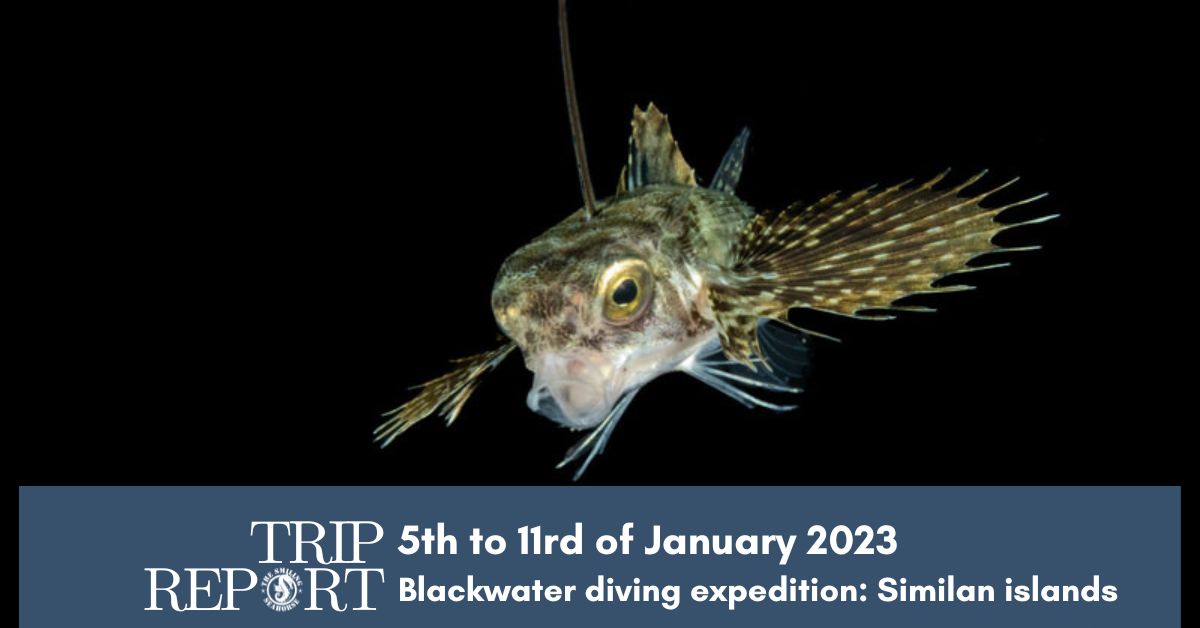
Oups, I’m a bit late posting this one! January has been a busy month full of photo opportunities, as we had the pleasure of welcoming our friend and photo-master-extraordinaire Alex Tyrrell from Dive4Photos back onboard. Alex came to give daily presentations to our guests during two consecutive photo clinics! The first was dedicated to blackwater diving, with daily blackwater dives above the deep, dark sea. The second was a more traditional underwater photography clinic, maximising every photo opportunity we could find. Check out the next blogpost for more information!
|
For our blackwater expedition, we welcomed some extremely well-equipped underwater paparazzi from Thailand, Singapore, India, the USA and France, all ready to have some fun. Our photo room has rarely been more crowded with cameras, cables, chargers and hundreds of batteries!
|
 |
We did the first dive at Shark Fin Reef for a check-up dive, then explored West of Eden and Elephant Head before finishing the day with the first blackwater dive of the week. Because this cruise was dedicated to blackwater diving, we headed to the edge of the continental shelf, a few hours west of the Similan Islands, giving us the opportunity to dive above hundreds of metres of deep water. And what did we see on these blackwater dives? So many cool and unusual creatures! We encountered pelagic life including anemone larvae, salps, a pelagic sea snake and flounder in their larval stages. The highlights of the trip were a male paper nautilus, larval snake blennies and flying gurnards. But photos speak a thousand words, so let me show you what it looked like!
 |
 |
Above, from left to right, you’ll see one of the many types of squid we encounter on blackwater dives in the Andaman Sea, a pretty golden filefish and a male paper nautilus! Read more about these fascinating nautiluses and their cousins, the argonauts. Males don’t have shells, while females produce a delicate shell-like structure to keep their eggs close by 🙂
 |
 |
 |
 |
Have you ever seen a pelagic nudibranch? This is what it looks like (top left); in the middle is a beautiful larval snake blenny, and on the right is a tiny baby crab. So cute!
 |
|
|
|
 |


In the four photos above, you can see a larval anemone, a larval flounder (before its eyes migrate to the other side of its face – yes, that’s a thing!), a reddish crustacean swimming in front of the cloud of ink left behind by a cephalopod, and finally an alien-looking sea snail crossing the open ocean with its sail-like tentacles.
 |
 |
 |
Flying gurnards (top left) are rarely seen on regular dives but can be surprisingly common on our blackwater dives. Moray eels (middle photo) look like transparent ghosts during their larval stage, before they grow large enough to settle back onto the reef. The photo on the right shows a sea elephant (Pterotrachea coronata), a finger-sized heteropod – a transparent marine snail that uses its trunk-shaped proboscis to hunt its prey. This gastropod looks nothing like your typical terrestrial snail!
 |
 |
We did blackwater dives at night, that’s true, and for those dives you don’t want to be on a dive site. But that doesn’t mean we didn’t want to enjoy some of the best dive sites in Thailand during the day! Above are some photos of Donald Duck Bay in the Similan Islands, where we went to dip our toes in the white sand and admire the incredible views across the Andaman Sea.
 |
 |
 |
 |
 |
 |
On our more regular dive sites, our macro lenses encountered plenty of colourful nudibranchs, shrimps and crabs, as well as harlequin shrimps, ghost pipefish and plenty more tiny reef creatures.
Thank you, Elodie and Emma, for the amazing male paper nautilus and pelagic tonguefish you photographed, and thank you to everyone else who shared this adventure with us. We loved it and hope you did too!
Thank you to all the guests who chose The Smiling Seahorse to take care of you all!




