
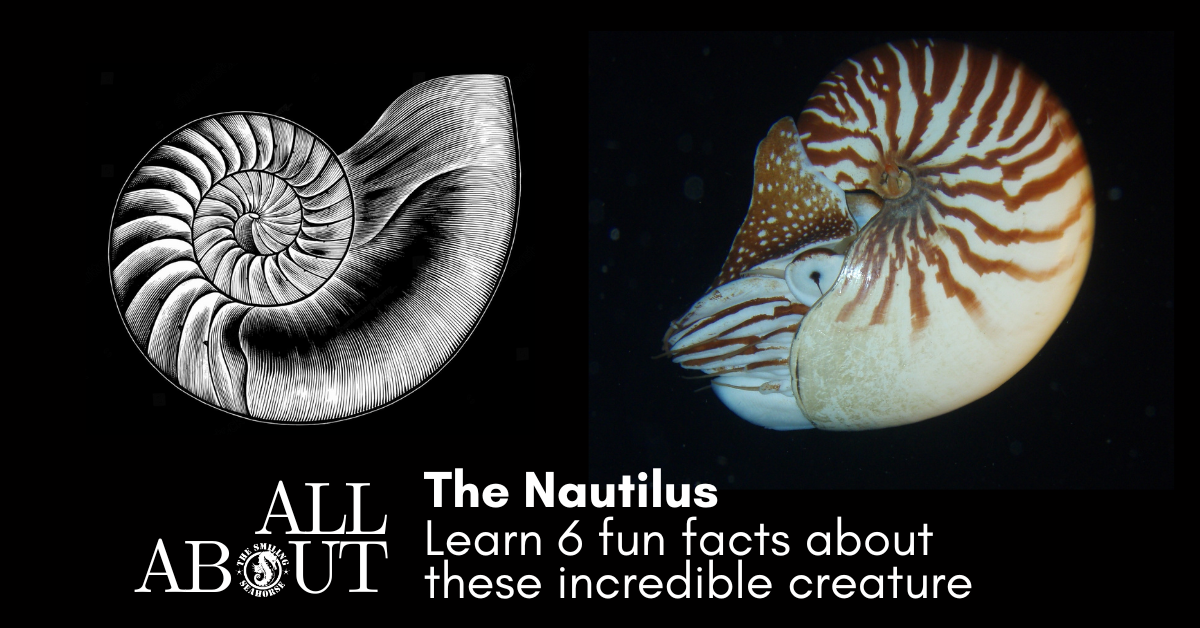
6 Fascinating Facts about NautilusNautilus measure 20 to 25cm in average. Its shell is white to orange with brown zebra stripes. Internal side of the shell is pearly white.
The Nautilus’ shell is made of isolated chambers, Nautilus are born with 4 chambers and build new chambers through time. Grown-up nautilus have more than 30 chambers. The creature (looking like a little octopus) lives in the newest chamber, which is also the biggest. The other chambers are filled with air and water to control buoyancy. A tube called the siphuncle goes through each chamber and is used to pass liquid and gas from one chamber to the other. The gas is initially diluted in liquid in one chamber and bubbles out when released in a second low pressure chamber. Just like opening a can of soda..
|
|

|
|
1- Nautilus moves by jet-propulsion by blowing out water through a siphon. Position of the siphon decides the direction of the nautilus: front, back, upward or descending. 2- Nautilus has 90 tentacles, situated outside the shell to catch and manipulate their prey. 3- Nautilus has a beak which cuts their food (crabs, shrimps and fish), just like other members of the octopus family. But unlike other members of the family, nautilus has poor visual perception. Eyes can only recognise light from dull, their smell is over developed and used for hunting their preys. 4- Nautilus spends their day at depths and moves toward the shallow water to hunt when the sun goes down. Nautiluses mate only once a year. 75% of nautilus caught to be studied are male and only 25% are females. Researchers don’t really know why. 5 – Nautiluses are true living fossils. They have been roaming the oceans for nearly 500 million years, with almost no changes in their appearance since they first evolved. Their iconic spiral shell, their way of life, and their unique biological features have remained remarkably stable throughout geological history. To put their age into perspective, nautiluses were already thriving 265 million years before the first dinosaurs appeared. These ancient creatures have survived multiple mass extinctions that wiped out countless other species, yet they continued to glide through the oceans with their timeless spiral shells. Today, they still drift gracefully through the deep, silent witnesses of an ancient world that existed long before mammals, birds, or even most fish as we know them. Despite their prehistoric origins, nautiluses remain surprisingly resilient. They have a long life expectancy, often living over 15 years in the wild—a remarkable lifespan for a marine invertebrate. Their slow, steady pace of life and their ability to adapt to deep, stable environments have contributed to their persistence through Earth’s most chaotic eras. Nautiluses are, in every sense, living relics of our planet’s distant past—beautiful, mysterious, and enduring. 6- A couple of nautiluses may have sex for up to 30 hours at a time… During intercourse, males often bite females on the mantle which will leave a mark on his partner’s shell. |


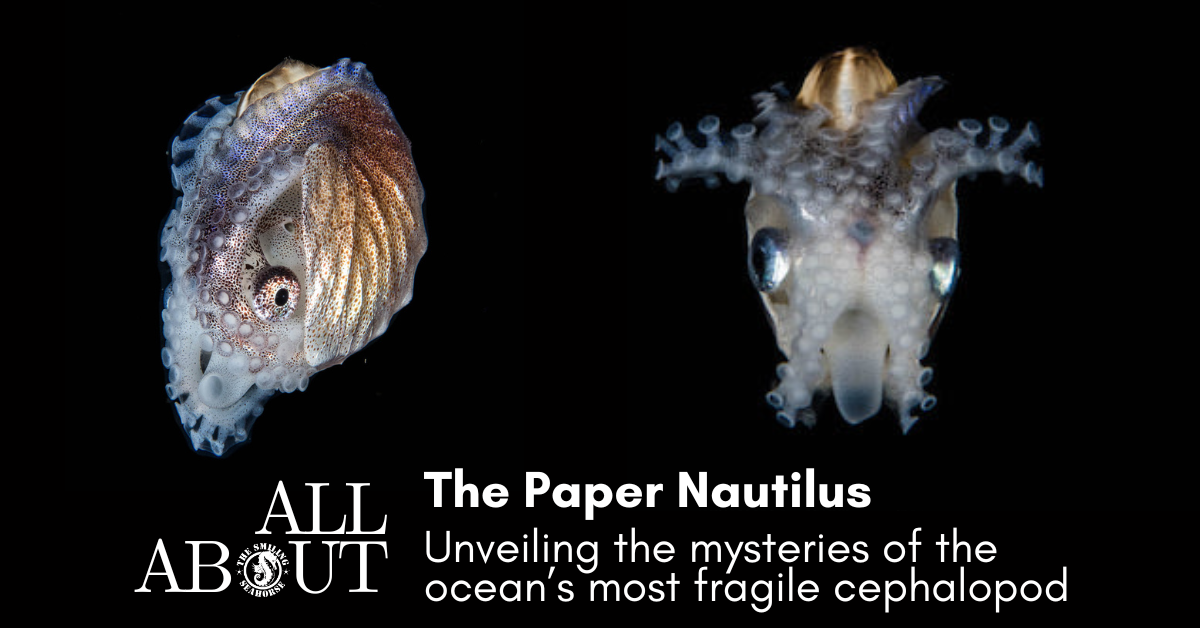
Paper Nautilus
|
Nautilus seen in March 2021 during a black water dive from The Smiling Seahorse
|
The reason I wrote this blog post is because we first came across this little fellow while diving Myanmar in 2017 but I just updated this article since our last sighting was in March 2021 in the Similans and we now have a few nice photos to add to this blogpost! 🙂
After some research, we found out that this weird creature is called paper nautilus or argonauts. We apparently encountered a female Argonaut as male are 10 times smaller (rarely passing the size of 2cm) and dont have a shell.Little is known about these creatures but I found these few facts interesting enough to share!One of the male’s arm serves as a penis and is snapped off his body during sex to inseminate the female. The arms then remains inside the female body. The female then secretes the papery shell with the tips of two tentacles. She lays her eggs inside the paper shell before using it as a house for herself. But the real cool fact about argonauts is their BCD (buoyancy control device). Have you ever encountered weirder octopus? |


3 Responses
Very informative, no nonsense, excellent!
Fascinated propulsion and in particular flotation of the nautilus. I am a retired engineer currently creating a bestiary inspired by medieval collections of beast illustrations. Some letters of the alphabet were in short supply but I am topping up with my own watercolour drawings: nesting wave albatross, marine iguana at cleaning station with pacific sergeant majors, Guanaco sentinal & Pichi. All spotted with ‘Think Galapagos’ tours. Thanks for reigniting my own sese of wonder.
What a beautiful articles and full of great information! Love it 🙂