
“`html
Morays and Eels of the Andaman Sea: A Guide to Thailand and Myanmar’s Eels
Did you know there are around 200 species of moray eels in the world, and that we can find quite a few of them in the Andaman Sea?
In this article, I wanted to present the incredible diversity of shapes, colours and patterns found among the moray eels and other eels we have encountered in the Andaman Sea. All the photographs below were taken by Franck Fogarolo, our cruise director and onboard photographer, on the west coast of Thailand and in Myanmar.
Morays vs Eels vs Sea Snakes?
All morays are eels, but not all eels are morays – and neither of them are snakes!
For example, garden eels and snake eels belong to the eel family but are not moray eels. So how can you tell them apart?


All eels are anguilliform: they have a long, snake-like body and fewer fins than many other fish, with no pelvic fins and, in many eel groups, no obvious pectoral fins. Like other true eels, morays have a dorsal fin that begins just behind the head, extends along the length of the body and is fused with the caudal and anal fins.
Unlike snakes, moray eels have no scales and can breathe underwater.
Sea snakes, on the other hand, are reptiles, just like turtles. They breathe through lungs and need to come to the surface for air, even pelagic sea snakes that spend much of their lives offshore. You can learn more about sea snakes in this fascinating blogpost.


Morays are present in tropical seas around the world, and they generally live around reefs and rocky bottoms. Most moray eels are nocturnal carnivores, hunting fish and crustaceans, and night dives are the best time to see them actively searching for their next meal.
Depending on the species, they can eat fish, molluscs such as squid and cuttlefish, and crustaceans such as crabs. During the day, most remain hidden in cracks or underneath rocks, leaving only their heads visible to scuba divers.
Most moray eels need to keep their mouths open to breathe: water passes through the mouth and over their gills. Although their visibly long and sharp teeth can scare many novice divers, morays are generally quite skittish animals. They will usually prefer to retreat into their hole rather than confront a diver.
Morays have no scales and no pelvic fins, and their fascinating diversity makes them some of the most entertaining animals to look for while diving in Thailand and around the Andaman Sea.
A Few Moray and Eel Species Encountered in the Andaman Sea
Giant Moray Eel
The largest species we can encounter in Thailand and Myanmar is the giant moray eel (Gymnothorax javanicus).
It is one of the three largest morays in the world and can measure more than 3 metres in length. While its size is impressive, its brown colour is relatively dull compared with some of the more colourful species below.


White-Eyed Moray Eel
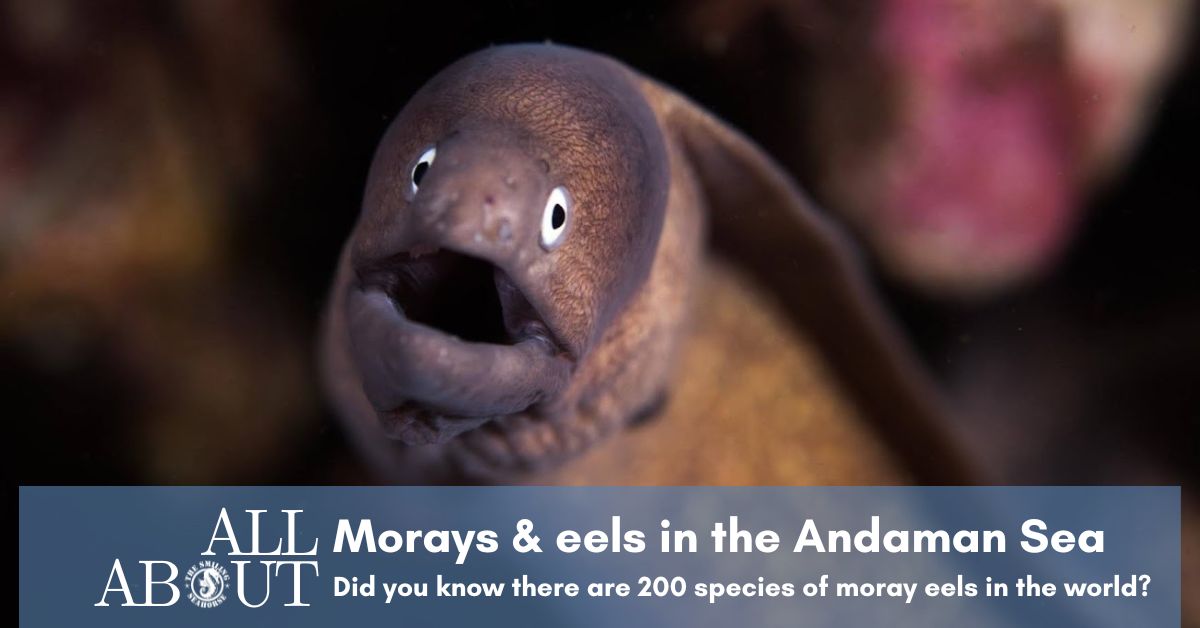
A much smaller moray eel we often find is the white-eyed moray (Gymnothorax thyrsoideus), also called the greyface moray.
Its body is speckled with small dark spots and has a predominantly beige colour that can vary in intensity between individuals. They all have those distinctive white eyes, however.
This moray loves shallow water and can live in lagoons or protected reefs. The white-eyed moray is only about 40 cm long, and it is not unusual to see three or more of them living together in the same crack.


Ribbon Eels
Surprisingly enough, the striking ribbon eel (Rhinomuraena quaesita) is also part of the moray eel family and is surely one of my favourites because of its distinctive colours.
Ribbon eels are particularly memorable for their spectacular appearance, and you can learn more about the drag queen of the seas in our dedicated ribbon eel article.


Honeycomb Moray
Another pretty species is the honeycomb moray (Gymnothorax favagineus). Also known as the leopard moray, tessellate moray or laced moray, its body is white and covered with dark brown spots, evoking the coat of a leopard.


Zebra Moray
Another interesting specimen is the zebra moray eel (Gymnomuraena zebra). This species can live for 10 to 20 years and reach a maximum length of around 150 cm.
Zebra moray eels are often confused with banded sea snakes, but look at their shape and pattern more closely and you will surely be able to tell one from the other.


Clouded Moray
We can also find the clouded moray (Echidna nebulosa), also called the snowflake moray.
This moray is recognisable thanks to its light-coloured body with two rows of large dark blotches along its sides. This species also has yellow eyes.
Clouded morays do not have sharp teeth but possess small, blunt teeth. They feed mainly on crustaceans.

Fimbriated Moray
We can also regularly observe the fimbriated moray (Gymnothorax fimbriatus). These greenish morays have bodies covered with black spots. In juveniles, the spots are much larger.
They are normally bright yellow or green in colour and have a longer snout than many other species, making them another fascinating moray to look for while diving in the Andaman Sea.


Bar-Tail Moray
Another shy moray eel that is not rare to see, but always quite fast to hide away, is the bar-tail moray (Gymnothorax zonipectus).
This species is easily identified by the light spot between the eye and the corner of the mouth, the long snout and nostrils, and the strongly defined, banded pattern of the body. This moray eel likes shallow waters and is usually quite solitary.

Barred Moray Eel
The barred moray (Echidna polyzona) holds many names: girdled moray, banded moray, barred moray, many-banded moray eel, ringed moray, striped moray and zebra eel.
With a maximum length of about 1 metre, these eels have a distinctive appearance, featuring dark brown or black bands across their yellow or cream-coloured bodies. They inhabit shallow coastal waters, including rocky reefs and coral reefs. Being nocturnal predators, they emerge from their hiding places at night to feed on small fish and crustaceans.

The Highfin Moray
The highfin moray (Gymnothorax pseudothyrsoideus) is another rarer species of eel found in the Indo-Pacific region.
The highfin moray is known for its elongated body and distinctively tall dorsal fin, which extends along much of its back. This impressive fin gives the species its common name, “highfin” moray. The eel can grow up to 1 metre in length.
These eels are typically found around coral reefs and rocky areas, often hiding within crevices or coral formations. They are skilled hunters, feeding primarily on fish, crustaceans and other small marine organisms.
Highfin morays are generally nocturnal, becoming more active and feeding during the night. They have a keen sense of smell and use their strong jaws and sharp teeth to capture prey.

Yellow-Headed Moray
Gymnothorax rueppelliae is most commonly known as the yellow-headed moray. This striking Indo-Pacific reef species is recognised by its contrasting dark brown body marked with pale vertical bands and its distinctly yellow to yellow-tan head.
It inhabits coral reefs, lagoons and outer reef slopes, hiding in crevices by day and emerging at night to hunt small fish and crustaceans.
It is sometimes confused with the Gymnothorax fimbriatus, but the yellow-headed moray typically shows broader, more clearly defined pale bars that fully encircle the body and a comparatively cleaner, solid-coloured head. The fimbriated moray, by contrast, usually has finer, more mottled banding and noticeable speckling on the head and jaws.
Despite its sharp teeth and open-mouthed resting posture, the yellow-headed moray is generally shy and plays an important role as a nocturnal predator within reef ecosystems.

Tiger Reef Eel
The tiger reef eel (Scuticaria tigrina) is a rare species of moray eel primarily found around coral reefs and rocky areas in the Indo-Pacific region.
Other names for this funny critter include tiger reef-eel, tiger snake moray, tiger moray eel, tiger moray, tiger eel, spotted eel and spotted snake moray.
Tiger reef eels are primarily nocturnal predators, preying on small fish and crustaceans. They utilise their strong sense of smell and excellent camouflage to ambush their prey. Their elongated body is densely marked with dark blotches and can reach lengths of up to 70 centimetres.

Did you know?
You can even see eels on blackwater dives! Such a cool, alien-like critter!

From tiny larval eels drifting through the darkness to enormous giant morays hiding in reef crevices, the diversity of eels in the Andaman Sea is remarkable. Keep your eyes open on both day and night dives, and you never know which strange-looking eel might appear!
Discover More About Diving and Marine Life in the Andaman Sea
Moray eels are just one small part of the extraordinary marine biodiversity found along the west coast of Thailand and around Myanmar. If you enjoy discovering unusual reef animals, these guides are a great place to continue exploring:
- All About the Magnificent Ribbon Eel – discover one of the Andaman Sea’s most spectacular morays.
- Incredible Cephalopods – meet octopuses, cuttlefish and other masters of camouflage.
- 101 Nudibranchs of Myanmar – explore some of the tiny and colourful animals found on Myanmar’s reefs.
- Marine Life of Thailand and the Andaman Sea – discover the incredible diversity of species found beneath Thailand’s waters.
- Diving in Myanmar – explore the reefs, walls and remote dive sites of the Mergui Archipelago.
- Diving in Thailand – discover the Andaman Sea’s best-known dive destinations.
Whether you are looking for a giant moray tucked beneath a reef ledge, a colourful ribbon eel emerging from its burrow or a tiny white-eyed moray hiding among the rocks, keep your eyes open on your next dive. Once you start looking for them, you will probably realise that the Andaman Sea has far more eels than you ever noticed before!
“`




