
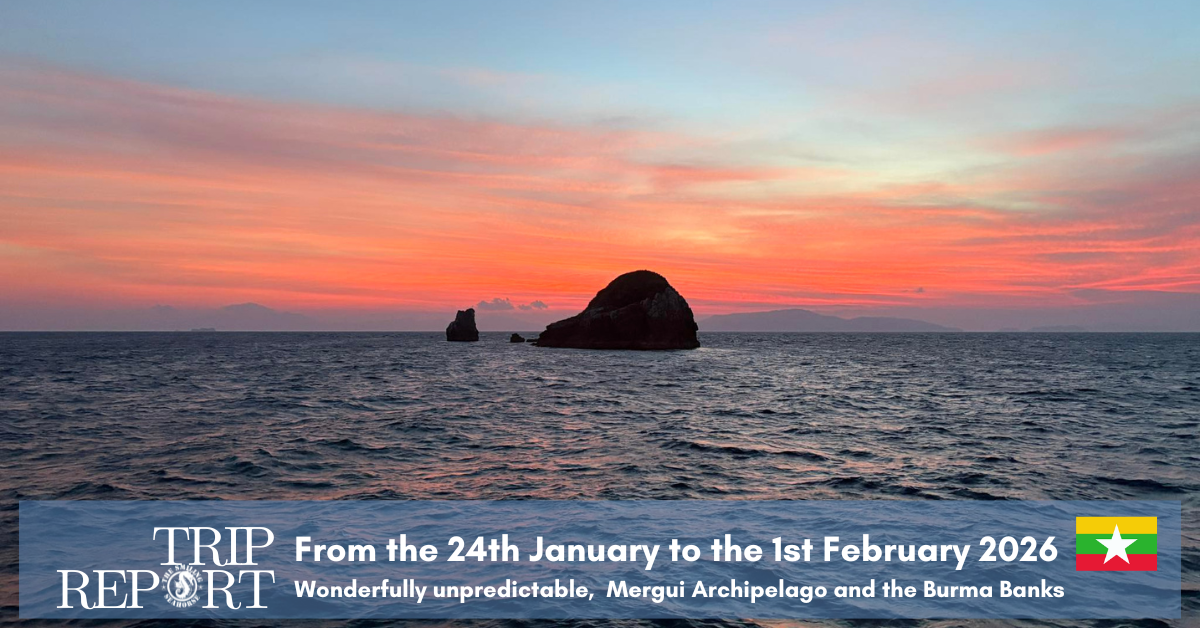
Mergui Archipelago and Burma Banks: An Andaman Diving Expedition
Remote, wild and wonderfully unpredictable, this expedition through the Mergui Archipelago and out to the Burma Banks delivered the full spectrum of Andaman diving. From open-ocean giants to minute macro masterpieces, the week unfolded as a constant contrast between power and precision, blue-water encounters and slow, detail-driven exploration.
Day 1 – From Ranong to the Mergui Archipelago
After clearing Thai immigration at Badin Pier in Ranong, we welcomed an international group of guests from Switzerland, Israel, France, Germany, the Netherlands, the USA, Norway and Finland. A smooth crossing to Kawthung allowed us to complete Burmese immigration before setting course north into the Mergui Archipelago.
As the mainland disappeared, jungle-covered islands emerged on the horizon, hinting at the untouched reefs ahead. Quiet anchorages, mangrove-lined bays and the feeling of true exploration set the tone for the days to come.


Day 2 – South & North Twin Reefs
Our first dives at South Twin Reef offered a gentle re-entry into the underwater world, blending colourful reef life with outstanding macro. Walls were decorated with Flabellina species and Chromodoris annulata, while squat shrimps and Durban dancing shrimps shared crevices with peacock mantis shrimps.
Schools of lined surgeonfish and ringtail surgeonfish cruised steadily above the reef, joined by clouds of neon and yellowback fusiliers. Out in the blue, dogtooth tuna made fast passes, while giant moray eels watched from their lairs and batfish hovered calmly above coral bommies. Tiny juvenile anemonefish added delicate movement among soft corals and sea anemones.
Dive three at North Twin Reef shifted the balance slightly towards larger reef predators. Octopus activity was constant, giant moray eels dominated the cracks, and powder-blue surgeonfish, coral groupers and titan triggerfish patrolled the reef. Macro lovers were rewarded again with Chromodoris annulata, Halgerda species and Flabellina nudibranchs tucked into the reef structure.
The night dive in North Twin Bay brought a dramatic change of pace. Octopus and cuttlefish hunted actively, squid hovered in midwater, jellyfish sheltered juvenile fish, and big red reef crabs marched across the sand. Scorpionfish and bar-tail moray eels emerged, while parrotfish and triggerfish slept wedged into the rock, trigger spines firmly locked in place.


Day 3 – Black Rock
A full day at Black Rock delivered the classic mix of adrenaline and detail that defines this iconic site. Morning dives were highlighted by curious oceanic manta rays circling gracefully above the pinnacle. Around them, schools of chevron barracuda, blacktip trevallies, bluefin trevallies, golden trevallies and bigeye trevallies formed shifting walls of silver.
On the reef itself, coral groupers and peacock groupers shared space with powder-blue and velvet surgeonfish. Giant moray eels and yellow-edged moray eels filled the cracks, while batfish lingered in the lee of the current. Neon and yellowback fusiliers formed dense, constantly moving clouds around the rock.
Macro life was just as intense: Bornella anguilla, Goniobranchus geometrica, white-bump sapsucking slugs, golden wentletrap snails, tiger cowries, peacock-tail anemone shrimps and broadclub cuttlefish expertly camouflaged on the seafloor.
The night dive revealed yet another side of Black Rock. Pygmy squid hunted small shrimps, devil scorpionfish lay in wait, and bar-tail moray eels cruised openly. Tiger cowries, money cowries and mole cowries dotted the reef alongside basket stars, sea cucumbers and massive hermit crabs. Moridilla brocki and slender Roboastra added vibrant flashes of colour to the darkness.


Day 4 – Three Islets & Crossing to the Burma Banks
At Three Islets, we explored Submarine, Shark Cave and Square, enjoying a rich mix of reef fish and macro highlights. Bamboo sharks rested under ledges, while cleaner pipefish and orange-spotted pipefish hovered above soft corals. Schools of neon, yellowback, slender and twinstripe fusiliers streamed past chevron barracuda and passing trevallies.
At Shark Cave, tomato anemonefish and Clark’s anemonefish guarded their homes alongside anemone crabs, while white-eye and honeycomb moray eels patrolled the reef. Macro finds included Nembrotha lineolata, Cuthona sibogae, mouthbrooding cardinalfish and Chromodoris annulata.
Square delivered tigertail seahorses, orange-spotted pipefish, batfish, yellowtail barracuda and golden trevallies, with Goniobranchus geometrica, egg cowries and juvenile seahorses tucked into the reef. A Kuhl’s stingray glided silently across the sand.
The night dive was packed with life: blunt decorated crabs, cone snails, princely cones, tiger cowries, gorgonian crabs, juvenile cuttlefish, marble rays hunting, basket stars, sleeping filefish, toadfish and hunting moray eels.
After the final dive, we headed west towards the Burma Banks, isolated seamounts rising from deep water and famous for shark encounters and wide-open pelagic scenery.


Day 5 – Burma Banks
At Row Bank, adult and juvenile nurse sharks dominated the scene, resting on sandy ledges and cruising slowly along the reef. Powder-blue and lined surgeonfish mixed with oriental sweetlips and two-spot butterflyfish.
Coral groupers and peacock groupers held position near the reef, while cleaner wrasse and sixline wrasse worked constantly. Basslets hovered close to the reef face, and yellow-saddle goatfish sifted the sand.
Rainbow Bank continued the shark theme, with more nurse sharks, schools of humpback unicornfish and sleek unicornfish, batfish, longnose emperors and large schools of black-and-white snappers mixed with giant one-spot and five-lined snappers. Great barracuda patrolled the blue, while honeycomb moray eels filled the cracks.
Due to weather conditions, we made the decision to head back towards the archipelago, trading open ocean for shelter and macro-rich reefs.


Day 6 – Western Rocky
The morning began at Volcano, also known as Shark Lagoon. Inside the lagoon, hard corals framed the dramatic rock amphitheatre, while colourful sponges and soft corals painted the walls in yellow, orange, pink, purple and green. Spirit mantis shrimps guarded their burrows, Cuthona sibogae and blue dragons crept across the reef, and tigertail seahorses clung to gorgonians.
Western Rocky, including the Islets, the Cave and Eagle’s Rock, delivered classic big-and-small contrasts. Schools of trevallies, fusiliers and yellowtail barracuda swept past lionfish, scorpionfish and titan triggerfish.
Giant moray eels filled the Cave, alongside Glossodoris hikuerensis, Risbecia pulchella, Bornella anguilla, Hypselodoris decorata, blue dragons and octopus. Five-lined snappers filled the chamber, while the Islets revealed harlequin shrimps, honeycomb and leopard moray eels and flashing flasher wrasses.


Day 7 – Sea Fan Forest
At Sea Fan Forest, towering purple soft corals and massive sea fans framed a thriving reef. Giant stonefish rested among the bases, while sleeping giant moray eels, rainbow runners and golden trevallies passed through the forest of fans. Schools of neon and yellowback fusiliers streamed overhead, joined by coral and peacock groupers, wrasses, blennies, parrotfish and triggerfish.
Macro highlights were abundant: Bornella anguilla, juvenile and adult Chelidonura punctata mating and laying eggs, Goniobranchus collinwoodi, Glossodoris cincta, Goniobranchus geometrica, devil scorpionfish, mating pharaoh cuttlefish, zebra moray eels, banded sea snakes, octopus and ornamental nudibranchs.
Some divers opted for a blackwater dive, encountering juvenile squids, larval crustaceans, tiny jellyfish, larval triggerfish and drifting eel larvae glowing in the darkness.


Blackwater Diving | Myanmar
Day 8 – Dendro’s Peak & Western Rocky
At Dendro’s Peak, giant, golden and bluefin trevallies hunted schools of juvenile and naked fusiliers. Rainbow runners sliced through the current, while stonefish, fimbriated moray eels and Chromodoris annulata decorated the reef. Common reef fish such as surgeonfish, butterflyfish, angelfish, wrasses and parrotfish filled the background.
The following dives at Western Rocky focused heavily on macro. The Islets and Eagle’s Rock delivered Glossodoris rufomarginata, large Goniobranchus reticulata, Hypselodoris decorata, resting marble rays, Maldivian sponge snails, Aldisa albatrossae and Bornella anguilla.
The Cave continued the nudibranch parade with Glossodoris averni, polka-dot phyllidia and Phyllidiopsis species.
The day ended with our traditional BBQ and boat party under the stars.


Day 9 – Dendro’s Peak & Farewell
Our final dive returned to Dendro’s Peak, where giant moray eels, Clark’s anemonefish, and schools of rainbow runners and trevallies provided a fitting farewell. Naked, neon and yellowback fusiliers, stonefish and banded sea snakes filled the water column, while cowries and colourful nudibranchs such as juvenile Goniobranchus annulata and Gemini offered last macro moments.
After surfacing, we headed back to Kawthung for Burmese immigration, shared a final drink at the Smile Bar, and returned to Ranong, closing another unforgettable Mergui Archipelago and Burma Banks adventure aboard the MV Smiling Seahorse.


A Week of Exploration in the Mergui Archipelago and Burma Banks
This expedition brought together everything that makes diving in the Mergui Archipelago so rewarding: remote reefs, dramatic pinnacles, wide-open blue water and an extraordinary concentration of marine life.
From the first dives at South Twin Reef to the oceanic manta rays of Black Rock, the nurse sharks of the Burma Banks and the macro-rich reefs of Western Rocky, every destination offered a different character. Some dives were all about movement and big animals, while others rewarded patience with tiny nudibranchs, shrimps, seahorses and other hidden treasures.
The journey was also a reminder of how quickly conditions can shape an expedition in this remote part of Myanmar. Weather eventually sent us back towards the shelter of the archipelago, but that change of plan opened the door to more macro-rich diving and further exploration of some of the region’s remarkable reefs.
By the time we returned to Ranong, we had crossed a remarkable section of the Andaman Sea, from jungle-covered islands and quiet anchorages to isolated seamounts surrounded by deep blue water. Another Mergui Archipelago and Burma Banks adventure came to an end, leaving plenty of memories from both the large and the very, very small.




