Your First Time Night Diving? How To Stay Calm And Collected
Diving at night is a “Same Same but Different” experience from diving during the day.
The main difference is that instead of being able to see all around you in every direction, you are surrounded by darkness and can only see what is illuminated by the beam from your diving light. But there is something fascinating about this limitation: you can actually see colours much better under the beam of your torch than you do in the natural light of the day. The reef can appear incredibly vibrant at night, with bright coral polyps extending from their skeletons to feed.
For your first night dive, that change can feel strange. The darkness makes the underwater world seem smaller, quieter and more mysterious, but it also gives you the opportunity to concentrate on details that you might completely overlook during the day. Instead of looking at the whole reef at once, you discover it one little illuminated patch at a time.
Night diving can be a daunting prospect, but there are a few things you can do to ease yourself into this unique experience so you can feel prepared and relaxed when you take to the water.
It’s Not All That Scary!
Diving at night can seem scary at first. The more you think about it, the more deep-sea monsters you probably imagine. But night diving can offer an added touch of magic and, because you will feel alone in your own “bubble of light”, it can quickly become your favourite meditation time.
Basket stars bloom at night
What Can You See on Night Dives That You Don’t See During the Day?
Some sea creatures are nocturnal and can only be seen at night, while others behave very differently once the sun has gone down. Animals that spend the daytime hiding in holes, under rocks or inside the reef can emerge to hunt and feed, making a familiar dive site feel completely different after dark.
This is one of the great attractions of night diving. You are not simply visiting the same reef with less light; you are visiting the reef at a completely different moment in its daily cycle.
Eels Come Out on Night Dives
For example, it is pretty common in our waters to see giant moray eels hunting at night while we usually only see their heads popping out of a hole during the day. At night, they are often seen free swimming and foraging for food, and so are many crabs that hide in the reef during the day.
Seeing a moray eel swimming freely rather than simply watching its head emerge from a crevice can be quite a surprise the first time you encounter one. The darkness also changes the way you observe the animal: your torch picks out its head, eyes and teeth against the blackness while the rest of the reef disappears outside the beam.
Moray eel searching for food at night
A beautiful moray head in the dark
And So Do Crustaceans — They Love Going Out at Night…
Crustaceans are also crawling out of their crevices in all types and shapes during the night, and you will be amazed by their shiny eyes in the dark, twinkling like stars in the sky.
Lobsters like to hide during the day and go hunting at night, when they can be seen out crawling on the reef. The same goes for shrimps, whose eyes can shine bright red when caught in the beam of your torch.
Slipper lobster, never seen during the day!
Spiny lobster comes out at night
Tapestry Shrimp
Durban Dancing shrimps
You wouldn’t believe the crabs we see at night, camouflaging themselves as much as they can with their surroundings. Once you start looking carefully, the reef seems to be full of movement that simply wasn’t obvious during the day.
Decorator spider crab
This sponge crab attaches a sponge, or piece of coral, to its back to “hide”
Basket stars only come out at night and, in the maze of their arms, you can find these cute little shrimps.
There are all types of cool hermit crabs too, living in discarded shells. The anemone hermit crab lives in symbiosis with anemones attached to its shell, giving it some protection.
Small shrimps hiding among the arms of a basket star
Have you ever taken a closer look at their eyes! I love them so much!!!!
Hermit crab showing its beautiful colours
The Mollusc Family Also Has a Few Night Owls!
Most shells are nocturnal
In the mollusc family, you will see plenty more nudibranchs, sea slugs and shells coming out as well. It is not uncommon to see shells during the day, but some only really come alive at night, when you can see their bodies out feeding or moving around.
For example here, a giant Triton shell eating a seastar
A cute nudibranch
In the Nudibranchia family, you will meet some nocturnal creatures, such as the gorgeous Spanish dancer. Here again, it is quite common to see Spanish dancer eggs during the day, but while the adults are pretty big, we rarely see them around during the day.
Spanish dancer is a nocturnal nudibranch swimming with a lovely flamenco skirt…
Spanish dancers are pretty big nudibranchs only seen at night
What Cephalopods Come Out at Night?
Cephalopods are also mostly nocturnal creatures. While squids can be seen schooling during the day, they rarely come as close as the individuals attracted by our torches at night.
Night diving can make cephalopods particularly fascinating to observe because your torch isolates them against the darkness. Squid can suddenly appear in the beam, hover for a moment and then disappear back into the blackness.
Pygmy squid are only seen during night dives
Squid are a lot more photogenic at night!
Coral blooming at night
One of the most fascinating things about diving at night is seeing the coral bloom. Coral polyps come out at night to feed, extending their tentacles to catch plankton and other small organisms. The reef can therefore look completely different after dark, with delicate coral polyps extending from structures that may look almost lifeless during the day.
Your torch also brings the colours back to life. Without artificial light, colours disappear quickly underwater as the available light changes with depth. Shine your torch onto the reef at night and suddenly reds, yellows, oranges and other colours can appear vibrant again.
On your first night dive, you may also experience the natural phenomenon of bioluminescence and feel like Harry Potter has given you his special wand! When the water is touched or disturbed, it can appear to light up as if by magic.
This effect is caused by plankton and can only be seen in certain locations and at certain times. In Thailand it can be seen pretty much every night, although it can be much stronger at certain times.
These experiences are unique to night diving and add an extra layer of excitement to an already different way of exploring the reef.
Prepare for Your Night Dive
Preparation is key when it comes to any kind of diving, but for diving at night it can be even more important. When you are comfortable with your equipment, your buddy and the dive site, there is much less for your brain to worry about once the sun has disappeared.
Before you head out for a night dive, it can be a good idea to dive at the same spot during the day. This gives you a better idea of what to expect in terms of the underwater landscape, environment and the type of conditions you might experience.
As well as diving in the same location during the day, you could also dive at the same spot at dusk or dawn. This allows you to experience the dive site when there is limited light, but just enough that you are still able to see most things around you.
Divers in Western Rocky cave
Diving during dusk could help to ease you into the night-diving experience, as it will get dark gradually during your dive.
While you can see a wide view of the underwater landscape on a dive during the day, your night-diving experience will be much different because you usually only look within the beam of your torch. You will be able to pick out more detail in a smaller area, offering a new perspective and letting you discover new sights. That is in addition to the nocturnal creatures that you might not have seen during a daytime dive.
Pack Your Diving Lights
As well as your essential diving gear, you will need to consider the additional equipment you are likely to need to dive in the dark.
One of the most important pieces of equipment for night diving is your primary diving light. This allows you to see in front of you, helping you navigate the underwater world in the dark. It also lets you view reef structures, caves and marine life that would otherwise disappear into the darkness.
Wonderful sea fans on a night dive
Your light should be bright enough, with enough lumens, for you to easily see where you are going underwater, but it does not need to be the brightest light on the market. An excessively powerful beam can be blinding to you, your buddy and the sleeping fish you may encounter!
The width of the beam can also be an important consideration and will likely depend on the conditions where you plan to dive. A light with both a wide beam and a spotlight can be useful, especially if you want to switch between illuminating a larger area and getting a close-up look at something in a tight space.
Think about the length of time you plan to dive and select a light with adequate battery life. Running out of light is not something you want to discover halfway through a night dive.
For night diving, you should also have a secondary light in case your primary light fails. This one should still be bright enough to enjoy the end of the dive and to signal your position to the boat once you reach the surface.
Another useful light for safety and visibility is a tank light. This lets your diving partner know where you are and vice versa. These lights are usually small LEDs and can either be flashing or continuous. However, it is actually pretty difficult to lose your dive buddy at night unless they turn off their diving torch — and even then, they will still be able to see you very well!
Round Up Your Diving Buddy
A diving partner can be even more essential for a good night dive, as you can help to keep each other safe and share your underwater discoveries.
Preparing for the night dive
Ready for the night dive
Before you enter the water, make sure you both know each other’s communication signals, including light signals. This means you can reassure each other, communicate underwater and alert each other if something needs attention.
It can be a good idea to dive with a partner who has experience with night diving, especially if it is your first time. Using familiar equipment can also help, as finding your marks on new equipment is harder in the dark.
Choose a Shallow Dive Spot
A shallow diving site with little to no current is ideal for your first night dive. Seeing the bottom from the moment you jump into the water can help reassure you on the way down rather than crossing a patch of dark water until you reach the reef.
A familiar, sheltered site also allows you to concentrate on getting comfortable with the darkness rather than dealing with several new challenges at the same time. Once you become accustomed to night diving, the darkness itself quickly becomes much less intimidating.
The MV Smiling Seahorse diving platform
Know the Hazards
It can be helpful to do a little research on the nocturnal marine life in the area where you plan to dive. This can give you a better idea of what to expect in terms of potentially dangerous marine animals that you may encounter.
In Myanmar, for example, we have a lot of crocodile needlefish right under the surface, and they can become spooked and disoriented if divers jump on top of them with lights shining directly into their eyes. This can be the biggest hazard you encounter here, as they might go straight towards the light without seeing that you are behind it, and their beak is pretty sharp!
Turning off your light to jump in is the easiest way to avoid this collision, as they will easily see and avoid you. You can then turn on your dive torch before descending.
Be careful if there are crocodile needlefish in the area!
Needlefish have a pointy nose!
Crocodile needlefish aren’t the only ones reacting like a deer in the headlights. Giant barracudas hunting at night can look pretty scary when they turn towards your torch with their sharp-toothed smile!
Lighting yourself with your torch is the best way to show them that you are indeed a human behind the light, and they will do just like during the day: they will move away from you.
Barracuda on a night dive
Barracuda portrait
Just like during the day, placing your hand on a scorpionfish can end painfully! The best way to avoid this kind of injury is to maintain good buoyancy control and avoid touching anything. Night diving is a great opportunity to observe marine life, but it is important to give the animals plenty of space.
How Long Does a Night Dive Last?
You don’t need to dive for as long as you do during the day, especially if it is your first night dive, but you can. Discuss this during your briefing with your dive guide and dive buddies, and agree on a hand signal to say “you’ve had enough” or “you want to stay a little longer”.
You may be surprised that, once you get used to the darkness, you may actually want to make the dive longer than you planned. As night dives are generally pretty shallow, it is quite common to come back to the boat with some air in your tank and far from reaching your NDL.
Cool in the sunset…
Ready to jump!
What Is Blackwater Diving?
Night diving is usually done on a reef. But there is also a new way to dive at night: offshore. Have you heard about Blackwater diving?
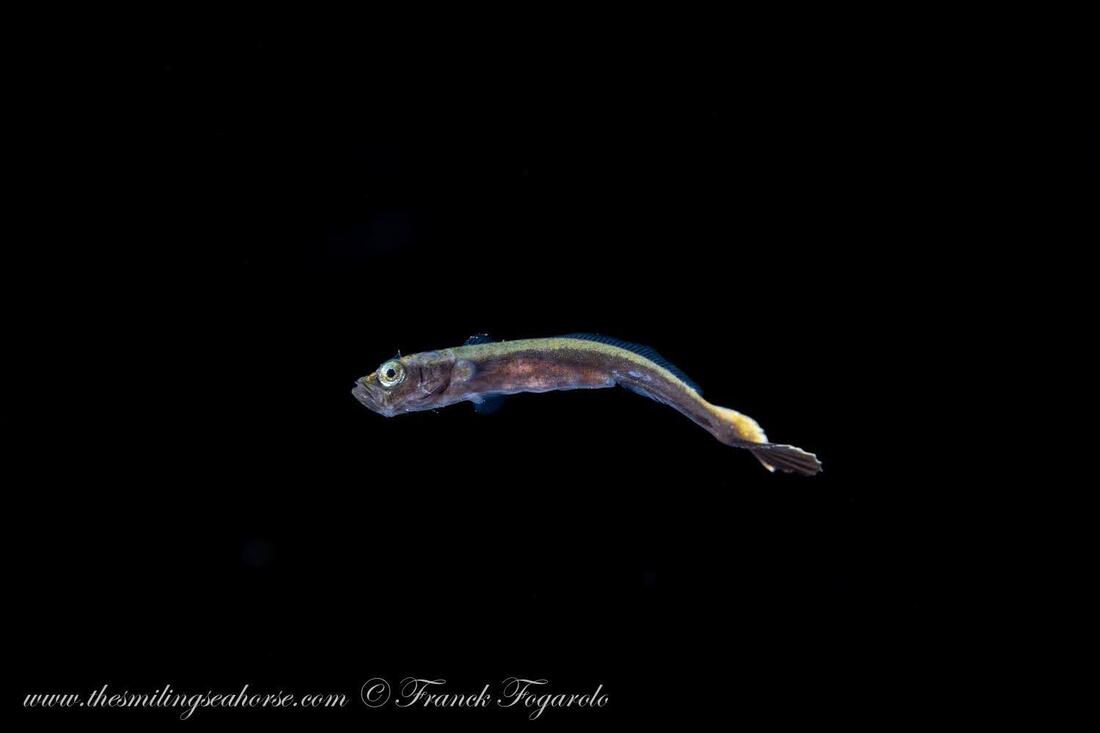
It is a night dive in the open ocean over hundreds of metres of water. We do not look at blooming coral on these dives, but they let you witness some of the most mesmerising “ocean babies”, including all types of larvae, cephalopods and crustaceans living in the open seas.
The Smiling Seahorse is the only liveaboard in Thailand offering Blackwater diving on every cruise, but most liveaboards offer the more traditional night diving on the reef.
Blackwater diving is therefore a very different experience from a conventional night dive. Instead of following the reef, you are looking into open water and waiting for the incredible variety of pelagic life that rises towards the surface during the night.
Pelagic octopus: Paper Nautilus
Deep-sea fish: Tripod fish
On Blackwater dives, you can see marine life that we know from the reef at its larval stage, but also some fish and other animals that are rarely encountered on the reef, including deep-sea and pelagic creatures such as the paper nautilus and tripod fish that usually live at depths of hundreds of metres.
For divers who enjoy marine life and underwater photography, this can open up an entirely different side of the ocean. Instead of searching around rocks and coral, you watch the darkness for something tiny, strange or completely unexpected to drift into your torch beam.
Ready to Try Your First Night Dive?
Your first night dive doesn’t have to be intimidating. Choose a familiar and shallow site, make sure your equipment is ready, dive with a buddy you trust, communicate clearly and give yourself time to become comfortable with the darkness.
And remember: the darkness is not the absence of the underwater world. It simply changes how you see it. Once your eyes and your mind adjust, that small bubble of torchlight can reveal an incredible amount of life — much of which was hiding from you during the day.
Get in touch to book your next holiday and try night diving with us!








One Response
This is a great article–and the photos are superb!