
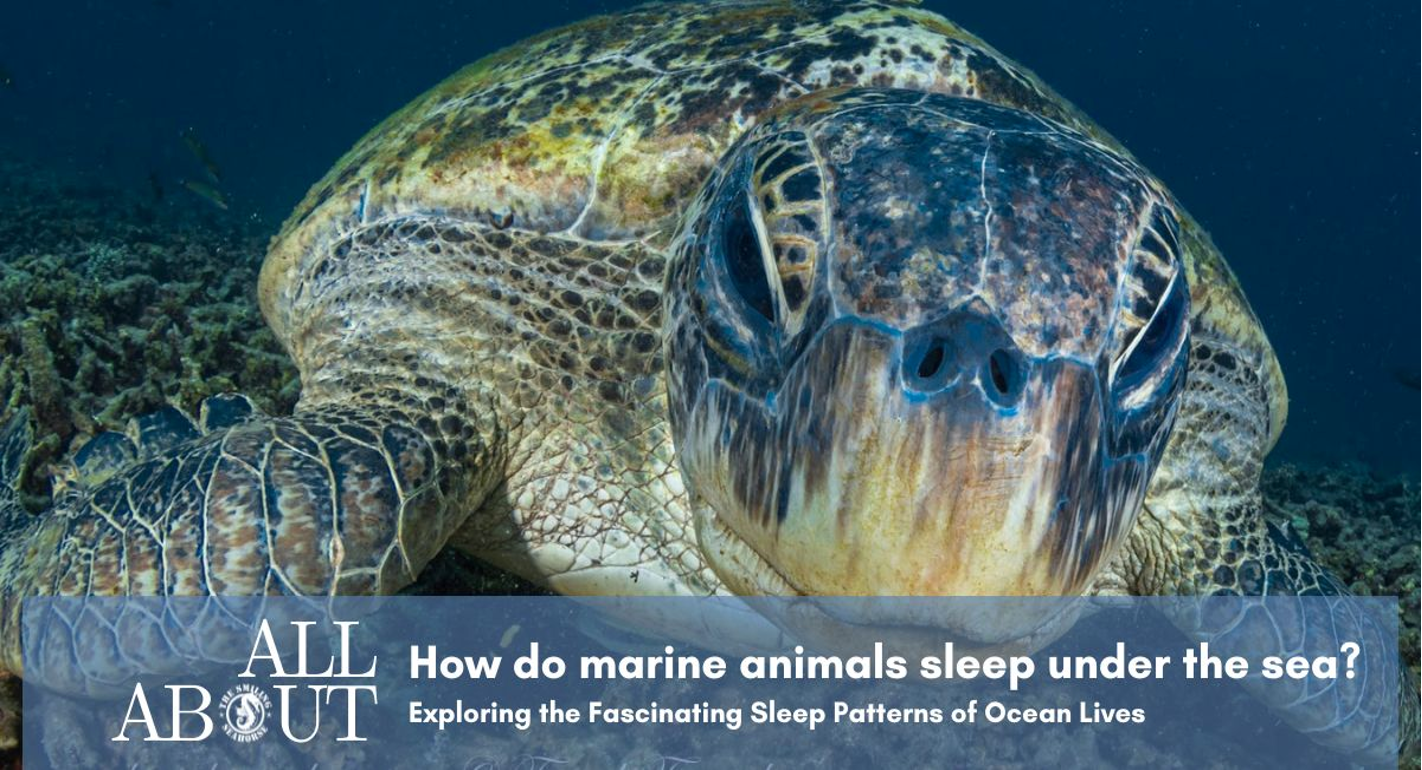
Exploring the Fascinating Sleep Patterns of Ocean Life
Have you ever wondered how marine animals sleep? When you are underwater, it is easy to forget that the creatures around you have completely different ways of resting. Some can settle down on the seabed, some keep swimming while they rest, and some can even sleep with half of their brain at a time!
Sleep is essential for animals, but in the ocean it is not always as simple as closing your eyes and settling down for the night. Marine animals have evolved some fascinating ways to rest while still dealing with predators, breathing, currents and the simple problem of living underwater.
Animals that can breathe underwater
Fish can breathe underwater, so they do not need to come to the surface for a breath of air when they are resting. But that does not mean they simply fall asleep in the same way we do.
Most fish do not have eyelids, which makes it rather difficult for us divers to tell whether a fish is actually sleeping! Scientists therefore look at changes in activity and behaviour to understand when fish are resting. Depending on the species, fish may rest in coral crevices, caves, among rocks or on the seabed.
Some fish have developed particularly ingenious ways of spending the night. Parrotfish, for example, can create a protective sleeping bag out of mucus and rest inside it. The mucus cocoon is thought to provide protection while the fish is sleeping, including making it more difficult for some predators and parasites to detect them.
If you are lucky enough to encounter a sleeping parrotfish while diving in the Similan Islands or elsewhere in the Andaman Sea, try not to shine your torch directly at it. After all, nobody likes being woken up by a diver with a very bright flashlight!
 Parrotfish Create a Protective Sleeping Bag Out of Their Own Mucus and Rest Inside it
But what about sharks and rays?
This is where things become much more interesting!
Most sharks need to keep swimming to keep water flowing over their gills, while some species have adaptations that allow them to rest on the seafloor.
Sharks and rays are cartilaginous fish, but their sleeping and resting strategies vary considerably between species. Many sharks rely on continuous swimming to pump oxygen-rich water over their gills, meaning that simply settling down on the seabed is not an option for them. Other species, however, have spiracles that allow them to draw water into their respiratory system while resting. Nurse sharks and angel sharks, for example, can rest on the seafloor while continuing to breathe.
So, rather than saying that sharks and rays never sleep, it is more accurate to say that their resting strategies are very different from ours. Some fish can remain almost motionless, wedged into coral or resting on the seabed, while others need to keep moving. Scientists therefore look at patterns of reduced activity and other physiological changes rather than expecting to see a sleeping fish with its eyes closed.
And then there are the ocean giants that make the mystery even more fascinating…
 Oceanic Manta Ray sleep in mysterious ways…
Oceanic manta rays and whale sharks are among the animals that keep swimming as they breathe. Because of this, exactly how they rest remains a fascinating question. There have been hypotheses about how continuously swimming animals might rest, including the possibility of resting one part of the brain at a time, but there is still much to learn about how manta rays themselves rest.
You can read more about these magnificent animals in our articles about oceanic manta rays and whale sharks.
Animals that have to hold their breath underwater
Not all marine animals breathe underwater. Dolphins, whales and sea turtles all have to come to the surface to breathe air, which makes their approach to sleep particularly fascinating.
Dolphins: sleeping with half a brain
Dolphins are voluntary breathers. Unlike humans, breathing is not simply an automatic process that continues regardless of whether they are conscious. This creates a rather important problem when it is time to sleep: how do you sleep without forgetting to breathe?
The answer is wonderfully clever. Dolphins use a form of unihemispheric sleep, in which one half of the brain rests while the other remains active. This allows the dolphin to continue swimming, remain aware of its surroundings and surface to breathe.
In other words, dolphins can essentially sleep with one eye open!
 Dolphins can put half of their brain to sleep and keep on swimming
It is a brilliant adaptation for an animal that has to remain conscious enough to breathe while sleeping in an environment where it cannot simply lie down and relax.
Sperm whales: sleeping upright
Sperm whales have another extraordinary solution. They have been observed resting in a near-vertical position in the water, almost as though they are simply hanging there.
During these periods of rest, sperm whales can become remarkably still. Their resting bouts are relatively short, and they still need to return to the surface to breathe. For a diver, seeing a huge sperm whale calmly logging in the water must be an extraordinary sight.
 Sperm Whales logging: they go in a state of rest, but are never entirely unconscious. Photo: IC/James Ferrara
Sea turtles: sleeping underwater
And then we have the sea turtles.
As reptiles, sea turtles need to breathe air, but they are remarkably well adapted to spending long periods underwater. When they are active, they need to return to the surface regularly to breathe. When they are resting, however, they can remain underwater for much longer.
Sea turtles can sleep underwater, often resting on the seabed, beneath rocks or in other sheltered locations. Their metabolism slows while they are resting, allowing them to conserve oxygen and remain submerged.
There are different resting strategies depending on the species and individual. Green turtles, for example, have been documented resting for extended periods during dives, and studies have found considerable variation between individuals in where and how long they rest.
So the next time you spot a turtle apparently doing absolutely nothing on the seabed, there is a good chance it is not being lazy. It may simply be having a very well-earned nap!
 Hawksbill Turtle taking a snooze under a rock
Want to know more about these beautiful reptiles? Have a look at our article about green turtles and discover some of the other fascinating facts about these wonderful sea turtles.
So, how do marine animals really sleep?
The more we discover about marine life, the more complicated the idea of “sleep” becomes.
For us, sleeping usually means closing our eyes, lying down and becoming largely unaware of what is happening around us. Underwater, that is not always possible. Some animals need to continue swimming. Others need to surface regularly to breathe. Some can rest on the seabed, while others have evolved ingenious ways of remaining partly alert while the rest of their body and brain gets a break.
Dolphins can sleep with one half of their brain at a time. Sea turtles can rest underwater for hours. Some sharks can settle on the seafloor, while others need to keep moving to breathe. And for animals such as manta rays, there are still plenty of questions waiting to be answered.
For divers, that is part of what makes spending time underwater so fascinating. We may think we are simply watching a fish, turtle, shark or ray going about its daily business, but there can be a whole world of behaviour happening beneath the surface that we barely understand.
So next time you are on a liveaboard diving trip and come across a seemingly motionless creature, take a moment before assuming it is just sitting there. It might be sleeping!




