
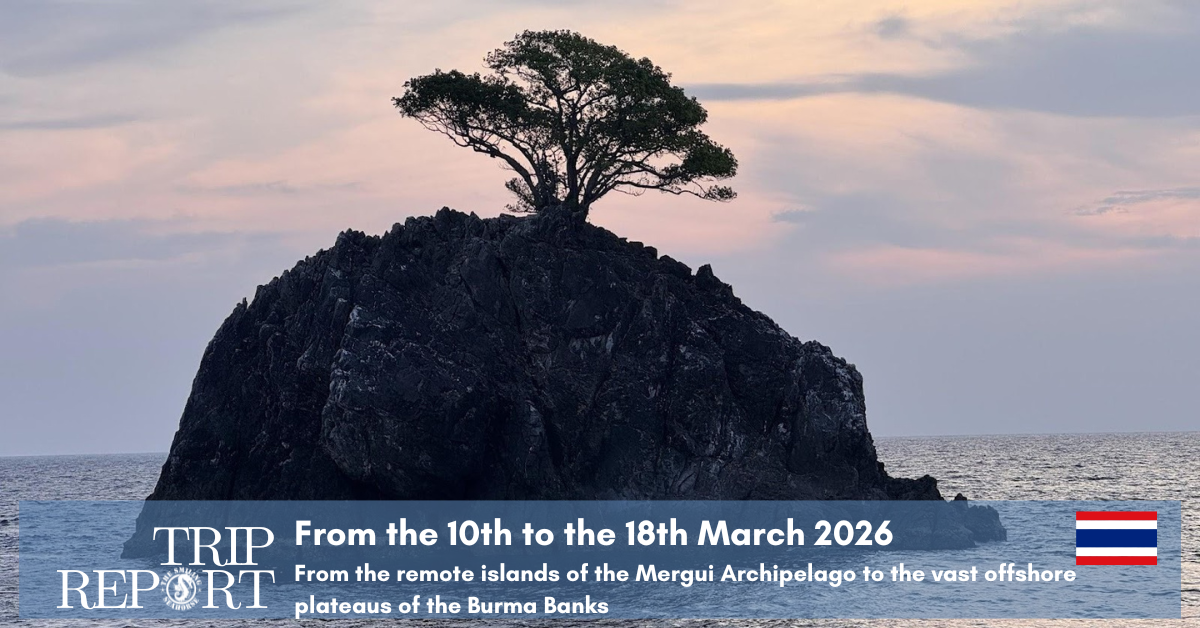
Mergui Archipelago & Burma Banks: A Week of Mantas, Sharks and Macro Wonders
This expedition brought together a wonderfully international group of divers from France, Switzerland, Germany, Romania, the USA, Singapore and Burma, including a very special guest, Thanda Ko Gyi, founder of the Myanmar Ocean Project and the database guru in Myanmar for mantas, working with both the Manta Trust and marine megafauna foundations. Beside education and ghost net removal, her work focuses on manta ray research, identification and conservation in Myanmar waters, adding a meaningful scientific dimension to our journey through one of Southeast Asia’s last true diving frontiers.
From the remote islands of the Mergui Archipelago to the vast offshore plateaus of the Burma Banks, the week unfolded as a perfect balance between encounters with large pelagics and an almost overwhelming richness of macro life.

Day 1 – From Ranong to the Mergui Archipelago
After clearing Thai immigration at Badin Pier in Ranong, we welcomed our guests on board before making a smooth crossing to Kawthung for Burmese formalities. Soon after, the Smiling Seahorse headed north into the Mergui Archipelago, where dense jungle-covered islands, quiet anchorages and untouched reefs set the tone for the days ahead.


Day 2 – High Rock
Our first immersion at High Rock served as a gentle and colourful introduction to the trip, allowing everyone to settle into the rhythm of diving in Burma.
The reef immediately revealed its macro treasures: long-tail sea hare slugs grazing on the rock, dark-margin glossodoris, orange-spotted pipefish weaving through the reef and delicate yellow wentletrap snails (Epitonium billeanum). Flounders rested motionless on sandy patches while cowfish drifted slowly in the current.
Moray eels were already part of the scenery, with white-eye moray eels and giant moray eels peering from crevices, while schools of juvenile yellowback fusiliers flickered above the reef. In the blue, chevron barracudas held their formation, hinting at the bigger action to come.
The rest of the day unfolded on board with an inspiring presentation by Thanda, sharing insights into manta identification and behaviour, setting the stage for what would become one of the trip’s defining themes.


Day 3 & 4 – Black Rock
Black Rock delivered its usual blend of raw energy and intricate detail, a place where the blue and the reef constantly compete for attention.
In the open water, oceanic manta rays appeared gracefully, circling above the pinnacle as if inspecting each diver. Thanks to Thanda’s expertise, we were able to identify six different individual manta rays over the course of our dives — a truly special highlight that added a scientific dimension to these encounters.
Around them, dense formations of chevron and pickhandle barracuda stretched into the distance, while blacktip trevallies, bluefin trevallies, golden trevallies and bigeye trevallies surged through schools of fish in coordinated bursts. Dogtooth tuna and longnose emperors cut through the water column, while massive schools of rabbitfish hovered over the reef.


Below the action, the reef itself was just as alive. Powder-blue surgeonfish and velvet surgeonfish grazed continuously, while giant moray eels, fimbriated morays, leopard morays and yellow-edged moray eels filled every crack and overhang. Batfish lingered calmly in sheltered zones, seemingly unfazed by the surrounding chaos. Schools of neon fusiliers, scissortail fusiliers and yellowback fusiliers formed thick, shifting clouds wrapping around the rock.

And then there was the macro.
Black Rock revealed an almost overwhelming diversity: Bornella anguilla, Goniobranchus geometrica, Goniobranchus geminus, Goniobranchus leopardus, Goniobranchus annulata, Risbecia pulchella, gloomy Tamja, white-bump sap-sucking slugs, golden wentletrap snails and tiger cowries.


Peacock-tail anemone shrimps, squat shrimps, anemone crabs and peacock mantis shrimps animated the reef, while pharaoh cuttlefish hovered just above the substrate. Stonefish blended perfectly into the rocks and rare sightings of yellow and red clown frogfish added excitement.
We also encountered Dendrodoris denisoni, orangutan crabs, reef crabs, honeycomb moray eels and Doriprismatica atromarginata. The tiny yet fascinating Trinchesia sibogae showcased its cerata, reminding us of the incredible defensive adaptations of nudibranchs, storing stinging cells from their prey.


Sunset brought a different atmosphere. Under torchlight, anemonefish hermit crabs, sea urchin crabs, broadclub cuttlefish and pygmy squids emerged, transforming Black Rock into a different world.


Day 5 – Three Islets & Crossing to the Burma Banks
At Square Rock, tigertail seahorses, including juveniles, clung delicately to the whip coral, while tiger cowries and their eggs decorated the substrate. Schools of yellowtail barracuda passed by as Cuthona sibogae, Hypselodoris decorata and blue dragons brought colour to the reef. Orange-spotted pipefish and cleaner pipefish hovered above the sand while scorpionfish and moray eels remained perfectly camouflaged.


Submarine combined action and detail, with spotted Hypselodoris, anemone crabs, stonefish and devil scorpionfish sharing space with bamboo sharks resting under ledges. Schools of juvenile yellowback and scissortail fusiliers mixed with snappers and rainbow runners, while juvenile Koran angelfish and oriental sweetlips added flashes of colour.
At Shark Cave, tomato anemonefish and Clark’s anemonefish guarded their homes alongside anemone crabs. White-eye and honeycomb moray eels hid within the reef while macro highlights included Nembrotha lineolata, Cuthona sibogae, mouthbrooding cardinalfish, Chromodoris annulata, skeleton shrimp and camouflaged snapping shrimps.


Our visit to Khyun Pillar Island offered a quiet pause away from the Dive-Eat-Sleep rhythm. Walking through the small Moken village, we experienced a glimpse of a way of life deeply connected to the sea, where tides and seasons shape daily routines. Children played along the beach, longtail boats rested in the shallows, and the surrounding jungle framed the scene with a sense of timelessness. A simple yet meaningful moment that added a human dimension to our journey through this remote archipelago.


As the sun began to dip, we returned to the water for a night dive rich with life. Blunt decorated crabs, blue-eyed rock crabs, cone snails and tiger cowries emerged from hiding, while gorgonian crabs, basket stars and emperor shrimps occupied every corner of the reef. Anemone hermit crabs and squat lobsters moved cautiously between rocks, alongside saw-edged spooner crabs. Sea cucumbers, pencil urchins and sleeping rabbitfish completed the scene, wrapping up the day in a completely different, nocturnal atmosphere.
That evening, we set course towards the remote Burma Banks…


Day 6 – Burma Banks
Row Bank introduced us immediately to the signature atmosphere of the Banks. Nurse sharks dominated the dives, resting on sandy ledges or gliding slowly past divers. Around them, powder-blue surgeonfish, lined surgeonfish, oriental sweetlips and two-spot butterflyfish filled the reef. Coral groupers and peacock groupers held their territories while cleaner wrasse and sixline wrasse worked tirelessly. Basslets hovered close to the reef face and yellow saddle goatfish sifted through the sand.

At Rainbow Bank, the pelagic energy increased. More nurse sharks rested across the plateau while schools of humpback unicornfish and sleek unicornfish moved in formation. Batfish, longnose emperors and large schools of black-and-white snappers mixed with giant one-spot and five-lined snappers. Great barracuda patrolled the edges while honeycomb moray eels filled the reef.


Blackwater dives added a completely different dimension: sea angels mating, crab zoea larvae drifting, larval sleeper lobsters, flying fish larvae, eel larvae, salps, eternal jellyfish and juvenile female paper nautilus drifting like tiny living sculptures.


Day 7 – Burma Banks
Coral Bank delivered one of the most intense sequences of the Banks for many of our divers. Nurse sharks swam directly through the group, while a massive mangrove whip ray lifted off from the reef and glided effortlessly past divers. Grey reef sharks appeared in the blue, replacing the nurse sharks as the dominant presence. Giant barracuda, large tuna, a hawksbill turtle, and huge schools of trevallies, snappers, fusiliers, parrotfish and surgeonfish surrounded us in every direction.


At Silvertip Bank, the action continued with nurse sharks and an abundance of reef life: scalefin anthias, redbar anthias, coral groupers, titan triggerfish, bird wrasse, raccoon butterflyfish, regal angelfish and blue-spined unicornfish moving across the reef.
During our navigation between dive sites, we were joined by a playful pod of dolphins riding the bow wave, effortlessly gliding alongside the boat and occasionally darting ahead before looping back again. One of those simple yet unforgettable moments that perfectly captures life at sea.

Blackwater dives revealed yet more pelagic wonders: barracuda larvae, flying fish, mantis shrimp larvae, shrimp larvae, dragonfish, glowing pyrosomes and drifting pencil squid completing the surreal night scene.


Day 8 – Seafan Forest & Western Rocky
Seafan Forest offered a calmer but still beautiful dive, where large purple sea fans and soft coral trees swayed gently in the current. Stonefish rested perfectly camouflaged among the reef, while schools of yellowback fusiliers and neon fusiliers drifted past. Coral groupers and peacock groupers hovered near the reef, joined by powder-blue surgeonfish, Indian sailfin tang and clouds of anthias adding colour to the scene.


At Western Rocky, the dives brought back a mix of macro and schooling fish, creating a perfect balance to end the trip. Inside the cave, a stonefish guarded the exit while giant moray eels watched from the shadows. Outside, ghostpipefish hovered near the islets and blue dragons and Chromodoris annulata added delicate splashes of colour to the reef.
Schools of fusiliers — including yellowback, twinstripe and neon fusiliers — mixed with giant trevallies, bluefin trevallies and passing barracuda circling the formations. Lionfish, scorpionfish and titan triggerfish filled the reef, while cleaner shrimps and squat shrimps animated the cracks, bringing the macro world back into focus.


As the evening started, under a calm, star-filled sky, we gathered on the upper deck for our traditional BBQ.
Stories from the trip flowed naturally between us — manta encounters at Black Rock, close passes with sharks on the Banks, and the countless macro discoveries that had kept everyone’s eyes glued to the reef. Laughter, shared moments and quiet reflections blended together, as plates filled and emptied and glasses were raised one last time.
Manta Ray at Black Rock | Camille Rovillain
As the evening unfolded, the mood shifted from relaxed to celebratory. Music floated through the air and before long, the upper deck turned into an open-air dance floor. Barefoot under the stars, surrounded by the ocean, the night carried on with energy, laughter and dancing — the perfect way to celebrate a week that had delivered both unforgettable big encounters and the smallest hidden wonders.
It was more than just a dinner; it became a true celebration of the journey we had shared — from the vast blue of the Burma Banks to the intricate beauty of the reefs — a perfect closing chapter before returning to shore.
Andaman Sea Scuba Diving Liveaboard Myanmar


Day 9 – Dendro’s Peak & Farewell
The final dive at Dendro’s Peak wrapped up the trip with a blend of everything we had experienced. Nudibranchs decorated the reef while fimbriated moray eels peered from crevices. Batfish hovered in the current and trevallies passed through the blue.


After surfacing, we made our way back to Kawthoung for Burmese immigration, shared a final drink at the Smile Bar and returned to Ranong, closing another unforgettable journey through the Mergui Archipelago and the Burma Banks aboard the MV Smiling Seahorse.
Beyond the incredible encounters — from six individually identified manta rays at Black Rock to the endless diversity of nudibranchs and reef life — this trip also carried a deeper meaning. With Thanda on board, every sighting became part of a bigger picture, contributing to the understanding and protection of marine life in Myanmar waters.
It was a reminder that these remote ecosystems are not only places of beauty and adventure, but also fragile environments that depend on awareness, research and responsible diving. Exploring them is a privilege — helping to protect them is part of the journey.
Until the next tide brings us together again — dive well, dive aware, and see you soon, fellow divers.





