
Whale Shark Expedition with Kirsty Magson – Exploring Thailand’s Andaman Sea
Our adventure set sail on a thrilling expedition dedicated to one of the Andaman Sea’s most iconic inhabitants: the majestic whale shark. With divers joining us from England, France, and Brazil, anticipation was high as we prepared for a special journey through some of Thailand’s most famous dive sites.
We were also delighted to welcome back Kirsty Magson, a marine biologist based in Thailand and the founder of the Thai Whale Sharks Project, which she started in 2017 to identify and monitor these gentle giants. Kirsty joined us for the fourth time that year, bringing her extensive knowledge and enthusiasm to the expedition.
Throughout the trip, Kirsty gave daily presentations about what scientists know about whale sharks, their behaviour and biology, and the wider marine environment in which they live. Even when the whale sharks themselves remained elusive, her presentations added another dimension to our dives and helped us better understand the extraordinary ecosystem we were exploring.
Starting in Surin National Park and Richelieu Rock
Our voyage began on 19 March as we said goodbye to Khao Lak and headed towards the Surin Islands National Park. From there, we spent the first two days exploring Richelieu Rock, renowned as one of the world’s great dive sites and one of the best places in Thailand to encounter whale sharks.
The conditions were ideal. Although no whale sharks appeared during our dives, Richelieu Rock more than made up for their absence with an extraordinary variety of marine life. Schools of Bigeye Trevally and Chevron Barracuda moved through the blue, while solitary Great Barracuda and massive Groupers patrolled the reef.
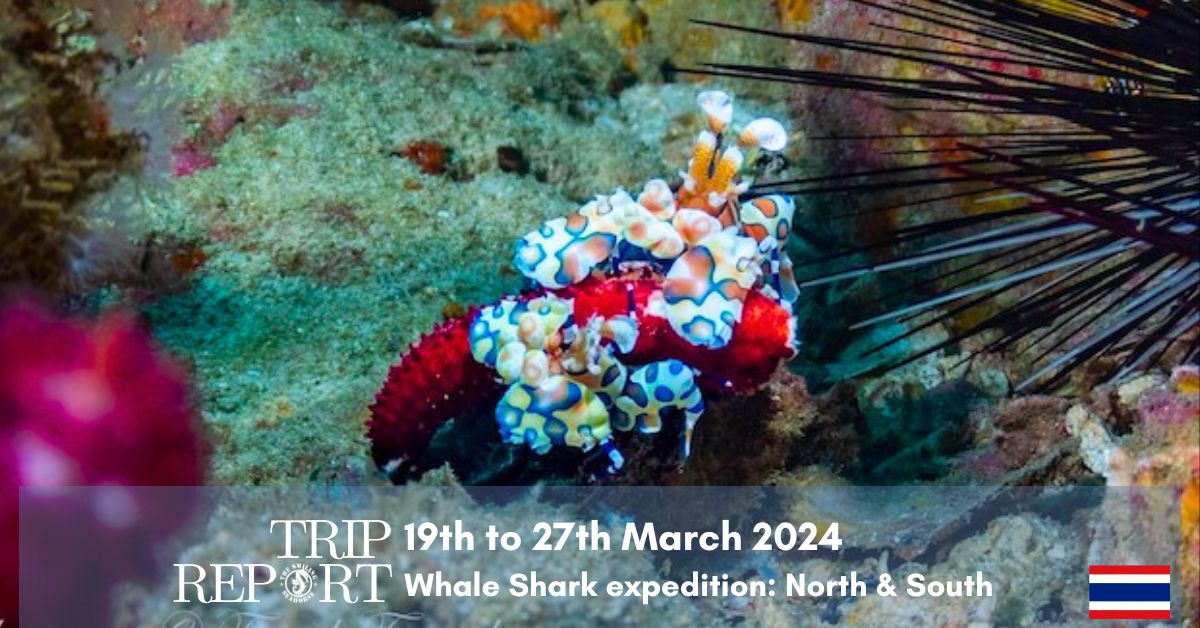
For the macro enthusiasts in the group, there were plenty of rewards too. A tiny baby Tigertail Seahorse was a particularly memorable discovery, while Harlequin Shrimp, Ghost Pipefish and Clownfish guarding their eggs provided plenty of opportunities to slow down and look closely.

 Schooling Barracuda</caption]
Koh Bon and Koh Tachai
On Day 3, we reached Koh Tachai, where crystal-clear water and vibrant marine life greeted us. Strong currents on our first dive brought an abundance of life into the blue. Chevron Barracuda, Batfish and even a Blacktip Shark made appearances, creating plenty of excitement for the divers.
The second dive was calmer and gave us time to explore the pinnacle at a more leisurely pace. Groupers, Surgeonfish and Butterflyfish were among the many inhabitants of the reef, while the intricate architecture of a lobster nest offered one of those smaller details that can easily be missed when concentrating on the larger animals.
As the day progressed, we also explored the waters around Koh Bon. A massive school of Bigeye Trevally mesmerised us with its synchronised movements as the fish swept through the blue.
 Bigeye Trevally schooling around the reef</caption]
 A beautiful Andaman Sea reef</caption]
Blackwater Diving in the Andaman Sea
The highlight of the day came after sunset, when we ventured into the mysterious world of Blackwater Diving. We positioned the boat over approximately 100 metres of water and created a vertical line of lights in the darkness.
The lights attracted an incredible variety of tiny and unusual ocean creatures as they travelled through the water column. For an hour, our divers watched the mysterious nightly migration, searching the darkness for creatures that are rarely encountered during ordinary reef dives.
Blackwater diving offers a completely different perspective on the ocean. Instead of exploring a fixed reef, the divers become spectators to an enormous nightly movement taking place throughout the open ocean. Every moment can bring something unexpected into the light.
Exploring the Similan Islands
Our expedition continued with the Similan Islands on Day 4. We explored Three Trees, Elephant Head and West of Eden in clear, warm water and encountered turtles, Ribbon Eels, Ghost Pipefish and even the elusive Pegasus Sea Moth.
The sighting of the Pegasus Sea Moth was particularly special. We had previously encountered them in the Mergui Archipelago and around Koh Lipe, but sightings in the Similan Islands are much less common.
Only James, who had been diving the Similan Islands for the past 22 years, had seen one there before. He had been waiting ten years for another encounter with this remarkable creature, making the sighting an especially memorable moment of the expedition.




