
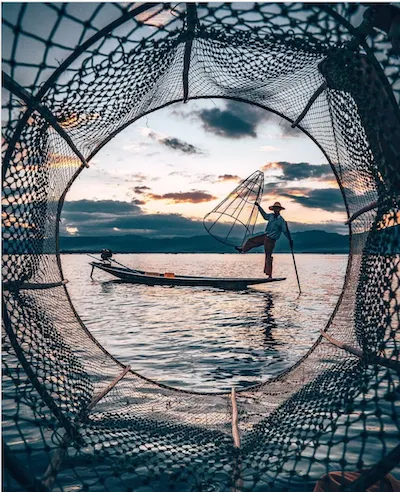
The fisherman balances on one leg at the stern of his very unstable wooden pirogue, using his other leg almost like an extra hand! He may wrap it around the oar to keep both hands free, or use his leg to launch a fishing trap or net. This remarkable technique is a fascinating example of the skills developed by people whose daily lives have always been closely connected to the water.

For the Intha people of Myanmar, fishing has traditionally been done by men, while women take care of growing vegetables in their famous floating gardens. These gardens are a remarkable feature of life around Inle Lake, where fertile floating beds allow communities to cultivate vegetables directly on the water.
On the other side of the country, in the south, the Moken form one of the nomadic peoples of the Andaman Sea. Traditionally, they lived on their boats, roaming between the islands and coastal waters of Thailand, Myanmar and Malaysia. Their traditional way of life has always been deeply connected to the sea, with their knowledge of the islands, currents, weather and marine environment passed down through generations.
According to recent census information available when this article was originally written, only around 2,000 Moken remained. Modern national borders and restrictions on movement have made their traditional nomadic lifestyle increasingly difficult, forcing many communities to settle in permanent villages.

The Moken: People of the Sea
“Moken” means “those who dive” in their language, and the name is particularly appropriate. Moken people are renowned for their exceptional diving abilities and their intimate understanding of the underwater world.
Traditionally, Moken fishermen hunted fish with spears, sometimes jumping from their boats onto the water and sometimes waiting underwater for fish to pass within range. They were able to dive to considerable depths while holding their breath and using very little equipment compared with modern recreational divers.
The Moken have also developed fascinating traditional techniques for finding and attracting their prey. One such method involves using banana leaves to attract fish. Their remarkable ability to read the sea and adapt their techniques to changing conditions reflects generations of experience living almost entirely from the marine environment.

Exceptional Knowledge of the Andaman Sea
Because Moken communities were born and spent their lives at sea, their generational knowledge of the Mergui Archipelago and the wider Andaman Sea is quite exceptional. Their understanding extends far beyond fishing: they have traditionally learned to read currents, tides, weather patterns, reefs and the behaviour of marine life.
This knowledge has sometimes proved invaluable in situations where modern technology was not available. For example, Moken communities recognised the signs of the 2004 Indian Ocean tsunami and moved away from the approaching wave, with some escaping at sea and others heading towards higher ground. Meanwhile, neighbouring coastal areas of Thailand suffered devastating loss of life.
The story of the Moken is an important reminder that the Andaman Sea is much more than a spectacular destination for diving and travel. It is also home to communities whose history, culture and livelihoods have been shaped by the sea for generations.
Join one of our diving cruises in the Mergui Archipelago for a chance to encounter Moken people and discover this remote and beautiful part of the Andaman Sea. The Smiling Seahorse organises liveaboard cruises in the Mergui Archipelago from November until May, combining world-class diving with the opportunity to experience one of Southeast Asia’s most remote marine environments.
Discover More About Myanmar and the Mergui Archipelago
Explore More of the Andaman Sea
- Mergui Archipelago – discover the remote islands, reefs and cultures of Myanmar’s Andaman Sea.
- Diving in Myanmar – explore spectacular reefs, pelagics and marine life in Burmese waters.
- Marine life of the Andaman Sea – discover the incredible diversity found beneath the surface.
- Myanmar liveaboard diving holidays – explore the Mergui Archipelago aboard the MV Smiling Seahorse.
- Cruises, schedules & itineraries – check our latest Mergui Archipelago departures.




