
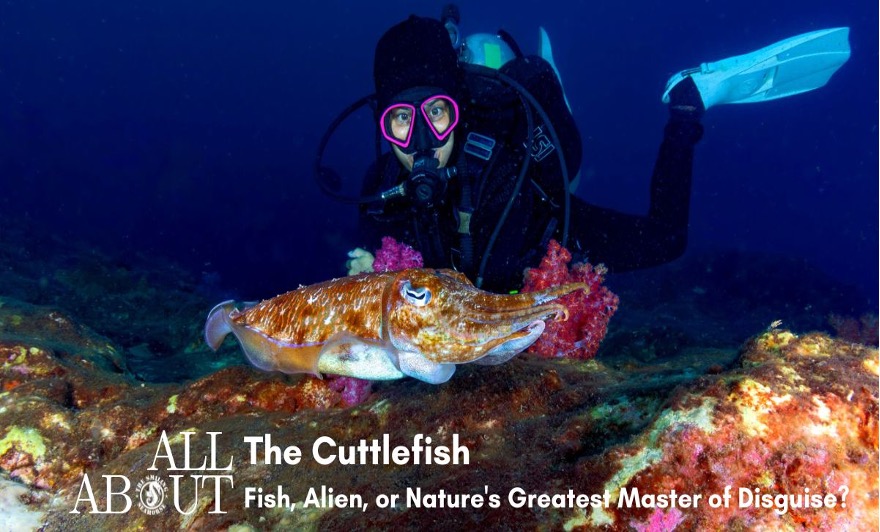
The Cuttlefish: Fish, Alien, or Nature’s Greatest Master of Disguise?
If you’ve ever encountered a cuttlefish underwater, you’ve probably wondered whether you were looking at a fish, an alien, or something entirely unique. With their mesmerising colour displays, hypnotic movements, and remarkable intelligence, cuttlefish are among the most fascinating creatures in the ocean.
Despite their name, cuttlefish aren’t fish at all. They belong to the class Cephalopoda, alongside octopuses, squid, and nautiluses, making them some of the most sophisticated invertebrates on Earth. Their ability to instantly change colour, mimic their surroundings, communicate through patterns, and solve problems has earned them a reputation as the “chameleons of the sea”.
Whether you’re a scuba diver, underwater photographer, or simply curious about marine life, learning about cuttlefish reveals why they are among the ocean’s greatest evolutionary marvels.

Questions You may have About Cuttlefish:
Looking for a quick answer? Explore the most common questions about cuttlefish below and jump directly to the answer:
- Are cuttlefish dangerous to humans?
- Can cuttlefish bite?
- Are cuttlefish intelligent?
- What is the difference between a cuttlefish and a squid?
- Can cuttlefish change colour instantly?
- Where can I see cuttlefish while diving?
What Is a Cuttlefish?
The cuttlefish is actually not a fish at all! Together with the octopus, squid, and nautilus, it is an invertebrate animal belonging to the cephalopod class.
A cuttlefish is a marine mollusc belonging to the class Cephalopoda, which also includes:
- Octopuses
- Squid
- Nautiluses
There are more than 120 known species of cuttlefish, living in tropical and temperate oceans throughout Europe, Asia, Africa, and Australia.
Unlike fish, cuttlefish have:
- No backbone
- No scales
- No true bones
- A soft body supported by a unique internal shell called the cuttlebone
This lightweight, porous structure helps them control their buoyancy, allowing them to hover effortlessly above coral reefs, sandy bottoms, and seagrass beds.

Are Cuttlefish Actually Fish?
This is one of the most common questions people ask.
No — cuttlefish are not fish.
The name is misleading and dates back hundreds of years, when early sailors grouped many marine animals under the broad term “fish”.
Instead, cuttlefish are cephalopod molluscs, making them much more closely related to:
- Octopuses
- Squid
- Snails
- Clams
They are therefore much more closely related to these animals than to tuna, clownfish, or sharks.
Like fish, cuttlefish breathe using gills, but their anatomy is completely different. They have:
- Eight arms
- Two specialised feeding tentacles
- Three hearts
- Blue blood
- Highly developed eyes
- One of the most sophisticated nervous systems found among invertebrates

Why Do Cuttlefish Look Like Aliens?
Divers often describe their first cuttlefish encounter as something straight out of a science-fiction movie.
It’s easy to understand why.
Their bodies continuously ripple with waves of changing colours while their skin flashes intricate patterns. Their large W-shaped pupils seem to watch every movement around them, while their arms move independently with incredible precision.
Unlike many marine animals, cuttlefish appear intensely aware of their surroundings. They may pause to observe divers, adjusting their colours in response to nearby objects before slowly gliding away using graceful fin movements that can make them look almost like flying saucers.
Every encounter feels like making eye contact with an intelligent extraterrestrial.

The Incredible Colour-Changing Champion
If there were an Olympic event for camouflage, the cuttlefish would almost certainly take home the gold medal.
Their skin contains millions of specialised cells that allow them to transform their appearance incredibly quickly.
Chromatophores
These tiny pigment-filled sacs contain colours such as:
- Yellow
- Orange
- Red
- Brown
- Black
Muscles controlled by the nervous system expand or contract these pigment cells almost instantly, changing the visible colour and pattern of the skin.
Iridophores
These reflective cells create brilliant:
- Metallic blues
- Greens
- Golds
- Purples
They produce these effects by reflecting light rather than by using pigment.
Leucophores
These cells scatter ambient light, helping the cuttlefish blend naturally into its surroundings.
Together, these three systems allow cuttlefish to produce one of the most sophisticated camouflage displays found anywhere in nature.

Camouflage Beyond Colour
Changing colour is only part of the story.
Cuttlefish can also completely alter the texture of their skin.
Within seconds, they can transform from:
- Perfectly smooth
- Rough and bumpy
- Covered in papillae that resemble coral
- Rock-like
- Sponge-like
This combination of colour, pattern, and texture makes them remarkably difficult for predators — and divers — to detect.
Many underwater photographers have unknowingly swum past a perfectly camouflaged cuttlefish, noticing it only after it suddenly changed colour.

Masters of Underwater Communication
Scientists now believe cuttlefish don’t change colour only to hide.
They also communicate.
Different patterns can signal:
- Aggression
- Fear
- Curiosity
- Courtship
- Territorial disputes
Male cuttlefish often display spectacular zebra-like stripes when competing for females, while hunting individuals may pulse dark bands across their bodies as part of their visual displays.
Some displays appear so complex that researchers continue to investigate the meanings behind these living light shows.

One of the Smartest Animals Without a Backbone
Cuttlefish possess one of the most advanced nervous systems among invertebrates.
Research has shown that they are capable of learning, remembering, adapting their behaviour, and solving problems, making them some of the ocean’s most remarkable invertebrate predators.

The Perfect Hunter
Cuttlefish are patient ambush predators.
Instead of chasing prey over long distances, they slowly approach while continuously adjusting their camouflage.
Once close enough, they strike with astonishing speed.
Their two specialised feeding tentacles shoot forward in milliseconds, grabbing unsuspecting prey before pulling it towards their powerful beak.
Their diet includes:
- Small fish
- Shrimp
- Crabs
- Prawns
- Worms
- Small molluscs
Their exceptional vision allows them to judge distance with remarkable accuracy, making their hunting technique especially effective.

Why Divers Love Seeing Cuttlefish
For many divers, spotting a cuttlefish is one of the highlights of any dive. Unlike fast-moving reef fish, cuttlefish often tolerate a respectful observer, giving underwater photographers plenty of time to admire their ever-changing colours and behaviours.
In Thailand’s Andaman Sea, encounters are particularly rewarding because coral reefs, sandy slopes, and other shallow marine habitats provide opportunities to observe these fascinating cephalopods.
Whether you’re exploring the Similan Islands, Surin Islands, Richelieu Rock, or the remote Mergui Archipelago, keeping a careful eye on the reef can lead to unforgettable encounters with these masters of camouflage.

The Secret Life of Cuttlefish: Courtship, Deception, and Survival
While cuttlefish are best known for their spectacular camouflage, their behaviour during the breeding season is even more extraordinary. Their ability to communicate with colour, deceive rivals, and reproduce showcases just how sophisticated these remarkable cephalopods really are.
A Spectacular Courtship Display
During the breeding season, male cuttlefish become walking — or rather swimming — light shows.
Using millions of chromatophores in their skin, they create constantly shifting displays of:
- Bright white flashes
- Bold black zebra stripes
- Pulsing waves of colour
- High-contrast patterns
These dazzling displays are used to attract females while simultaneously intimidating rival males.
Unlike birds that rely on songs or mammals that use scent, cuttlefish communicate extensively through visual signals. Every flash, stripe, and ripple can convey information about the animal and its intentions.
Divers lucky enough to witness a courtship display often describe it as one of the most mesmerising sights in the underwater world.

The Incredible “Split Personality” Trick
One of the most astonishing behaviours documented in the animal kingdom belongs to male cuttlefish.
Imagine being able to show two completely different appearances at the same time.
A courting male may display:
- Bright, bold colours towards a nearby female to advertise his fitness.
- Muted, female-like coloration on the side facing a rival male.
This remarkable tactic can reduce the likelihood of confrontation while allowing the male to continue courting.
Scientists describe this as dynamic tactical deception, demonstrating an impressive level of behavioural flexibility rarely seen outside highly intelligent animals.

Sneaky Males That Disguise Themselves as Females
Not every male is large enough to challenge dominant rivals.
Instead of fighting, smaller males can resort to deception.
By changing their body coloration and posture to resemble females, they can quietly approach a courting pair without attracting the attention of the dominant male.
Once close enough, they may seize the opportunity to mate before making a quick escape.
This strategy has been observed in several cuttlefish species and is considered one of nature’s ingenious examples of an alternative reproductive tactic.

A Short but Extraordinary Life
Despite their intelligence and complex behaviours, most cuttlefish have surprisingly short lives.
Depending on the species, they typically live between one and two years.
During this brief lifespan they must:
- Grow rapidly
- Learn to hunt
- Avoid predators
- Find a mate
- Reproduce
After breeding, many adult cuttlefish die naturally, making room for the next generation.

Tiny Hunters From Day One
Baby cuttlefish hatch as perfectly formed miniature versions of the adults.
Unlike many marine animals that drift as larvae, young cuttlefish begin hunting for themselves soon after hatching.
They are capable of:
- Changing colour
- Camouflaging themselves
- Capturing tiny shrimp
- Avoiding predators
Remarkably, many of their hunting and camouflage abilities appear to be present from an early age rather than needing to be learnt entirely through experience.
Even at only a few centimetres long, they already display the precision that makes adult cuttlefish such formidable predators.

How Do Cuttlefish Swim?
Watching a cuttlefish glide through the water is unlike observing almost any other marine animal.
Instead of constantly beating fins like fish, they use a combination of graceful movements and powerful bursts of speed.
Hovering With Fins
A long fin runs almost entirely around the edge of the body.
By gently undulating this fin, a cuttlefish can:
- Hover effortlessly
- Move forward slowly
- Swim backwards
- Turn with remarkable precision
This smooth motion gives them an almost ghost-like appearance underwater.
Jet Propulsion
When danger strikes, elegance gives way to explosive speed.
Cuttlefish rapidly force water through a muscular funnel beneath their bodies, creating powerful jet propulsion.
Within an instant they can accelerate away from predators while releasing a cloud of ink to confuse attackers.

Three Hearts and Blue Blood
One of the most surprising cuttlefish facts is their unusual circulatory system.
Unlike humans, who have one heart and red blood, cuttlefish possess:
- Three hearts
- Blue blood
Two hearts pump blood through the gills, where oxygen is absorbed, while the third circulates oxygen-rich blood throughout the body.
Their blood is blue because it contains haemocyanin, a copper-based molecule that transports oxygen instead of the iron-based haemoglobin found in mammals.
This is an important adaptation for life in the marine environment.

The Amazing Cuttlebone
The cuttlebone is perhaps the cuttlefish’s most unique anatomical feature.
This lightweight internal shell is made of calcium carbonate and contains thousands of tiny chambers filled with gas and fluid.
By regulating the contents of these chambers, a cuttlefish can control its buoyancy with extraordinary precision.
This allows it to hover above the seabed while searching for prey or avoiding predators without constantly swimming.
Interestingly, dried cuttlebones are commonly sold for pet birds as a natural source of calcium, although many people are unaware that they come from cuttlefish.

How Cuttlefish Defend Themselves
Despite their incredible camouflage, cuttlefish have many natural predators, including:
- Sharks
- Dolphins
- Seals
- Large groupers
- Barracudas
- Tuna
- Moray eels
- Octopuses
To survive, they rely on a combination of remarkable defensive strategies.
Camouflage
Their first line of defence is simply disappearing into their surroundings.
Mimicry
Some species can imitate rocks, corals, algae, or other elements of their surroundings to avoid detection.
Ink Clouds
Like octopuses and squid, cuttlefish release dark ink that creates a visual screen, allowing them to escape while predators are temporarily disoriented.
Ink may also interfere with a predator’s chemical senses, providing an additional advantage during escape.
Rapid Escape
If camouflage fails, powerful jet propulsion enables them to flee surprisingly quickly.

Cuttlefish Found in Thailand and the Andaman Sea
The tropical waters of Thailand are home to several fascinating species of cuttlefish, making every dive a potential opportunity for an unforgettable encounter.
Pharaoh Cuttlefish (Sepia pharaonis)
The Pharaoh Cuttlefish is the largest and most commonly encountered species in Thailand’s Andaman Sea.
Growing up to 50 cm (20 inches) in length, it is easily recognised by its broad body, large fins, and constantly changing patterns.
Divers may encounter Pharaoh cuttlefish around:
They are especially fascinating to watch while hunting or during the breeding season, when males display dramatic colour changes.

Broadclub Cuttlefish (Sepia latimanus)
Another spectacular resident of the Andaman Sea is the Broadclub Cuttlefish, one of the largest cuttlefish species in the Indo-Pacific.
It is famous for its hypnotic moving stripes, often called the passing cloud display, which sweep across its body while hunting or communicating.
This species is particularly popular among underwater photographers because of its bold patterns and often calm behaviour around divers.

Flamboyant Cuttlefish (Metasepia pfefferi)
Although much smaller than its relatives, the Flamboyant Cuttlefish is arguably the most striking of them all.
Its vibrant yellow, pink, white, and dark brown coloration makes it look almost unreal.
Unlike most cuttlefish, it spends much of its time walking across the seabed using its arms rather than swimming.
It is also the only known venomous species of cuttlefish, using toxins as a defence against predators. Fortunately, it is not aggressive and poses no danger to respectful divers who avoid touching marine life.

Can Cuttlefish Recognise Humans?
Cuttlefish are among the most intelligent invertebrates on Earth, and researchers continue to uncover just how sophisticated their behaviour really is.
Scientific studies have shown that cuttlefish can:
- Learn through observation
- Remember successful hunting strategies
- Solve simple problems
- Adapt to changing environments
- Distinguish between different prey species
While there is no definitive evidence that cuttlefish recognise individual humans in the same way that some highly intelligent marine animals can, divers often notice that they display remarkable curiosity.
Rather than immediately fleeing, many cuttlefish will stop, observe a diver, slowly rotate their bodies, and even change colour while maintaining eye contact. This behaviour suggests that they are carefully assessing potential threats before deciding how to respond.
For underwater photographers, this curiosity can lead to some of the most rewarding marine-life encounters.

Why Underwater Photographers Love Cuttlefish
Few marine animals are as photogenic as cuttlefish.
Unlike many reef fish that dart away at the first sign of a diver, cuttlefish often remain calm, allowing photographers to capture a wide range of behaviours.
Every second presents a new opportunity as they:
- Shift through dazzling colours
- Display intricate skin patterns
- Ripple moving bands across their bodies
- Change skin texture
- Hover gracefully above the reef
- Lock eyes with the camera
Because no two displays are exactly alike, every photograph is unique.
For macro photographers, smaller species such as the Flamboyant Cuttlefish offer incredible detail, while wide-angle photographers can capture the impressive size and behaviour of larger species like the Pharaoh or Broadclub Cuttlefish.

Best Places to Dive With Cuttlefish in Thailand
Thailand’s Andaman Sea offers excellent opportunities to encounter cuttlefish in their natural habitat.
Although sightings are never guaranteed, reefs, rocky formations, and sandy seabeds provide many different environments in which these fascinating cephalopods can be found.
Similan Islands
The Similan Islands are famous for their granite boulders, clear water, and rich marine biodiversity.
Divers may encounter Pharaoh and Broadclub cuttlefish cruising over coral reefs or hovering near sandy patches.
Surin Islands
With coral reefs and a rich variety of marine life, the Surin Islands provide opportunities to encounter cephalopods.
Patient divers may spot cuttlefish blending perfectly into the reef before suddenly revealing themselves in an explosion of colour.
Richelieu Rock
Known as one of Thailand’s premier dive sites, Richelieu Rock is celebrated for whale sharks, but it is also an excellent location for observing smaller marine life.
Cuttlefish are occasionally seen hunting among the soft corals and schools of reef fish.
Koh Bon and Koh Tachai
These offshore pinnacles attract abundant marine life, creating feeding grounds for cephalopods.
Divers may encounter hunting cuttlefish along sandy slopes or around coral bommies.
The Mergui Archipelago (Myanmar)
For those seeking truly wild diving, the Mergui Archipelago offers exceptional opportunities to observe cuttlefish among remote reefs and diverse marine habitats away from heavily visited dive sites.

Tips for Observing Cuttlefish Responsibly
Watching a cuttlefish is a privilege, and respectful diving practices help ensure these incredible animals remain relaxed and behave naturally.
When you encounter one:
- Keep a respectful distance.
- Move slowly and avoid sudden movements.
- Never chase or corner the animal.
- Do not touch or attempt to manipulate its behaviour.
- Maintain excellent buoyancy to avoid damaging the reef.
- Limit the use of bright focus lights if the animal appears stressed.
The calmer you remain, the more likely the cuttlefish will continue displaying its natural behaviours.

Threats Facing Cuttlefish
Although the conservation status of cuttlefish varies between species and regions, they can face increasing pressure from human activities and changes to marine ecosystems.
The greatest threats can include:
Climate Change
Changes in ocean temperature can affect breeding cycles, prey availability, and habitat quality.
Habitat Loss
The degradation of coral reefs, mangroves, and seagrass beds can reduce important feeding and breeding habitats.
Pollution
Plastic pollution, discarded fishing gear, and chemical contaminants continue to threaten marine ecosystems worldwide.
Overfishing
In some regions, cuttlefish are heavily harvested for food, which can place pressure on local populations and alter marine food webs.
Protecting healthy marine habitats benefits not only cuttlefish but thousands of other species that depend on these ecosystems.

15 Incredible Cuttlefish Facts
Here are some of the most fascinating facts about these extraordinary animals:
- Cuttlefish are not fish — they are cephalopod molluscs.
- There are over 120 known species.
- They possess three hearts.
- Their blood is blue because it contains haemocyanin.
- They have W-shaped pupils that provide exceptional vision.
- They can change colour, pattern, and skin texture extremely quickly.
- They communicate using dynamic visual displays.
- They are among the most intelligent invertebrates on Earth.
- They hunt using two lightning-fast feeding tentacles.
- Many species live only one to two years.
- Baby cuttlefish hatch ready to hunt soon after emerging.
- Their internal cuttlebone helps control buoyancy.
- Some males disguise themselves as females to sneak past rivals.
- The Flamboyant Cuttlefish is the only known venomous cuttlefish species.
- Every cuttlefish encounter is unique because their colour patterns are constantly changing.
Frequently Asked Questions About Cuttlefish
Are cuttlefish dangerous to humans?
No. Cuttlefish are shy animals that generally prefer to avoid confrontation. They are harmless to divers who observe them respectfully without attempting to touch or handle them.
Can cuttlefish bite?
Yes, they possess a strong beak capable of crushing crabs and shellfish. However, bites involving humans are extremely rare and generally occur only if the animal is handled or seriously disturbed.
Are cuttlefish intelligent?
Absolutely. They are widely regarded as some of the most intelligent invertebrates, capable of learning, problem-solving, memory, and complex visual communication.
What is the difference between a cuttlefish and a squid?
Although closely related, cuttlefish have a broad body, an internal cuttlebone for buoyancy, and exceptional camouflage abilities. Squid generally have a more streamlined body adapted for fast swimming in open water.
Can cuttlefish change colour instantly?
Yes. Specialised skin cells called chromatophores, iridophores, and leucophores allow cuttlefish to change their appearance extremely quickly, sometimes in less than a second.
Where can I see cuttlefish while diving?
Excellent locations include the Similan Islands, Surin Islands, Koh Bon, Koh Tachai, Richelieu Rock, and the spectacular reefs of Myanmar’s Mergui Archipelago.
Discover the Incredible Marine Life of the Andaman Sea
Every dive in the Andaman Sea offers the possibility of encountering one of nature’s most extraordinary creatures. Whether it’s a Pharaoh Cuttlefish displaying hypnotic waves of colour, a Broadclub Cuttlefish hunting across the reef, or the tiny yet spectacular Flamboyant Cuttlefish walking across the seabed, these encounters leave a lasting impression on every diver.
At The Smiling Seahorse, our liveaboard cruises explore some of the richest marine ecosystems in Thailand and Myanmar, where cuttlefish share the reefs with whale sharks, manta rays, frogfish, octopuses, ghost pipefish, nudibranchs, and hundreds of colourful reef fish.
If you’re passionate about marine life, underwater photography, or simply discovering the hidden wonders of the ocean, join us on a diving adventure and experience the magic of the Andaman Sea for yourself.

Discover More
- Incredible Cephalopods – Discover the fascinating world of octopuses, squid, cuttlefish, and other cephalopods.
- Marine Life of Thailand and the Andaman Sea – Explore the incredible species you may encounter while diving.
- Thailand Diving – Explore some of the Andaman Sea’s most famous dive destinations.
- Underwater Photography in Thailand – Discover tips for photographing marine life underwater.
>





3 Responses
Wow that’s amazing that they can change one side of their body to mimick a female the other just normal, they must like to dress in drag! So someone might have to call up RuPaul and he or she can judge that drag race! Certainly are amazing intelligent creatures that dressed in drag or shape shifters!
I see a pic of a diver near a cuttlefish. Is this a common thing? Is it easy to swim near one without it swimming away out of fear?